
Batumi cable car: 2026 prices, opening hours, parking
The Argo cable car in Batumi: a 39 GEL ticket, opening hours, where to leave the car, when the queues disappear and whether you can drive to the top yourself.
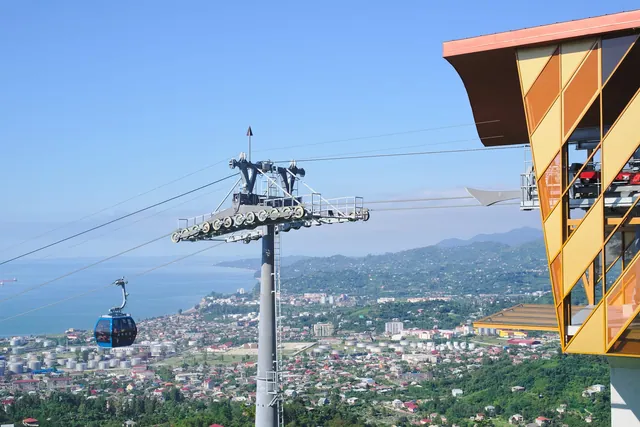
The cable car in Batumi — the "Argo" — lifts you onto Anuria hill in 10–15 minutes, and a return ticket costs 39 GEL for adults and 9 GEL for children aged 5–11. The lower station is in the centre, next to the port; the upper one sits at around 250 metres. There is no car park of its own at the lower station, and that's the first thing to take into account if you've arrived by car. For the wider picture of the city, see the guide on what to see in Batumi.
How much a ticket costs in 2026
The price of the Argo cable car is the same for Georgian citizens and foreign visitors if you're only buying the ride. The difference shows up in the combo tickets that include the museum and the attractions at the top.
| Ticket | Adult (12+) | Children 5–11 |
|---|---|---|
| Cable car (return) | 39 GEL | 9 GEL |
| Cable car + Digital Space (foreign visitors) | 65 GEL | 35 GEL |
| Cable car + Digital Space (Georgian citizens) | 49 GEL | 29 GEL |
| Cable car + Joyroom (foreign visitors) | 49 GEL | 19 GEL |
| Cable car + Digital Space + Joyroom (foreign visitors) | 75 GEL | 45 GEL |
| Quick Pass (skip the queue) | +20 GEL | +5 GEL |
A few practical points about the tickets:
- A ticket always covers the ride up and the ride down. There's no one-way fare, so riding up and walking back down doesn't work out any cheaper.
- Keep your receipt until the end of the trip. It's what gets you back into a cabin.
- You can buy at the ticket office at the lower station or in advance on biletebi.ge. Buying online removes the queue for the till, but not the queue for boarding.
- Over two years the price has gone from 30 to 39 GEL, so it's worth checking argo-batumi.ge before you go.
I crumpled up my first ticket and dropped it in a bin the moment I reached the top platform. Then I spent ten minutes explaining myself at the turnstile on the way down; in the end they were decent about it and let me through, but I wouldn't recommend repeating the experience. Now I just tuck it into my phone case.
The Digital Space combo is mostly bought for a rainy day or when travelling with children: it's a digital projection show at the upper station, and a session runs 35–60 minutes. If all you want is the view, the basic ticket is enough.
Opening hours and when there are no queues
The official hours of the Batumi cable car are 10:00 to 00:00, every day, with no days off and no winter break. Out of season the station sometimes closes before midnight — some sources give 22:00 — so for a late visit it's better to call: +995 591 870 008.
The queues are fairly predictable. The peak is summer Friday and Saturday evenings, roughly 18:00 to 21:00, when everybody wants to be up there for sunset. Last August I turned up at seven on a Friday and spent almost forty minutes in the queue, the last twenty of them under the overhanging glass canopy, where the air is stifling. On a weekday morning, between 10:00 and 12:00, you're in a cabin almost straight away. In winter there are no queues at all.
Winter also gives you more distance. In January I could pick out snowy ridges to the east from the upper platform; at the end of August the same spot was hung with dense white haze and the horizon ended about three kilometres out. In summer the humidity off the sea eats the whole far view.
Where the lower station is and what to do with the car
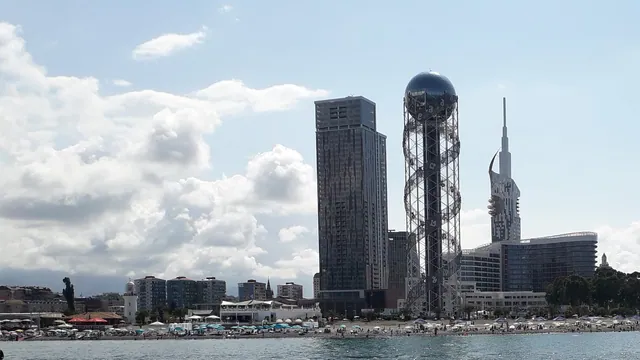
The lower station stands on Bako Street, in the port part of town between Old Batumi and the sea terminal, opposite the Goodwill supermarket. The glass building is visible from a long way off. It's about 10 minutes on foot from Piazza Square, and around 15 from the Ali and Nino sculpture along the seafront.
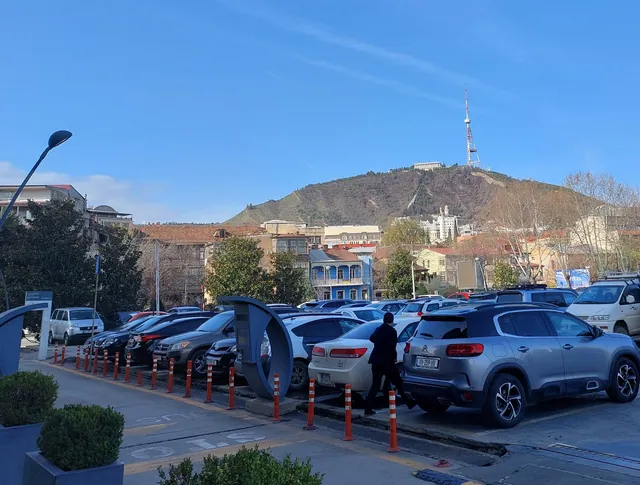
The station has no car park. None at all. That's spelled out separately in the official FAQ, and it's the main trap for anyone who has arrived in a rental car: this is the port district, the paid street bays are occupied from morning to night, and leaving the car under a no-parking sign is a bad idea, because the tow trucks in Batumi work briskly.
The first time I honestly drove in circles for twenty minutes and ended up abandoning the car three blocks from the station, by the cathedral. Now I do it more simply: park once for the whole evening near the Piazza or by the boulevard and walk, because everything interesting there is within fifteen minutes on foot anyway.
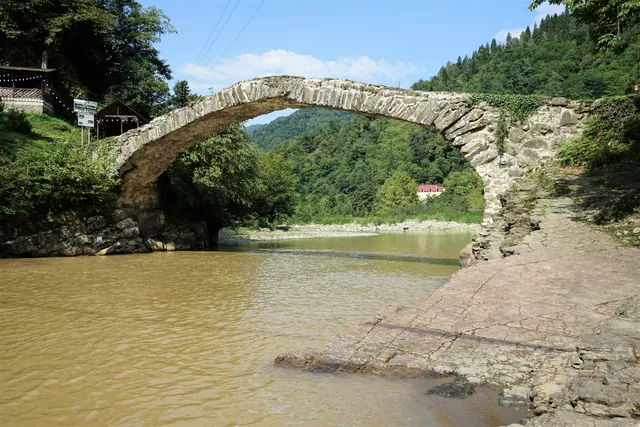
With the wait and a walk around at the top, the cable car takes an hour to an hour and a half, so there's no point planning a whole day around it. It makes more sense at the end of one: drive up the coast in the morning to the Botanical Garden at Green Cape or to the bridge and waterfall at Makhuntseti, be back in town by six, leave the car in one place for the whole evening and go up for sunset. That way the parking question is solved once. A rental car in Batumi is usually taken for exactly those trips out of town, while the station itself is central and you'll reach it on foot from anywhere on the seafront. If you don't have a car yet, with MY.DRIVE you can pick one up straight at Batumi Airport — that's 7 km and 15–20 minutes from the centre.
You can also drive up to the top
People rarely write about this, but an ordinary paved road runs up to the upper station through the suburbs. I drove it the first time in a sedan and worried for nothing: the surface is intact and the switchbacks are gentle. It only gets narrow in a couple of places by private yards, where passing an oncoming car takes some patience. There's a paid car park at the top.
The car version works like this: you drive up under your own steam, walk around the platform for free, and if you feel like coming down in a cabin you buy the ticket up there. That option helps when someone in the group doesn't cope well with height in an enclosed cabin: one person takes the cable car, the other drives up and collects them at the top. A friend and I did exactly that after she went pale halfway up on her first ride and asked never to be invited again.
In the evening this approach is also more comfortable because it's calmer at the top, the parking is more predictable, and the view of a lit-up Batumi is exactly the same.
What there is at the upper station
The upper platform is more than a viewpoint. There's a small complex up there:
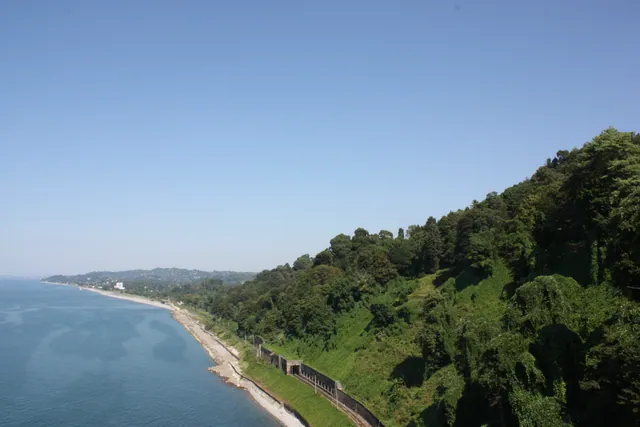
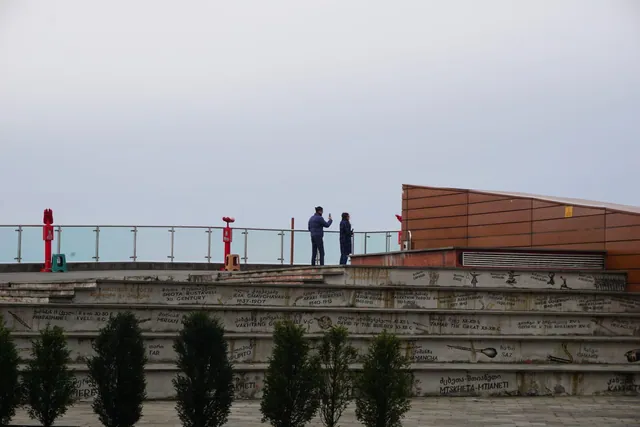
- Viewing terraces looking out over the port, the Alphabet Tower, the Ferris wheel and the line of the Black Sea coast
- The Argo restaurant with Georgian and European food; in summer there's an open-air bar too
- Digital Space, a digital projection show in a hall of its own
- Joyroom, with a mirror maze, a flight simulator and selfie spots
- A wine corner with tastings, and a souvenir shop
- A small church, a free toilet, Wi-Fi
Prices in the cafés and souvenir stalls at the top are noticeably higher than in town. If you're planning dinner, it's cheaper and better to go back down and walk to any place in the Old Town.
The wind on the platform is appreciably stronger than down on the seafront. In April I went up in a T-shirt because it was +22 on the boulevard, and ten minutes later I was standing with my back to the railing, warming my hands on a cup of coffee. Since then I keep a windbreaker in my backpack even on a warm day.
Views from the cabin: what you get to take in
The line is 2,586 metres long, the longest cable car in Georgia. It runs over the city at a height of about 50 metres, and the picture outside the window changes three times.
First you have the seafront, the port and the central blocks below you, with their mixed-up architecture: high-rises interleaved with old two-storey houses and inner courtyards. Then come the residential districts, where you can see washing on the balconies and people down in the yards. Closer to the top it turns almost rural: vegetable plots, mandarin trees, corrugated roofs. That third stretch is usually the one people like more than the first.
The cabins are enclosed, the windows are panoramic and the movement is smooth. Photography is allowed, though the glass throws reflections in places. On the way up, sit facing the sea: I once took a seat with my back to it and spent the whole ride shooting over my neighbours' shoulders, with nothing much to show for it.
With children, a pushchair or pets
There are no age or height restrictions, the cabins are fully enclosed and the speed is low, so even small children handle the ride calmly. The stations have lifts, and the cable car is accessible for wheelchair users. Dogs and cats are allowed into the cabins.
At the top it's worth keeping a closer eye on children: the viewing platforms are open and stand right on the drop.
When the cable car doesn't run
The one regular reason for a stoppage is the weather. In strong wind or a thunderstorm the line is halted, usually for an hour or two until conditions improve. It doesn't happen often, but in November I arrived on the windiest day of the week and boarding only resumed an hour and a half later. If the sky looks murky and umbrellas are turning inside out on the seafront, it's better to call before setting off.
Technical shutdowns are rare, and they're announced in advance on the complex's Instagram.
In short
The Batumi cable car costs 39 GEL for the ride up and back, runs from 10:00 to 00:00 and takes 10–15 minutes each way. Come on a weekday before noon, or in winter: no queues, and better visibility. The key thing for anyone with a car: there's no parking at the lower station, but a decent paved road leads up to the upper one with a paid car park, and up there you can buy a ticket for the way down only.