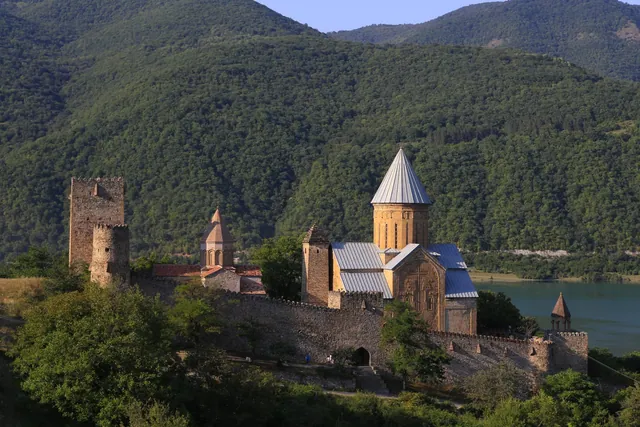

Narikala Fortress in Tbilisi: how to get up and what to see
Narikala Fortress in Tbilisi: the 2.5 GEL cable car, two walking routes, parking, what survives inside and the best time of day to go.
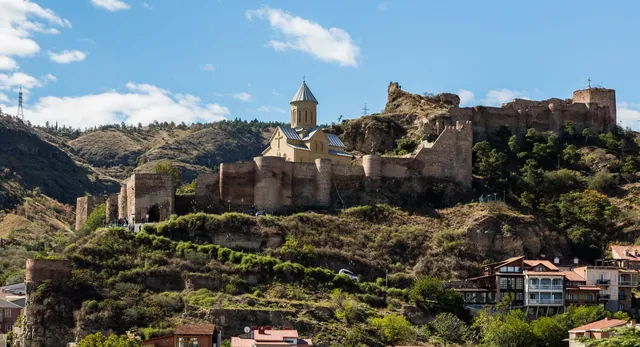
Narikala Fortress is free and open around the clock. There is no ticket office, no turnstile, no closing time. You can get up there three ways: the cable car from Rike Park for 2.5 GEL, a 20–25 minute walk from Meidan Square, or by car almost to the walls along Botanikuri Street. Allow an hour to an hour and a half for the fortress, the ridge walls and the Kartlis Deda monument.
The cable car from Rike Park
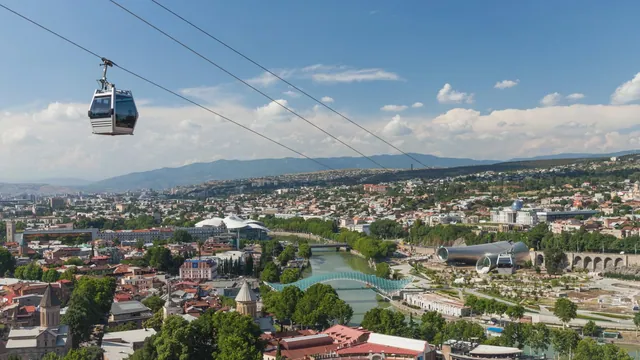
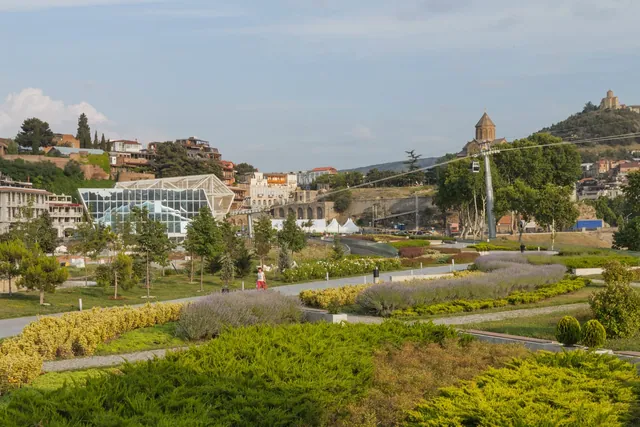
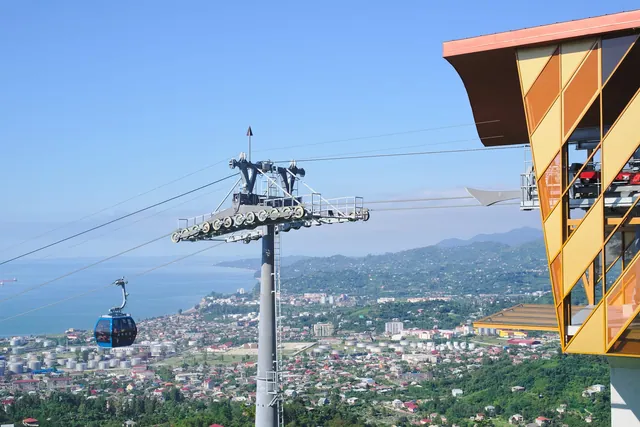
The lower station sits in Rike Park, by the entrance from Europe Square. The upper one lands on the Sololaki ridge, two minutes' walk from the fortress gates. The line is 508 metres long with a vertical rise of 94 metres. The ride takes 1 minute 42 seconds, passing over the rooftops of the Old Town and the Mtkvari River.
A one-way ride costs 2.5 GEL and the only accepted payment is a Metromoney transport card. The card itself costs 2 GEL, is sold at the station, and will work later on the metro, city buses and Tbilisi's other cable cars. Cash is not accepted in the cabin. The line runs 11:00 to 23:00, so before midday your only options are your legs or a car.
The queue is the real variable. On a weekday morning you walk straight into a cabin; on a Saturday evening the line at the lower station can eat half an hour. The sensible move is to ride up and walk down through the fortress and Sololaki. The descent takes the same twenty minutes, without the wait.
On foot: two routes up from the Old Town
The first starts at Meidan Square and follows Orbiri Street. Asphalt first, then stone steps. You climb roughly 90 metres, about a thirty-storey building spread out over city streets. 20–25 minutes at an easy pace, past the Armenian church of Surb Gevorg, coming out at the main gate of the lower fort.
The second begins in Abanotubani by the sulphur baths and climbs through the Betlemi quarter. Shorter and noticeably steeper, but it goes through the oldest part of the city: narrow courtyards, wooden balconies, staircases wedged between houses. In the middle of a summer day this one is punishing. There is almost no shade.
Footwear matters more than you would expect. The stone on the upper steps is old and polished smooth, and after rain it turns slick. On my first November visit I came down in flat-soled trainers and did half the staircase sideways, one hand on the wall. In wet weather, take the cable car down instead of the stairs.
By car: where to leave it
You can drive almost to the walls. The road runs up Botanikuri Street, past the lower gates of the Botanical Garden, and ends at a small area near the fortress. There are few spaces, and in high season they are taken by midday.
The more reliable option is to leave the car below, near Rike Park or on the left bank, and ride up. Old Town streets are narrow, one-way and lined with parked cars, and turning around in an unfamiliar vehicle is a slow business.
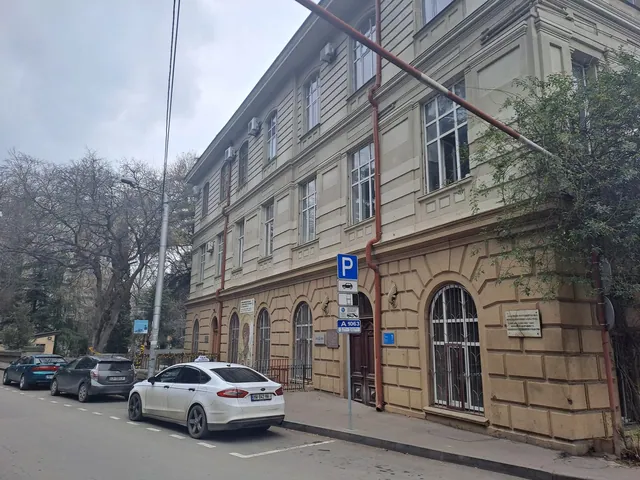
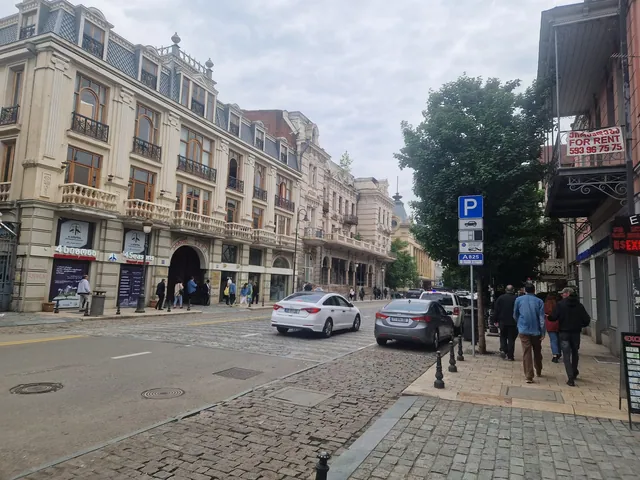
On payment: central Tbilisi is split into hourly parking zones, with Zone A at 1 GEL per hour and the first 15 minutes free. The zone type and rate are printed on the plate under the "P" sign. Outside the zoned streets the city runs an annual permit at 50 GEL, with six-month and weekly options. Rental cars are usually already registered in the system, but the hourly charge in the centre is on the driver, paid by app or SMS.
If your rental car is from MY.DRIVE and you are staying outside the centre, driving to Rike and taking the cable car up makes more sense than threading the old streets: there is somewhere to leave the car by the park, and the fortress is a couple of minutes from the upper station.
What to see inside Narikala Fortress
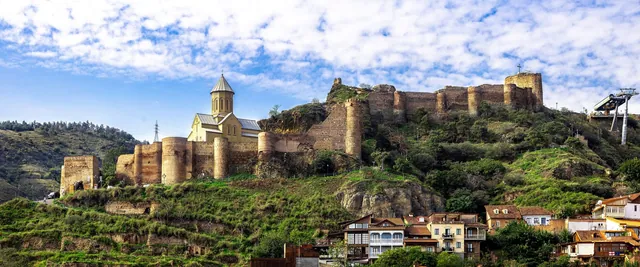
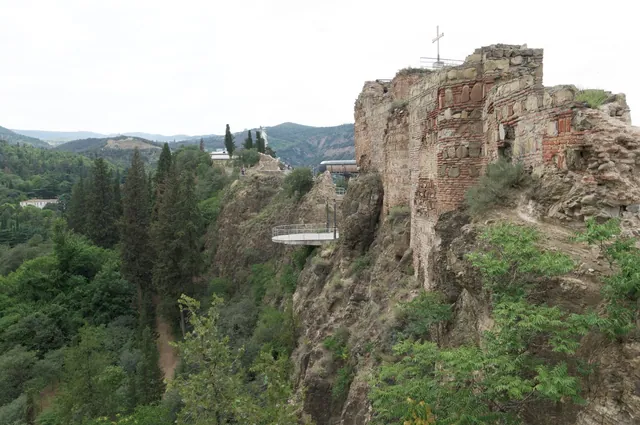
Narikala is not one building but several structures from different centuries stacked on a rock. What you see first past the gate are the walls of the lower fort and the stairs to the upper level. You can climb them freely. There are almost no railings and the cliff edge is unfenced, so with children stay towards the middle of the platforms.
What has survived:
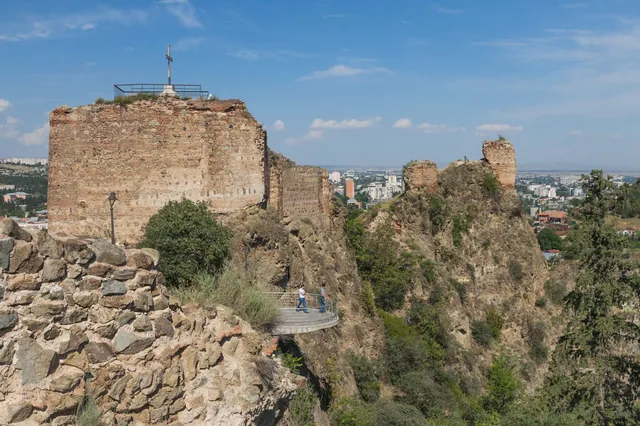
- The Istanbul Tower, square-plan, 16th century, the most recognisable part of the complex
- The shell of the Shakhtakhti tower fort at the western end of the ridge, with a stretch of wall running to it
- The cross at the summit, the highest point of the Old Town
- St Nicholas Church in the lower fort
The view is the best in the city not because of altitude but because of the angle. The Mtkvari is visible along almost the whole centre, the tiled roofs and domes of the Abanotubani bathhouses sit directly below you, Metekhi Church stands on the cliff opposite, and further upriver the glass Bridge of Peace catches the light. There is always wind on the upper level, even when the lanes below are airless.
St Nicholas Church
A church has stood here since the 12th century. Nothing of the old building remains: its foundations were found only during excavations in the 1960s, and the church itself came down in 1827.
The present building went up in 1996 to a design by Tariel Kiparoidze and was consecrated in 1997. It is a cross-domed church with doors on three sides, and the interior frescoes, painted in our own time, show scenes from the Bible alongside episodes from Georgian history. It is an active church, entry is free, and covered shoulders and knees are appreciated.
History: from Shuris-tsikhe to the ruins of 1827
There is no founding date. By the 4th century a fort already stood on this rock under the name Shuris-tsikhe, translated as "rival fortress". The usual order is reversed here: the fortress came first and the city grew around it. Geography explains why. The Sololaki cliff hangs over the narrowest point of the valley, where the Mtkvari is pinched between two rock faces, and it commands the only passage along the river. Nothing could move past unseen, which is why the point was held for fifteen centuries running.
The owners changed almost every century. The Persians took it at the end of the 4th century; the kings of Kartli took it back by the middle of the 5th. In the 6th century King Dachi, son of Vakhtang Gorgasali, widened the fortifications and made them the core of his new capital. The Umayyads rebuilt the fortress substantially in the 7th century, and from the 8th century onward it served for nearly four hundred years as the seat of the Arab emirs, with a palace inside the walls from which the city was governed. In 1122 David the Builder took Tbilisi and returned the citadel to the Georgian crown, extending the walls again.
The name arrived long after the fortress. The main theory ties it to "Narin Qala", "little fortress", a term used by the Mongols who reached the city in the 13th century; a Persian origin for the same word is also proposed. At first only the lower tower carried the name, and it settled over the whole complex around the 18th century. The logic of it is odd. The fortress dominates the city, and it looks "little" only against the full system of town walls that once ran from here down to the embankment and on to what is now Freedom Square.
Most of the stone you see today is 16th and 17th century. By then the Mongols, Timur's armies and repeated Persian campaigns had all passed through, and almost nothing of the earlier layers survives at surface level. In 1795 the army of Agha Mohammad Khan sacked Tbilisi and damaged the fortifications. Narikala itself was never taken by assault: the city fell around the citadel, or its garrison was starved out.
The fortress lost its military purpose after Georgia was annexed by the Russian Empire. In 1818, on General Yermolov's orders, a powder magazine was set up in the lower fort inside the St Nicholas church building. It blew up in 1827. That same year a strong earthquake hit the city. Sources disagree on which did more damage, but the outcome was the same: the church was levelled to its foundations, sections of wall and other structures collapsed, and no one rebuilt any of it. By the 1980s what remained was part of the Istanbul Tower, the shell of Shakhtakhti and fragments of wall along the ridge. Excavations ran from the 1960s and restoration began only in the 1990s, and it was closer to conservation than reconstruction: walls were stabilised and their top courses relaid, but the fortress itself was never rebuilt. That is why Narikala reads as ruins rather than a restored castle.
Kartlis Deda: ten minutes along the ridge
A path runs west from the fortress along the Sololaki ridge. Ten minutes along it stands Kartlis Deda, a 20-metre female figure holding a bowl of wine in her left hand and a sword in her right. The message is direct: wine for those who come as friends, steel for those who do not.
The statue went up in 1958 for the 1,500th anniversary of Tbilisi, by the sculptor Elguja Amashukeli. The first version was timber clad in aluminium and was meant to be temporary. It was replaced with an aluminium figure in 1963, and a new version with an altered dress and headdress was installed in the 1990s. The terrace at her feet gives a different angle on the city than the fortress does: more of Sololaki and the centre, less of the river.
Stairs lead down from the monument to Betlemi Street and into Sololaki. It is a good way to finish the walk. The descent takes about fifteen minutes and drops you among the cafes around Lado Asatiani Street.
The Botanical Garden, right by the upper station
The upper gates of the National Botanical Garden are next to the cable car's top station, barely a hundred metres from the fortress. An adult ticket is 4 GEL, a student ticket 1 GEL, a child ticket 50 tetri and a family ticket 6 GEL. In the warm season the garden runs roughly 09:00 to 19:30, closing earlier in winter.
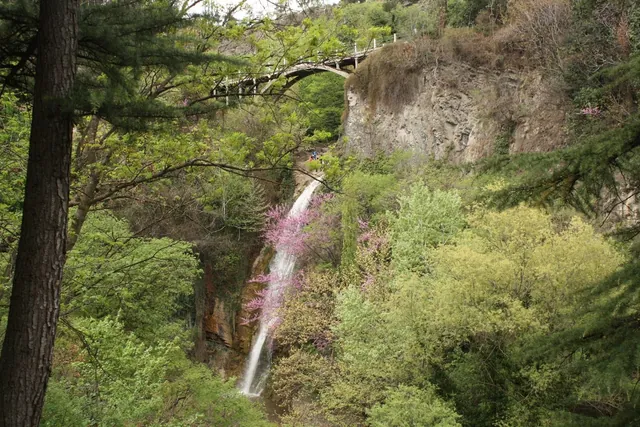
The sequence that works best: cable car up, fortress, Kartlis Deda, then into the garden through the upper gates and down past the waterfall to the lower gates on Botanikuri Street, ten minutes' walk from the sulphur baths. The whole loop takes 3–4 hours and ends down in the Old Town rather than on top of a hill.
When to come
Before 10:00 is the quietest window, though the cable car is still shut and you will be walking. Midday is crowded, especially May through September. The hour before sunset gives the best light on Metekhi and the old roofs, and also the longest cable car queue of the day.
In summer there is no shade on the fortress grounds, no water and no kiosks. I once came up around two in the afternoon in July and left twenty minutes later for the Botanical Garden, which is several degrees cooler under the trees. Carry water up with you; the nearest shops are down at Meidan.
Winter access is the same, but the steps and stone can be iced over and the path to Kartlis Deda gets slippery in places. In the evening the walls are floodlit, and that looks better from below, at Meidan, than it does from inside.
Worth knowing
Narikala is free and always open, so the only cost is getting up: 2.5 GEL for the cable car plus 2 GEL for a Metromoney card if you do not have one. The clean version of the plan is cable car up, walk down through the Botanical Garden or Sololaki. You queue once and finish in the city rather than on the hill. An hour to an hour and a half covers the fortress; allow half a day for the full loop with the monument and the garden. Wear proper shoes. There are almost no railings up top.