
Didgori Monument: How to Get There from Tbilisi, What to See and the Story of the Battle
The Didgori Memorial Complex is 57 km from Tbilisi. Learn the history of the 1121 Battle of Didgori, how to get there by rental car, when to go and what to see nearby.
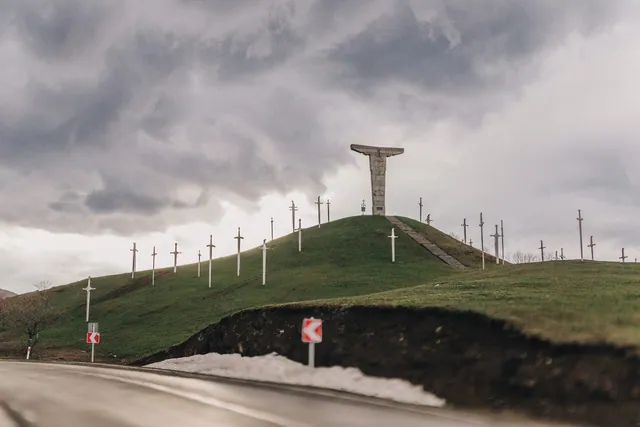
The Didgori Memorial Complex stands on a windswept plateau 57 kilometers southwest of Tbilisi. Stone swords are driven straight into the ground, bronze warrior figures rise above the slope, and the wind almost always blows in from the mountains. People don't come here to tick a box on a list: the place stays with you because of its scale and its quiet.
If you're in Georgia and haven't been to Didgori yet, it's a good reason to get a car and head out of the city.
What Is the Didgori Monument
The Didgori Memorial Complex was built in 1976 to a design by the renowned Georgian sculptor Merab Berdzenishvili and architect Giorgi Chakhava. It is dedicated to one of the most important battles in Georgian history, the Battle of Didgori, fought on August 12, 1121.
The monument sits on the Didgori plateau where several of the country's regions meet (Mtskheta-Mtianeti, Shida Kartli and Kvemo Kartli), on the edge of Trialeti National Park. The complex's coordinates are 41.7626, 44.5125.
It's hard to call it a monument in the usual sense. The complex was conceived as a symbolic battlefield: a central stele stands on the hilltop, wide steps lead up to it, and huge stone swords are driven into the ground all around, like gravestones over fallen warriors. Nearby is an amphitheater with columns that looks out over the mountain ridges. You feel the history here through the space itself rather than through museum displays.
The Battle That Changed Georgia
To understand why Georgians revere this place so deeply, you need some context.
In the 11th century most of Georgia had been taken by the Seljuk Turks. Tbilisi, the future capital, was under their rule. In 1089 David IV the Builder came to the throne, crowned at the age of 16. The young king set about methodically rebuilding the country: he united scattered principalities, reformed the army and settled the warlike Kipchaks in Georgia.
By 1121 a coalition of Muslim rulers (the Seljuk forces of the emirs Ilghazi, Toghrul and Dubays) invaded Georgia, intending to finish off the strengthening kingdom once and for all. Depending on the source, their army numbered anywhere from several tens of thousands to several hundred thousand. David went out to meet them with an army of about 56,000–60,000 men: Georgians, Ossetians, Kipchak mercenaries and even a detachment of Crusader knights from Western Europe.
The king chose the battlefield with care. In the narrow mountain gorges near Didgori, the huge enemy army could not deploy or make use of its numbers. The battle lasted only three hours. Ilghazi's army was routed, the emir himself was badly wounded, and the Georgian cavalry pursued the remnants of his forces for several more days.
The very next year David liberated Tbilisi, which became the capital of a united Georgian kingdom. This was the start of what historians call Georgia's "Golden Age".
Historians are unequivocal about this battle. According to the scholar D. Rayfield, the victory at Didgori destroyed Muslim hegemony over Georgia and Armenia. The Georgian historian S. Kakabadze called it "the greatest result in the history" of his people.
What to See on Site
The memorial grounds are fairly large, and a walk around takes 30–40 minutes. I wouldn't rush: I'd climb up to the stele first and only then go down to the swords and the amphitheater, so the complex reads as a whole. Here's what you'll see:
The central stele is a tall monument on the hilltop with bas-reliefs and borjgali symbols (the Georgian solar sign). A wide staircase with mountain views leads up to it.
The stone swords are set along the hillside and gleam in the sun. They have become the complex's signature sight and are the most photographed part of it.
The bronze warrior figures are monumental sculptures that make it easy to picture the battlefield.
The amphitheater with columns sits in the lower part of the complex and is a comfortable place to rest and take in the landscape.
Bells and ritual objects round out the symbolic ensemble.
Mass tourism has barely reached this place so far. On a weekday there's hardly anyone here, so you can walk, take photos and simply think in peace.
Entry to the grounds is free. Parking at the foot of the hill is free too.
Didgoroba: When It's Especially Worth Coming
If you can plan your trip for August 12, do. On this day Georgia celebrates the national holiday of Didgoroba, the anniversary of the battle.
The grounds around the memorial host:
- formal military ceremonies with the presentation of the "Cross of Didgori" medal, a state award for courage;
- theater performances and historical reenactments;
- music and folk festivities;
- sports competitions.
Thousands of people come here from all over Georgia. The mood is festive and at the same time full of national pride.
How to Get to the Didgori Memorial
This is the main practical question, and the answer is straightforward: it's hard to get here without your own transport.
There is no public marshrutka to Didgori. The nearest settlement you could in theory reach by marshrutka is far from the monument. From there you'd have to walk several kilometers uphill along a road where a car passes once every half hour.
There are three realistic options:
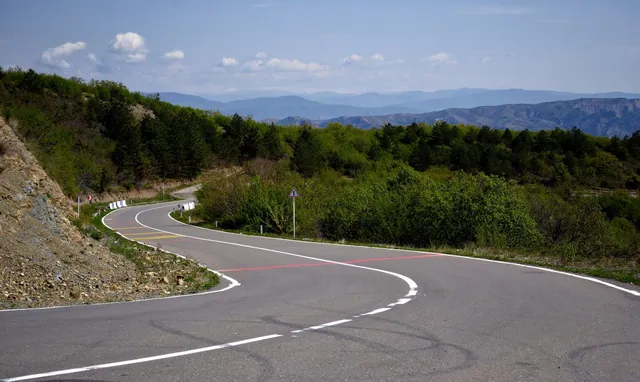
1. A rental car is the most convenient way. From Tbilisi, drive southwest towards Manglisi, then turn off at the Didgori sign. The drive takes about an hour. The route is easy to set up in a navigation app: enter the coordinates 41.7626, 44.5125 or search for "Didgori Monument" in Google Maps or Waze. The paved road runs almost all the way to the complex, and there's free parking at the foot of the hill.
Renting a car in Tbilisi lets you plan the route your own way: stop at Didgori, then carry on to Manglisi, the Tsalka canyon or the glass bridge at Dashbashi. You can book a car on MY.DRIVE online, with unlimited mileage and free delivery within the city.
2. A taxi works, with one catch: agree in advance with the driver that he'll wait for you. A simple one-way taxi will leave you in the middle of the mountains with no way back.
3. An organized tour. Many Tbilisi operators include Didgori in itineraries together with the Tsalka canyon and Dashbashi. It's convenient if you'd rather not plan the logistics yourself.
What to See Along the Way
A trip to Didgori easily turns into a route around the area southwest of Tbilisi. A few places that fit into one day:
Manglisi is a small town 20 km from the Didgori turnoff. It's home to Manglisi Cathedral, one of the oldest Christian churches in Georgia, built in the 4th–5th centuries.
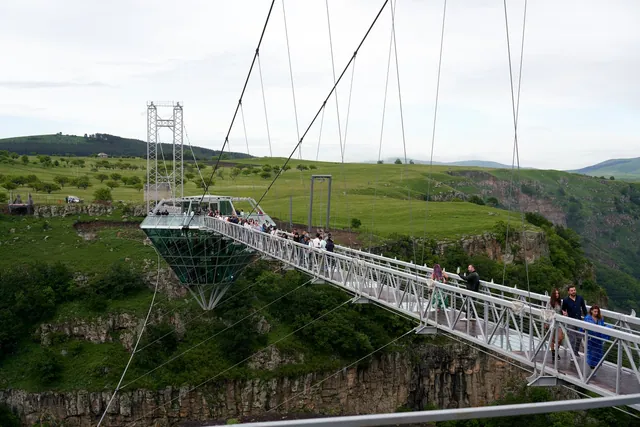
The Tsalka canyon (Dashbashi) is a scenic canyon with a waterfall and the famous glass viewing bridge over the gorge. A good stop for anyone who likes heights and beautiful photos.
Trialeti National Park is where the memorial sits, on its edge. Rolling meadows, forests and almost untouched nature.
I'd make Didgori the first stop, while the plateau is still quiet, and leave Manglisi and the canyon for the afternoon.
When to Go
Late spring and summer (May–August) is the best time. The hills around the memorial are covered in wildflowers, and the green slopes contrast with the gray stone of the monument. In August there's also the Didgoroba holiday.
Autumn is beautiful too: muted colors, golden leaves, fewer people. It's the season I like most, precisely because of how calm the plateau is.
Winter is harsh and atmospheric in its own way: snow on the plateau and a gray sky give the place an almost mystical feel. However, in winter the road to the monument is often closed because of snow, so be sure to check conditions before you go. The Didgori plateau is much higher than Tbilisi: even if it's warm and sunny in the city, it can be below freezing here with a strong wind.
A Few Practical Tips
- Dress warmer than the Tbilisi weather suggests: the plateau is much higher than the city, and the temperature difference can be 5–10 degrees. Didgori is always windy, so you'll need a jacket or at least a thick sweater even in midsummer.
- Bring water and a snack: there are no cafés or shops nearby.
- A charged phone with offline maps: parts of the route have no stable internet.
- The best time to arrive is the morning or the afternoon, when the sun lights up the swords and sculptures well.
- Free entry: no ticket office, so just come at your own pace.
Summing Up: Why Go to Didgori
At Didgori you feel the country's history physically: through the scale of the monument, the wind on the open plateau and the silence broken only by the rustle of grass between the stone swords.
For visitors to Georgia it's a chance to get beyond Tbilisi's Old Town and see a different side of the country, mountainous and steeped in history. A trip by rental car fits into one day.
Distance from Tbilisi: ~57 km Travel time: ~1 hour Entry fee: free Coordinates: 41.7626, 44.5125 Best season: May – August