
Ananuri Fortress: What to See, When to Go and How to Get There
Ananuri Fortress on the Georgian Military Highway, 66 km from Tbilisi: free entry, carved 17th-century churches, a panorama over the Zhinvali Reservoir from the tower. Opening hours, parking, routes from Tbilisi, Gudauri and Kazbegi.
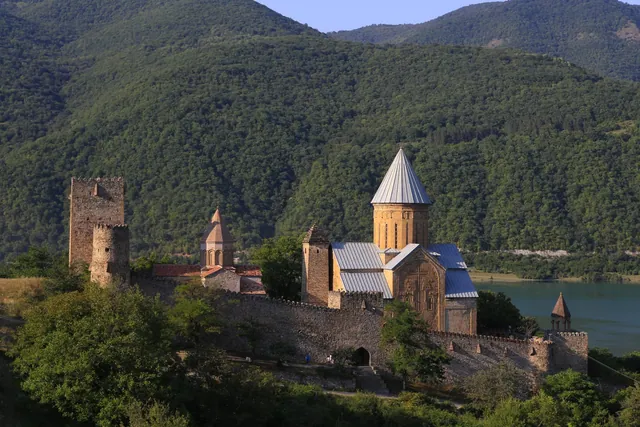
Ananuri is one of the few fortresses in Georgia you don't have to make a special trip for: it simply turns up on your way. The walls stand right against the Georgian Military Highway, 66 km from Tbilisi, roughly within the first hour of the drive towards Gudauri and Kazbegi. Entry is free, an hour is enough to look around, and from the tower you get a view over the turquoise Zhinvali Reservoir.
Across several drives along this highway I've stopped here in the morning, in the rain, and in February in the snow — and I've never once regretted the hour. Below: what to see inside, when it's best to come, and how to fit the fortress into a route.
Where it is and why everyone pulls over
The fortress sits where the Vedzatkhevi River flows into the Aragvi — a natural lock on the mountain corridor. Whoever held this headland held the road into the mountains.
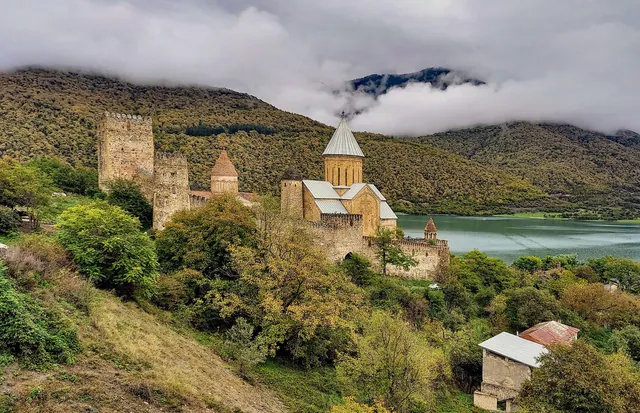
Today the Zhinvali Reservoir laps at the foot of the walls, and the water can take on an almost improbable shade of turquoise. It's that contrast — warm grey stone towers, a blue mirror of water, green slopes behind it — that made Ananuri one of the most photographed spots in the country. Just bear in mind that the water level shifts through the year: in spring the reservoir is full and comes right up to the walls, while by late summer a band of bare ground appears along the shore. The view doesn't suffer for it, but the postcard comes out different.
There's a more prosaic reason for its popularity too: it's a convenient stop. You can see the fortress from the road, parking is free, there are cafés nearby, and it's under an hour from Tbilisi. For many people Ananuri is the first stop on a day trip along the Georgian Military Highway, and often the only place they get out of the car at all before Gudauri.
History: eristavis, a siege, and the first Russian tourist
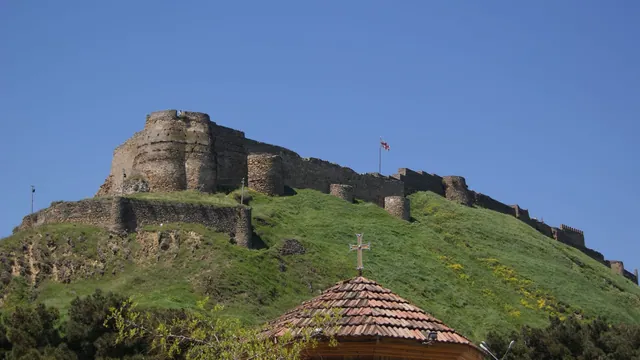
Ananuri appeared in the 16th century as the main stronghold of the Aragvi Eristavate — the feudal principality that controlled this gorge. The fortress blocked the road coming from the Dariali Gorge and served as a refuge: during raids, people from the surrounding villages withdrew behind these walls.
The loudest story here isn't about an outside enemy — it's about neighbours. In 1739 Ananuri was stormed by Prince Shanshe from the Ksani Valley: one of the largest feudal battles in Georgia, a war between neighbours for control of the gorge.
In 1795 the defenders held the gorge against the army of Agha Mohammad Khan, who had invaded Georgia. Standing on the upper platform, that reads better than it does in a textbook: the gorge narrows below you so tightly that there was simply nowhere to bypass the fortress.
After Georgia joined Russia at the start of the 19th century, a Russian garrison was stationed here. In May 1829 Alexander Pushkin called in while travelling the Georgian Military Highway — his visit is considered the first documented instance of a Russian tourist in these parts. Since 2007 Ananuri has been on the UNESCO tentative list.
What to see inside
The complex splits into two parts: the citadel — the upper, well-preserved section — and the lower fortification, of which mostly ruins remain. The most interesting things are up top, and you can walk it without any plan at all: inside the walls the space is about the size of a small courtyard.
The Church of the Assumption (1689) is the main building and the main reason to linger. Its southern façade is covered in stone carving: a large cross with grapevines growing out of it, animals, birds. The carving is shallow, so it almost disappears at midday and comes out in the morning and evening, when the sun rakes across it — if the façade looks flat and unremarkable to you, you simply came at the wrong hour. Inside, parts of the altar paintings survive; after the bright courtyard your eyes need twenty seconds or so to start making anything out.
Next to it stands the Church of the Virgin Mary — earlier and noticeably more austere: almost no decoration, just volume and masonry. In the lower part of the complex there's the small Mkurnali Church, 16th–17th centuries.
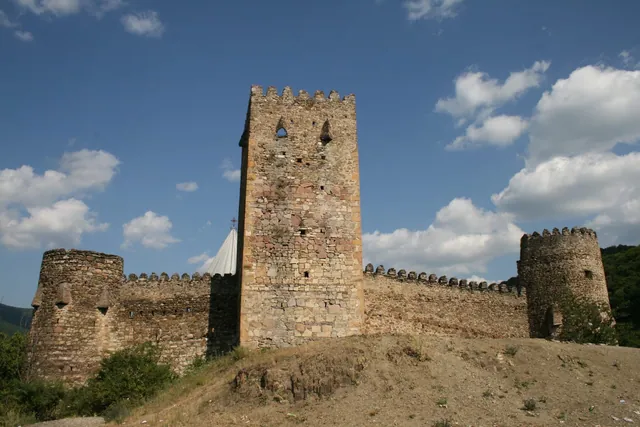
The square tower is a stop of its own. Inside there's a narrow, steep staircase and low openings; better to go up one at a time and not at peak hour, otherwise the steps turn into two-way traffic. At the top there's a full panorama: mountains, the gorge, the flat surface of the reservoir. It's almost always windy up there, even when the courtyard is still and hot, so it's best to hold your cap in your hand.
Plenty of people skip the lower fortification, and that's a pity: from there the walls look the way an attacker saw them, and there's usually nobody around at all.
An unhurried walk around the citadel takes about an hour. If you want to go down to the lower ruins closer to the water, add another 30–40 minutes. Entry is free, opening hours are 10:00–18:00.
How to get there from Tbilisi
By car this is the easiest stretch of the Georgian Military Highway. From Tbilisi to Ananuri is 66–70 km, roughly 50–60 minutes along the S3. There are no switchbacks on this section and the surface is fine; the one thing to get used to is the lorries heading for the Russian border and the overtaking into oncoming traffic. The fortress stands right by the road, on your left as you drive; the turn-off to the car park is short, so slow down in advance.
A rental car solves the main thing here — time. With MY.DRIVE you can leave Tbilisi at seven in the morning, arrive for opening and see the fortress while the coaches are still on the road, then carry on — to Gudauri or straight to Kazbegi. On a marshrutka the timetable makes that choice for you.
Without a car: minibuses towards Stepantsminda, Gudauri and Pasanauri leave from the bus station by Didube metro — ask the driver to drop you at Ananuri. The trip takes about an hour and the fare is 4 GEL. Coming back you flag down passing transport on the highway, and there isn't always a free seat — worth building in some slack for that.
How to get there from Gudauri
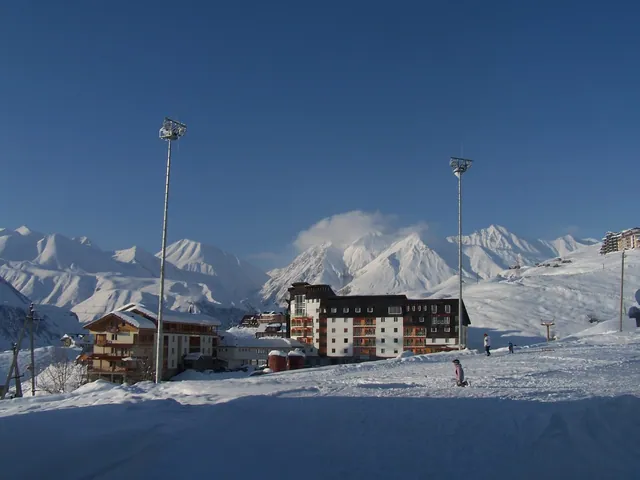
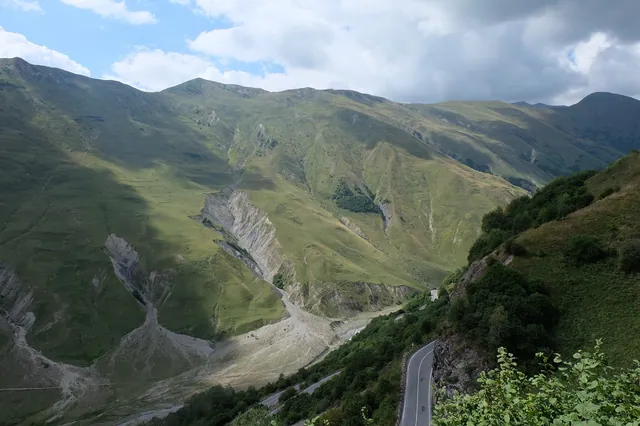
From Gudauri to Ananuri is about 50 km down the Georgian Military Highway, roughly 40 minutes. The road drops from the pass into the valley: switchbacks, mountain views, no traffic jams.
If you've come to Gudauri for the ski season, it makes sense to leave Ananuri for the drive back to Tbilisi — the fortress will be exactly on your way, and after a day on the slopes half an hour walking the walls feels like a rest rather than one more item on the itinerary.
How to get there from Kazbegi (Stepantsminda)
From Stepantsminda to Ananuri is about 85 km, roughly 1.5 hours south. The whole drive runs along the Georgian Military Highway, including the Jvari Pass: that stretch is covered in detail in the guide Tbilisi to Kazbegi by car.
The scheme that works best: leave Stepantsminda after breakfast, spend an hour at the fortress, and be in Tbilisi by lunch. On the way back the light is usually better than it was on the way up — the sun is already high and the reservoir takes on its colour.
How much time to allow
Thirty to forty minutes — if you're just pulling off the highway: the citadel courtyard, the Church of the Assumption from the outside and a quick climb up the tower. That's enough to get the place, and it doesn't break your day.
An hour is the sensible option. You have time to go inside the churches, climb the tower without queueing in either direction, and walk the walls at your own pace. That's usually what I leave for it when I'm heading further into the mountains.
An hour and a half to two hours — if you go down to the lower ruins and stop at the viewpoint by the Zhinvali dam. Once the tour coaches leave, the courtyard empties and the fortress feels completely different: wind, water and almost nobody on the steps.
It isn't worth driving out from Tbilisi and back for Ananuri alone — an hour each way for an hour of sightseeing. As a stop along the way, though, it costs you almost no time at all: you're on this road anyway.
When to go
The tour coaches arrive in a wave from around the middle of the day, and in high season the citadel courtyard gets crowded. In the morning at opening time, or after five in the evening, it's an entirely different place: you can hear the wind and the water.
Spring and early summer are the best bet: the reservoir is full and the slopes are green. In autumn there are fewer people and the light is soft, but the water may have pulled back from the walls. In winter the fortress is open, and in the snow it looks especially imposing; this section of the highway is generally cleared — unlike the section higher up towards the pass, which gets closed in bad weather. If you're travelling in the cold season, check road conditions before you set off, and don't assume that because you made it to Ananuri you'll make it to Gudauri.
Practicalities
- Parking — free, right by the fortress. There's usually space, but at the busiest time of day you'll be manoeuvring between coaches.
- Food — a few spots next to the car park: khinkali, khachapuri, coffee. It's roadside level rather than fine dining, but they'll feed you even in the off-season.
- Clothing — the churches require covered shoulders and knees, and a headscarf for women; wraps and scarves are often left by the entrance. Non-slip shoes are a good idea: the stone inside the walls is polished smooth in places.
- With children — the courtyard is easy to walk, but the tower staircase is steep and has no proper handrail; better to lead little ones by the hand or save the tower for another time.
- The viewpoint at the dam of the Zhinvali Reservoir is 2–3 km from the fortress, ten minutes including the stop; from there you see the whole basin of water.
How to fit it into a route
Ananuri is almost never a destination in its own right — and that's fine. Combinations that work:
- A day out from Tbilisi: Mtskheta → Ananuri → the viewpoint at the dam → back. A relaxed 5–6 hours, no rushing.
- On the way into the mountains: Ananuri → Gudauri with the arches of the viewing platform → Kazbegi. Here the fortress is a warm-up before the pass.
- On the way back from the north: Stepantsminda → Ananuri → Mtskheta → Tbilisi. Mtskheta is 20 km from Tbilisi, so you can still fit it in even in the evening.
The bottom line
An hour's drive from Tbilisi, free entry, an hour to look around — the ratio of effort to impression here is one of the best in the country. Inside is a real medieval fortress with carved 17th-century churches, not a restored mock-up, and a view worth climbing an awkward staircase for. With a car you decide how long to stay: forty minutes between two points on a route, or half a day with the reservoir and the lower ruins.