
What to see in Kutaisi: the main places in town
What to see in Kutaisi in a day: Bagrati Cathedral, the Colchis Fountain, the White Bridge, the Jewish quarter, the market and the botanical garden. Route, parking, opening hours.
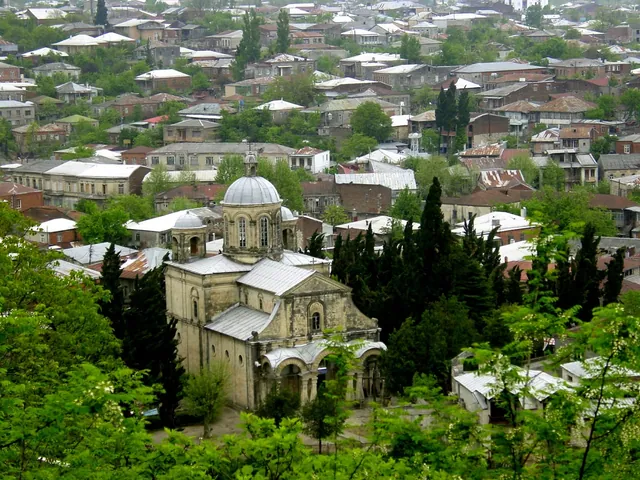
The essentials of Kutaisi fit into a single day on foot: Bagrati Cathedral on its hill, the Colchis Fountain on the central square, the White Bridge with its statue of a boy, the Jewish quarter with its 19th-century synagogues, the green market and the botanical garden with a chapel inside an oak tree. The distances between them are short, and the furthest point from the centre is a twenty-five-minute walk. Below I go through what to see in Kutaisi, how much time to allow for each place and what to do with the car.
How much time to allow for the city
Kutaisi stands on the Rioni, and almost everything a visitor comes for lies within two kilometres of David Aghmashenebeli Square. The city can be walked in a day, lunch and the climb to the cathedral included. If you want it unhurried and with museums, make it a day and a half.
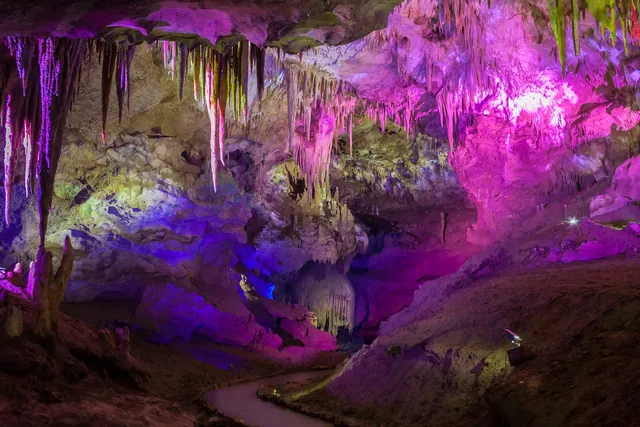
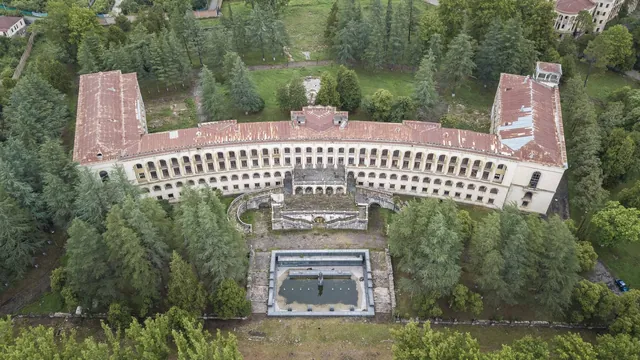
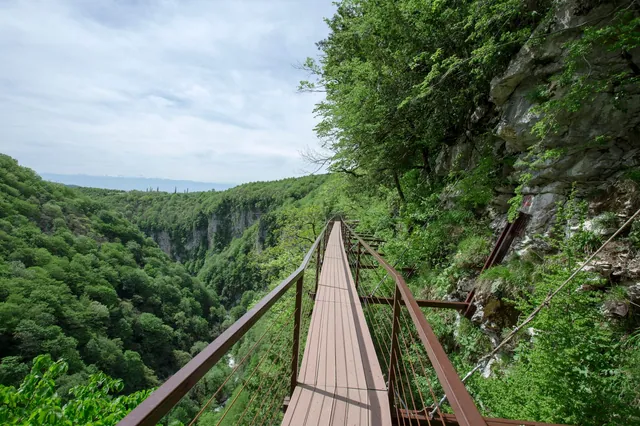
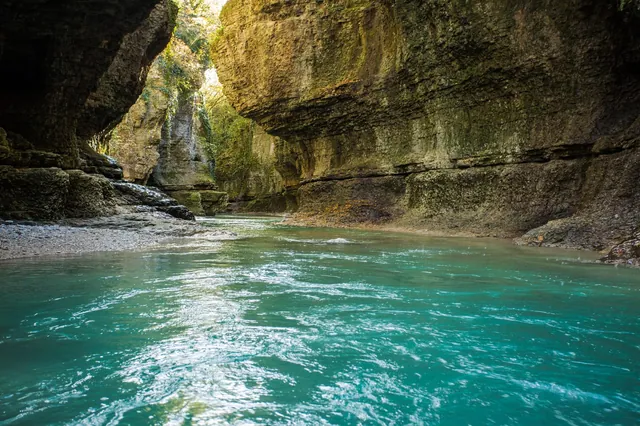
A second day usually goes not on the city but on what surrounds it: Gelati, Motsameta, Sataplia, the Prometheus Cave, the canyons, Tskaltubo. We have separate pieces on those; this one covers only what lies inside the city limits.
One thing about the weather is worth remembering. Imereti is humid, rain happens here in any season, and in autumn and winter it comes down seriously and for a long time. An umbrella in the car won't go to waste even in June.
Bagrati Cathedral: the main point and the best panorama
The cathedral was founded in 1003 under King Bagrat III, and David the Builder was crowned here. In 1691, during a Turkish siege, a powder store blew up; the church lost its dome and its roof and stood as a ruin for almost three centuries. The restoration was finished in 2012, and that is when the glass inserts and the external lift appeared. Because of them, in 2017 UNESCO removed Bagrati from the World Heritage list — while Gelati Monastery kept its status.
Entry is free and the church is in use. Headscarves and skirts are usually in a basket by the door.
From the centre the climb takes 20–25 minutes, the last stretch uphill. By car you can get almost to the walls; there's a car park for a few dozen vehicles at the foot. The first time I went up was at one in the afternoon in July, and I then spent fifteen minutes looking for somewhere to stand: there's practically no shade on the terrace in front of the cathedral, and the stone bakes. In summer it's better to come after six in the evening — you'll catch the sunset over the valley into the bargain.
The Colchis Fountain and the central square
The fountain opened in 2011, designed by the architect David Gogichaishvili. Thirty gilded figures stand on its tiers: horses, deer, rams, a tamada with his drinking horn. They are enlarged copies of Colchian bronze finds; the originals are kept in the National Museum in Tbilisi.
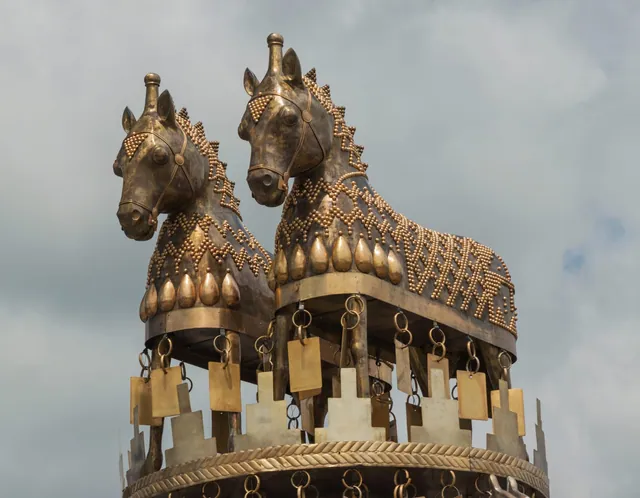
The square itself has had an eventful biography. Until 1924 the Alexander Nevsky Cathedral stood here, then Soviet monuments took the spot, then an equestrian David the Builder, later moved down to the railway station. Now there are cafés around the fountain, the lighting comes on in the evening, and almost any walk around town starts from here.
The White Bridge and the boy with the hats
The pedestrian bridge over the Rioni was built in the second half of the 19th century, and it means more to the people of Kutaisi than it does to visitors. A boy sits on the railing with two hats in his hands, a character from the Georgian film "An Unusual Exhibition" (1968). In the story he snatches the hats off two men mid-conversation and jumps from the bridge into the river.
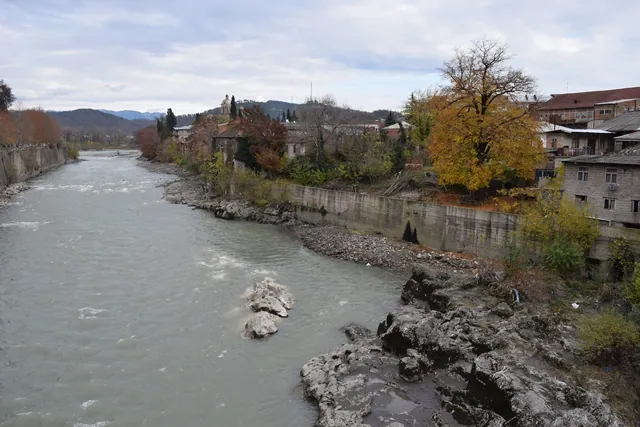
The river here is loud enough that you have to ask people to repeat themselves. The water is muddy and fast, with limestone cliffs along the banks.
Two steps from the bridge stands Okros Chardakhi, the "golden tent", the house of the Imeretian kings. The building is small and most people look at it from the outside. The lower cable-car station is right there too.
The cable car and Gabashvili Park
The cable car dates from 1961 and the line is only about 336 metres long, but it runs directly over the Rioni. The cabins have barely changed since, and that is probably the main thing you take away from the ride.
It doesn't run every day: there are technical breaks, stoppages for wind and rain, and the timetable drifts. Don't count on it as transport — you can walk up in about fifteen minutes.
Gabashvili Park has a Soviet Ferris wheel, a few fairground rides, shade and a view over the city from above. It's a place for locals rather than tourists, and that's exactly what makes it pleasant.
The botanical garden and the chapel inside an oak
The garden opened in 1969 on the site of one laid out in the middle of the 19th century; there are around 700 plant species here now, plus ponds, pavilions and an amphitheatre. There is one headline sight: the 400-year-old Hartwiss oak, in whose hollow a tiny chapel was fitted out in January 2014. It holds one person inside, two at a push.
Entry costs a token couple of lari, and you can walk the whole thing in an hour. The garden isn't far from Bagrati, so it makes sense to join the two into a single walk.
The Jewish quarter and the synagogues
The spine of the district is Boris Gaponov Street. Three 19th-century synagogues stand here, two of them in use. Gaponov himself translated "The Knight in the Panther's Skin" into Hebrew, and there's a monument to him nearby.
This is an ordinary residential quarter: carved balconies, washing in the courtyards, vines overhead, broken asphalt. People live here rather than work as scenery, so loud groups and photographing at close range go down badly. You can go into a synagogue; men need to cover their heads.
The green market: where to buy cheese and spices
The market takes up a whole block in the centre, with trade going on both in the covered hall and along the streets. Imeretian cheese and sulguni, Svan salt, khmeli suneli, churchkhela, honey, ajika, pickles, herbs by the armful. Prices are noticeably lower than in Tbilisi, and tasting the cheese before you buy is considered normal.
Bring cash in lari: by no means every stall has a card terminal.
My sulguni was wrapped in three layers of paper and then a bag, and by the evening the car still smelled of cheese. If you're buying for the road, put it in the boot rather than in the cabin.
What to eat in Kutaisi
Imereti cooks differently from eastern Georgia, and you notice it straight away. Less meat, more vegetables, nuts and herbs, and a different kind of heat.
- Imeretian khachapuri: round, closed, with young Imeretian cheese inside. This is not the Adjarian boat with an egg — the dough is thinner and the cheese sharper
- Ghomi with sulguni: a thick, unsalted corn porridge with a piece of cheese dropped into it. Its nearest relative, Megrelian elarji, turns up in Kutaisi cafés just as often
- Lobio in a clay pot, with mchadi and pickled peppers. Cheap and very filling
- Kupati and chashushuli, if you want meat
- Pelamushi: a thick dessert of grape juice and corn flour, the Imeretian classic at the end of a long meal
- Local wine: Tsitska, Tsolikouri, Krakhuna. White, dry, often from qvevri and often homemade
The average bill in an ordinary city café is noticeably lower than in Tbilisi, and the portions are bigger than the menu descriptions suggest.
The museums of Kutaisi
The Niko Berdzenishvili History Museum is at 18 Pushkin Street. The holdings are enormous, more than 190,000 items, but the display occupies only part of the building. It's worth going for the "Golden Treasury": chased metalwork, crosses, icons from the churches of western Georgia. It opens roughly from 10:00 to 18:00 and a ticket costs a few lari.
Next to it there's an art museum with works by Pirosmani and 20th-century Georgian painting. Small, an hour's worth. On the way between the two you'll pass the gymnasium where Mayakovsky studied, and whole blocks of pre-revolutionary buildings — reason enough to go on foot rather than drive.
Mtsvane Kvavila: a quiet spot with no tourists
A historical and architectural complex on high ground; the name translates as "green flower". There's a defensive tower here, several churches (the oldest going back to the 12th century, one of them in ruins) and a pantheon from 1956, to which the graves of Georgian public figures were moved.
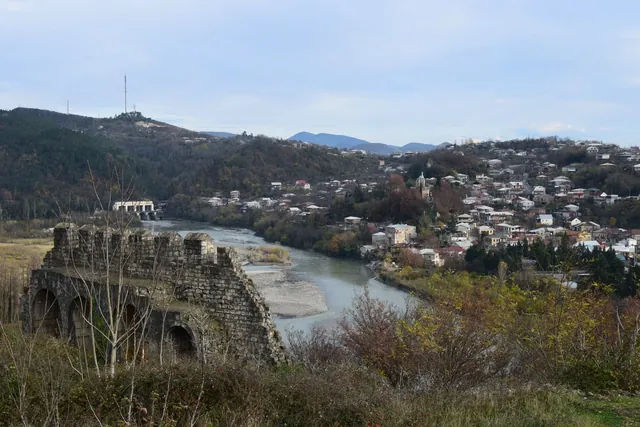
There are almost never any tourists. It opens up a view over the western part of the city and the river, with a dam on the Rioni close by. You can walk here from the Jewish quarter, on along Gaponov Street and then right.
What you'll come across on the way
- The Meliton Balanchivadze Opera House in the centre, with the playbill hung straight on the facade
- The Cathedral of the Annunciation, baroque inside, still in use
- The former parliament building: a glass dome on the way out towards the airport. Parliament went back to Tbilisi in 2018–2019 and the building has stood empty since; the authorities have announced plans to put a technology hub inside. You can't get in, but it's clearly visible from the highway
- The Rioni embankments and the old bridges: the Red, the Chain and the Rustaveli
What to see in Kutaisi in one day: a ready-made route
- 9:00. The botanical garden, before it gets hot. An hour with room to spare.
- 10:30. The climb to Bagrati Cathedral, the panorama, a circuit of the walls. An hour.
- 12:00. Back down into the centre, David Aghmashenebeli Square and the Colchis Fountain.
- 13:00. Lunch. The centre is thick with cafés; khinkali and Imeretian khachapuri are on almost every menu.
- 14:30. The White Bridge, Okros Chardakhi, the cable car and Gabashvili Park, if it's running that day.
- 16:00. The green market, then the Jewish quarter and the synagogues.
- 18:00. Mtsvane Kvavila at sunset, the city seen from the hill.
If you only have half a day, keep Bagrati, the fountain, the White Bridge and the market. That's enough to get the measure of the place.
Do you need a car in Kutaisi itself
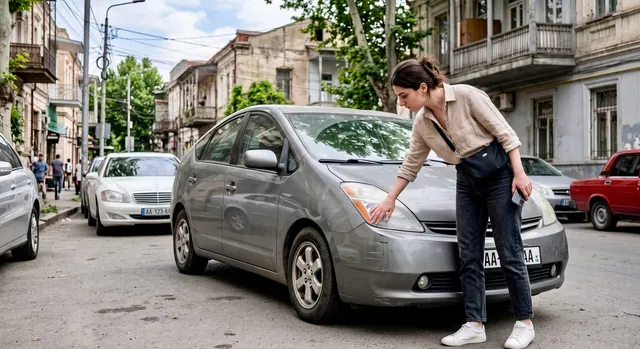
Inside the city a car is more hindrance than help: the centre is compact, the streets are narrow and plenty of them are one-way. Some of the parking in the centre is paid, marked with a "P" sign with the tariff on the plate, while beyond the central blocks you can leave the car for free. Bagrati Cathedral and the botanical garden have car parks of their own.
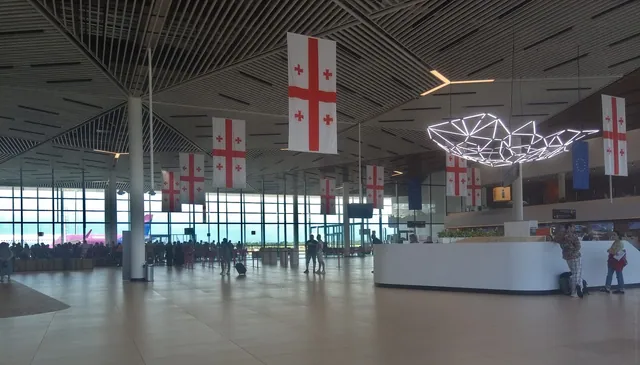
Beyond the city, though, it's hard without wheels. Gelati is about 11 km away, Motsameta 6, Sataplia 9, the Prometheus Cave around 20, Tskaltubo 12, and Martvili canyon a little over 50. By marshrutka that's one point a day with changes and waiting; with your own car the same two or three fit into half a day. You can pick a car up right at Kutaisi airport: it's about 15–25 km from there into town, and the details on cars in Kutaisi itself.
What's worth knowing
Kutaisi doesn't try to charm you at first glance, and that's its particular quality: half of what's interesting here isn't on the squares but in the courtyards and the side streets. A day for the city and a day for the surroundings is the proportion that works. In summer plan your walking for the morning and the evening — in July and August the midday sun is hard going. And keep cash on you: the market and the smaller museums take cards only half the time.