
Okatse Canyon: the walkway above the gorge, the drive and tickets
Okatse Canyon in Imereti: 780 metres of suspended walkway 140 m above the gorge floor. Driving from Kutaisi, Batumi and Tbilisi, ticket prices, entry rules, seasons and what to see nearby.
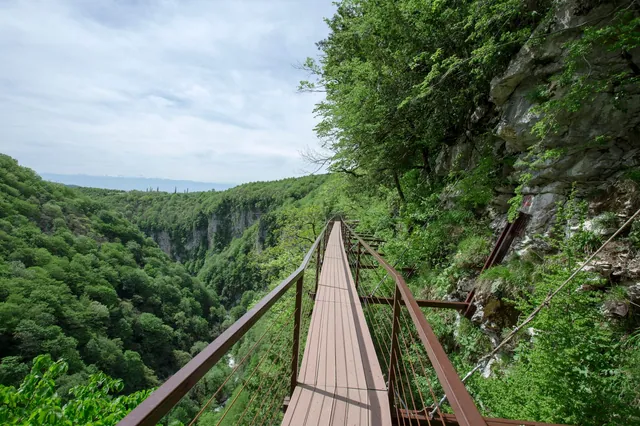
Okatse Canyon lies in Imereti, by the village of Zeda Gordi, about 50 kilometres from Kutaisi. People come here for one thing: 780 metres of metal walkway fixed straight into the wall of the gorge, around 140 metres above the floor. Everything else is the approach through the forest and the climb back up, six or seven kilometres on foot and roughly three hours.
From the car park you can neither see the canyon nor really hear it. First comes the forest, a level path, beech trees and ferns, then a metal grating underfoot, a handrail at chest height and open air on your left. The bottom of the gorge reads as a narrow strip of green a very long way down. People on the walkway go quiet almost in unison.
What Okatse Canyon is
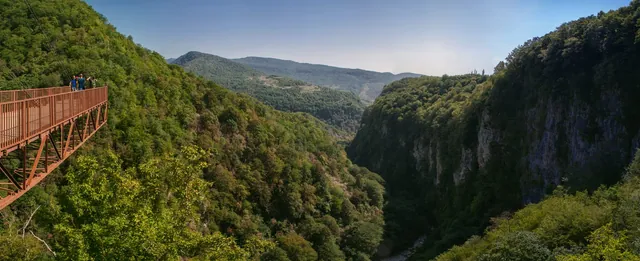
Administratively this is Khoni Municipality in Imereti, and the nearest settlement is Zeda Gordi. The gorge was cut by the Okatse River, which spent millennia working through limestone and left a cleft around 16 kilometres long and up to 140 metres deep.
Until 2014 the place was effectively out of reach: no paths, no railings, no ticket office. That year a visitor centre with an ethnographic exhibition was built, a forest trail was laid, and a cantilevered structure was anchored above the drop. That structure is what made Okatse recognisable and put it in the same league as Martvili Canyon and Prometheus Cave.
The three places work in completely different ways, and that matters when you plan a day. At Martvili you get into a boat and look at the cliffs from below. In the cave you walk underground at a steady +14 °C. At Okatse you are up in the air the whole time, and your legs do the work.
The walkway above the gorge
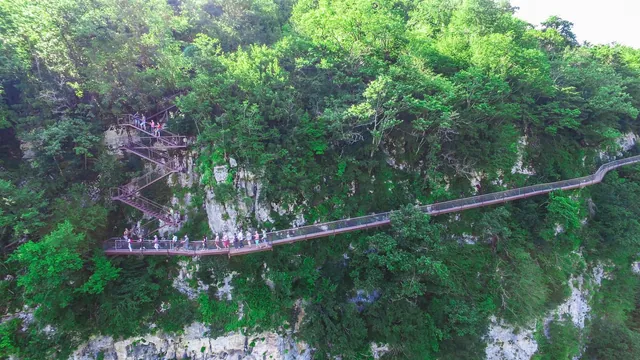
The suspended walkway is about 780 metres of steel set into the rock face. It runs 140 metres above the gorge floor, roughly the height of a 45-storey building. Traffic on it is one-way: you cannot enter and leave at the same point, so you walk the whole structure.
At the far end there is a viewing platform projecting out over the canyon. There are benches on it, and they are not for decoration: plenty of people need a pause to sit above the void and get their breathing back.
The route starts at the visitor centre. It is about 2.5 km along a forest path to the walkway entrance, roughly an hour at an easy pace. The way back is the same path but uphill, and it takes a little longer. In total that is 6–7 kilometres on foot and around three hours for everything, stops and photographs included.
Part of that can be cut out: a shuttle from the visitor centre to the start of the walkway sometimes runs. Whether the vehicle is there at all, and on what schedule, depends on the season and the flow of visitors, so it is not worth counting on in advance.
Entry rules
Children under 120 cm are not allowed on the suspended walkway. It is a height restriction rather than an age limit, and it is checked at the ticket office.
Children under 14 go through only with an adult. Animals are not allowed in, and there is nowhere on site to leave a dog.
In rain and in icy conditions the walkway is closed. The decision is made on the spot and is not up for discussion: wet grating 140 metres up really is slippery. Sometimes the closure lasts a couple of hours, sometimes the whole day.
Getting there
Okatse sits off the tourist corridors, and almost everyone arrives by car. Renting a car removes the main problem with this direction: you do not have to fit around minibuses, you can leave at seven in the morning and add a second stop to the canyon.
From Kutaisi, about 50 km, roughly an hour. The best base for a day trip. The road runs through Khoni, then climbs to Zeda Gordi.
From Batumi, about 165 km, 2.5–3 hours. Realistic in a day with an early start, though the day will be a full one.
From Tbilisi, about 280 km, 4–5 hours. A return trip within 24 hours is possible in theory; in practice it means 9–10 hours behind the wheel. Staying the night in Kutaisi makes more sense.
The road is paved and, as of 2026, in decent order all the way to the trail entrance. You do not need an off-roader, an ordinary saloon will get there comfortably. The last kilometres climb at a noticeable gradient, so it is worth checking brakes and clutch beforehand, especially if the car has been hired for a week and has already been through Svaneti.
There is parking at the visitor centre in Zeda Gordi. You can drive higher, closer to the start of the trail, if you prefer, and navigation apps already know that stretch.
Without a car. Minibuses run from Kutaisi to Zeda Gordi, but the schedule is erratic and the return leg easily turns into a lottery. A taxi from Kutaisi and back costs around 50 GEL per car. Drivers wait near the visitor centre and quote above the going rate, so agree the price before you get in.
Tickets and opening hours
Entry costs 30 GEL for a foreign national. Children under 6 go free, and children aged 6–18 on a foreign passport pay the same 30 GEL.
Georgian citizens pay a reduced rate: 16 GEL for an adult ticket, 5.5 GEL for children aged 6–18.
Opening hours are 10:00 to 18:00, daily in high season except Monday. The ticket office shuts before the end of the working day, because the route takes about three hours. Turn up at 15:30 or 16:00 and you may not be let onto the walkway at all.
The season runs from April to November. Formally the canyon is open year-round, but in winter the walkway is closed more often than it is open.
When to go
April and May. One of the best windows: fresh greenery, mild air, few people. The downside is spring rain, which closes the walkway for a few hours at a time. Check the forecast the evening before.
June, July, August. High season. The walkway runs reliably, but by midday groups and excursion buses gather at the visitor centre. In that weather six kilometres through the forest are easier than they sound, because it stays cool under the canopy.
September and October. The nicest time. The heat drops, the leaves turn, visitor numbers fall noticeably. Okatse photographs better in autumn than in summer.
November to March. The off-season. The canyon is open, but the suspended walkway closes in rain and ice, and checking that remotely in advance is close to impossible. A winter trip risks spending a day and coming back with nothing. If you go anyway, phone the visitor centre on the morning of the same day.
Tips before the trip
Bring water and food. There are no shops at the entrance and you will be out on the route for three hours.
Footwear: trainers with non-slip soles. After rain the forest path turns to mush and the metal gets slippery even when the walkway stays open.
Set off in the morning. An early start buys you quiet on the walkway and half a day in reserve for a second stop.
Check the weather. Rain means a closed walkway.
If you are afraid of heights, keep to the wall side and avoid looking down through the grating in the first few metres. It gets easier after that: the walkway is wide, the handrail is solid, and the structure does not sway.
Do not rush on the viewing platform. The benches are there precisely so you can sit a while.
What is nearby: a day in western Imereti
Okatse is rarely the only stop of the day, and rightly so: three hours on the route still leaves you half the daylight.
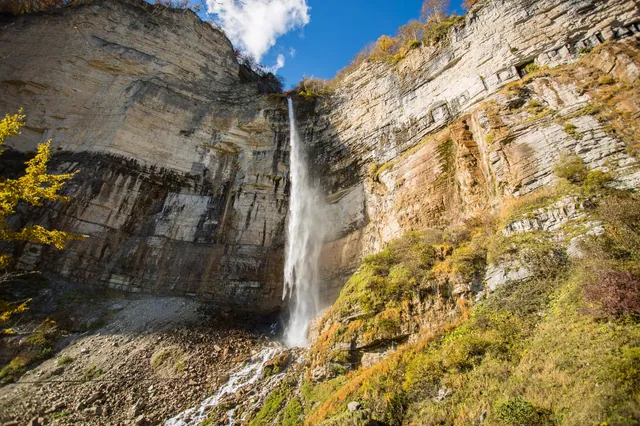
Kinchkha Waterfall is the obvious neighbour, about 8 km along the same road. A hundred-metre cascade among white limestone cliffs, entry 20 GEL, a zipline over the gorge for 50 GEL. The viewing platforms are short, so your legs get a rest after Okatse. A few kilometres from the waterfall, on the Tekhuri River, there are free thermal sulphur springs: a logical way to close the day if you still have the energy.
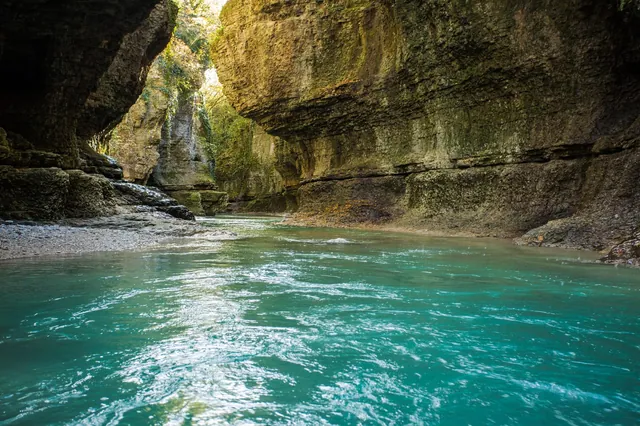
Martvili Canyon is about 45 km away, roughly an hour's drive. The complete opposite of Okatse: a boat on turquoise water up to a 12-metre waterfall, walls up to 70 metres, the whole ride 20 minutes plus a short walking loop. Entry 40 GEL, the boat another 20. One thing to note: Martvili is closed on Mondays too.
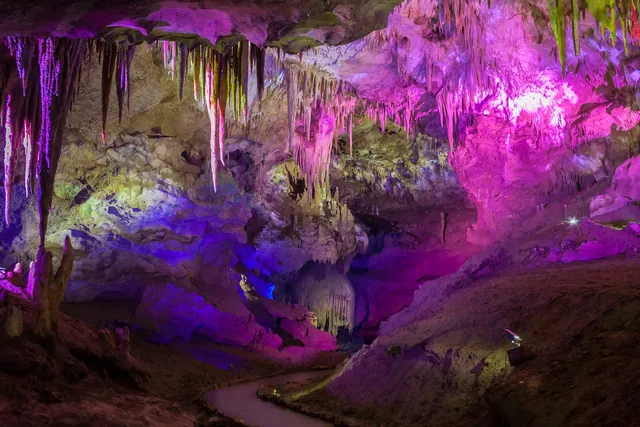
Prometheus Cave is about 50 km away, via Kutaisi. Inside are six halls, an underground river and a steady +14 °C. The route is 1.4 km and takes an hour to an hour and a half, entry 40 GEL, a boat along the underground channel another 30. It works well in the second half of the day, when it is hot above ground.
Combinations that work in a single day:
- Okatse at opening plus Kinchkha. The calmest option: on the walkway at 10:00, at the waterfall by 14:00, back in Kutaisi by evening. There are only a few kilometres between them.
- Martvili in the morning plus Okatse in the afternoon. Boat first, height second. Leave Kutaisi by 8:30 at the latest, otherwise you will be rushing at Okatse. Do not plan it for a Monday, when both canyons are closed.
- Prometheus in the morning plus Okatse after lunch. This works if the walkway is definitely open: the cave runs to a timetable, Okatse depends on the weather.
Three big sites in one day technically fit, but Okatse eats three hours and you arrive at the third stop with nothing left. With children, two is better.
On the way back into the city it is worth adding Gelati Monastery or the Sataplia reserve with its dinosaur footprints: both are close to Kutaisi and need an hour at most. Everything the city itself has is gathered in a separate piece on what to see in Kutaisi.
In short
Okatse is a story about half a day and your own legs. An hour's drive from Kutaisi, 30 GEL for entry, six or seven kilometres on foot and 780 metres above a drop, of which you will probably remember the last hundred.
Come at opening, watch the forecast and take a car: without one this corner of Imereti barely assembles into a route, and with one Okatse, Kinchkha and Martvili fit into a single day without hurrying.