
Geghard Monastery: Driving There From Yerevan
Geghard Monastery sits 40 km east of Yerevan. Drive time, road conditions, free entry, opening hours, winter access and a day trip with Garni.
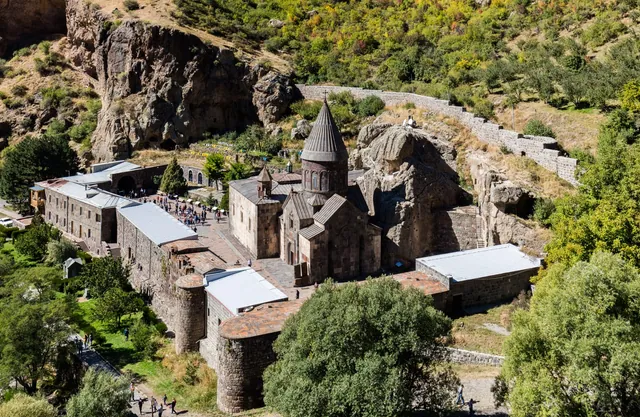
Geghard Monastery sits 40 km (25 miles) east of Yerevan, a drive of 45 to 60 minutes. Half the complex is carved straight into the cliff, entry is free and parking at the gate costs nothing. The final stretch is a narrow climb on decent asphalt. Pair it with Garni, which sits on the same road. Both pins are on the places map and in the route builder.
How long is the drive from Yerevan to Geghard?
Forty kilometres and roughly 50 minutes behind the wheel. The route is difficult to get wrong: east out of Yerevan through the Nork districts and Voghjaberd, down toward the Azat river gorge, then past Garni and the village of Goght. The road is marked H3 and ends at the monastery gate, with nothing beyond it.
Yerevan itself eats most of the time. Between 8 and 10 in the morning the eastern exit crawls, and twenty minutes can disappear inside the city. Traffic thins out after Voghjaberd.
Asphalt covers the whole route and the surface is good by Armenian standards. The descent to Garni is steep, with a couple of blind corners. Speed cameras cover this direction, and limits outside built-up areas shift between 60 and 90 km/h, so read the signs rather than the traffic around you.
Mobile coverage drops in patches after Garni. Download offline maps before you leave and search the pin as Geghard Monastery, since apps handle the Armenian spelling Geghardavank less reliably.
What the road does after Garni
It is 9 km from Garni to the monastery, about fifteen minutes. The lane narrows, hugs the wall of the gorge and climbs from roughly 1,400 to 1,700 m (4,600 to 5,600 ft). Guardrails are missing along much of it and the shoulder is loose in places.
Tour coaches cause more trouble than the tarmac. On tight bends they take the full width, and passing turns into a negotiation by hand signals. Goght is the last village. After it there is rock on one side and the river far below on the other.
Parking outside the gate is small and fills up in season. I usually skip the upper lot and leave the car two hundred metres downhill by the lower pastry stalls, because turning around there beats reversing between coaches. From there it is a three-minute walk uphill.
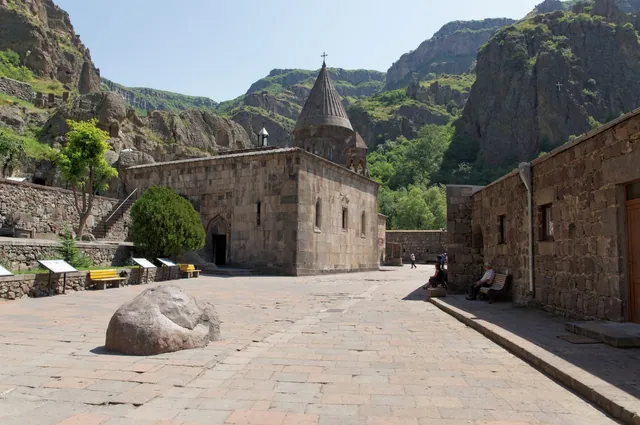
Churches cut into solid rock
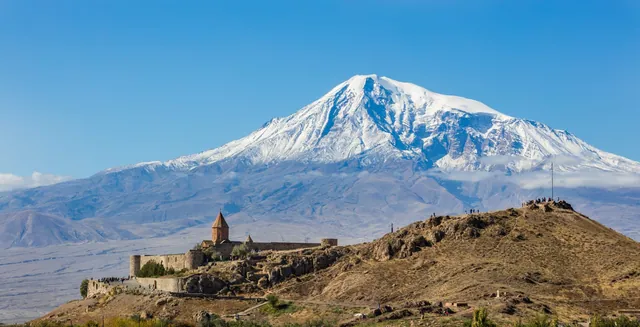
Katoghike, the main church, was built in 1215 under the Zakarian princes. From outside it reads as a conventional domed church, which is misleading, because the real thing begins behind it. The attached gavit, a vaulted hall serving as a narthex, has four columns and an opening in the roof that drops one shaft of daylight onto the floor.
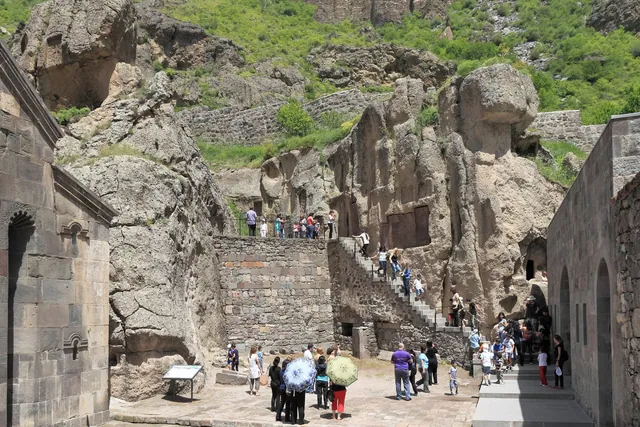
Passages lead from the gavit into chambers hollowed out of the mountain. The Avazan church dates to the 1240s and was cut by a master named Galdzag. A spring runs inside: water gathers in a basin against the wall and drips from the ceiling, so the floor never dries. You hear it before you find it.
Beside it stand the zhamatun (another vaulted hall) of Papak and Ruzukan and the tomb of the Proshyan family. A relief on the tomb wall shows a lion, an eagle gripping a lamb, and a chain linking the two. None of this was built and attached. It was removed from the cliff, columns and vaults included.
An external staircase climbs to the upper chamber. The ceiling is low and space is tight, which is why groups rarely bother with it. Khachkars, the Armenian carved cross-stones, cover the rocks above, several cut directly into the vertical face.
Inside the stone the temperature holds near 10°C (50°F) year-round. In July, with Yerevan close to 40°C, you feel the change on the threshold.
When Geghard is quietest
Coaches arrive in waves, roughly from 11:00 to 15:00. Before ten in the morning and after five in the afternoon the site is empty enough to hear the river and the wind moving through the gorge.
Singing happens in the rock chambers. Groups commission sharakans, medieval Armenian hymns, and the sound holds in the stone for several seconds after the voice stops. There is no schedule for it, so it comes down to timing.
I once left Yerevan at three in the afternoon expecting to fit in both Garni and Geghard. I reached the monastery at sunset, and the rock chambers are dim even at midday, so the Proshyan reliefs were effectively invisible. A late start in winter is not worth the drive.
Where the name Geghard comes from
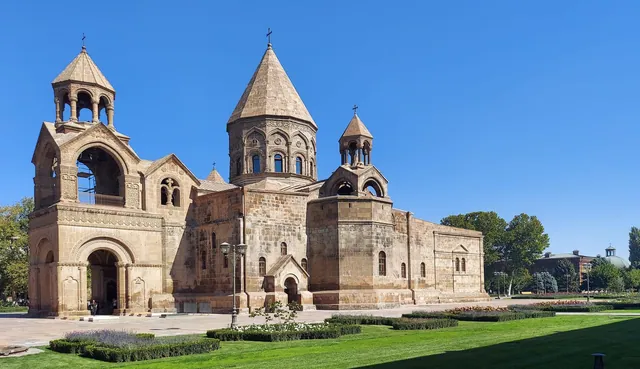
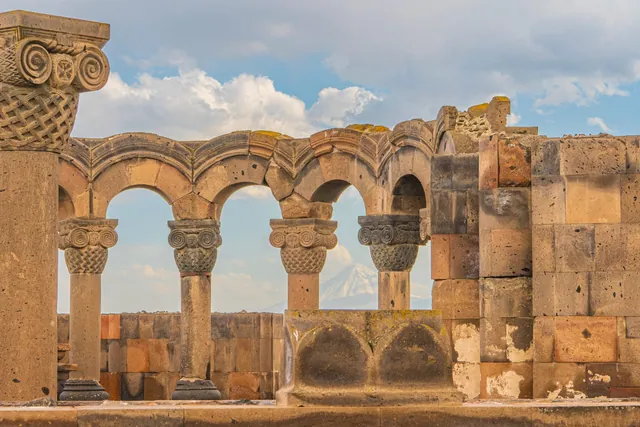
Geghardavank translates as monastery of the spear. Tradition holds that the lance from the Gospel account of the crucifixion was kept here for centuries. The relic now sits in the treasury at Etchmiadzin, while the name stayed with the monastery. On the western road out of Yerevan by Vagharshapat sits another UNESCO site, Zvartnots Temple.
The older name was Ayrivank, the cave monastery. Foundation is attributed to Gregory the Illuminator in the fourth century, and Arab raids destroyed the complex in the ninth. Everything a visitor sees today was built or carved in the thirteenth century.
Since 2000 the monastery and the upper Azat valley have been on the UNESCO World Heritage list.
How much does it cost to enter Geghard?
Entry is free and there is no ticket office. Donations are voluntary, candles run about 100 to 200 AMD, and parking costs nothing.
The grounds are usually open from around 9:00 to 18:00, closing earlier in winter with the light. Service times and access hours shift, so check before you drive out.
Stalls by the parking area sell gata, a sweet layered pastry with a butter and sugar filling, along with dried fruit and sujukh, walnuts threaded on string and dipped in grape must. Gata costs roughly 500 to 1,000 AMD (about 1.50 to 2.50 US dollars at 2026 rates). Haggling is not the custom and prices barely differ between stalls.
Getting to Geghard without a car
No scheduled service runs to the monastery. Minibuses go to Garni and Goght, which leaves 4 to 9 km to cover by taxi or on foot, uphill.
| Option | One way | Rough cost | What to account for |
|---|---|---|---|
| Own or rented car | 45–60 min | depends on class and season | your own schedule, Garni on the way |
| Taxi from Yerevan | about an hour | 8,000–12,000 AMD (20–30 USD) | hard to find a ride back, agree on waiting time |
| Minibus to Garni plus taxi | 1.5–2 hours with a transfer | from 300 AMD plus the taxi fare | irregular timetable, harder to return in the evening |
| Group tour | half a day | varies by operator | you usually get 40–60 minutes on site |
A rental makes sense on arithmetic rather than freedom. A taxi there and back with waiting time costs about what a day of rental does, and the car then covers Garni, the Symphony of Stones and dinner without anyone watching the clock. Prices on MY.DRIVE are final at checkout, with nothing added at pickup.
Is Geghard open in winter?
Yes. The monastery works year-round, the road is cleared and there is no mountain pass to close on the way. Snow lingers in the gorge far longer than in the capital (one March it was 15°C in Yerevan and packed snow still sat in the shade beside the walls).
One stretch causes problems in the cold months: the descent from Voghjaberd to Garni. Ice forms in the shadow of the rocks, especially after overnight rain. Keep the speed below your usual and check the tyres when you pick the car up.
December daylight is short and the gorge is in dusk by five. Leaving Yerevan before nine gives you the whole site in decent light.
What to bring and what to wear
Shoes with grip matter more than anything else you pack. The floors in the rock chambers are wet, the stone has been polished by eight centuries of footsteps, and the threshold between the gavit and Avazan is noticeably slick.
Bring cash in Armenian drams from Yerevan. Do not count on an ATM in Goght or at the monastery, since there most likely is not one. I have never come across a working machine out there, and the pastry stalls and candle boxes take nothing else.
Geghard is a working monastery. Cover shoulders and knees; a headscarf is not required for women, though many cover their hair inside the church. Photography is allowed, without flash during services.
A few small things help:
- a light jacket even in the heat, since it is cold inside the rock;
- your phone torch for the upper chambers;
- water, which is not sold on the grounds.
Where to eat along the way
There is no food at the monastery beyond the sweet stalls. The nearest tables are in Goght and Garni, in family-run cafés with hand-painted signs along the road.
The menu is much the same everywhere: khorovats, meat grilled over wood, vegetables from the same grill, homemade cheese with herbs, and lavash from a tonir, the clay pit oven sunk into the floor. Many households bake in front of guests and serve the bread hot, folded in four. In summer the tables move onto terraces above the gorge.
Checking prices in advance rarely works, as menus are often spoken rather than printed, so ask what things cost before you order. Cards are not accepted everywhere, which brings you back to the cash advice. Eating on the way back works better: it puts you at Geghard early, before the coaches.
What else fits into the same day
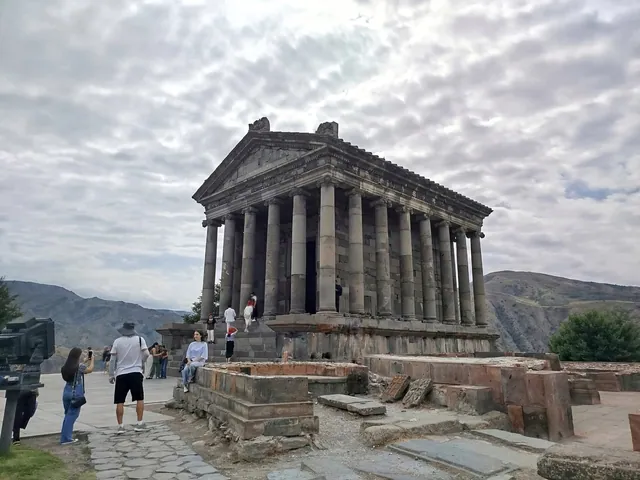
Garni, 9 km away, holds a first-century temple on the lip of the gorge, the only surviving Hellenistic-style structure in the country, along with the ruins of a bathhouse with a mosaic floor. An hour covers it.
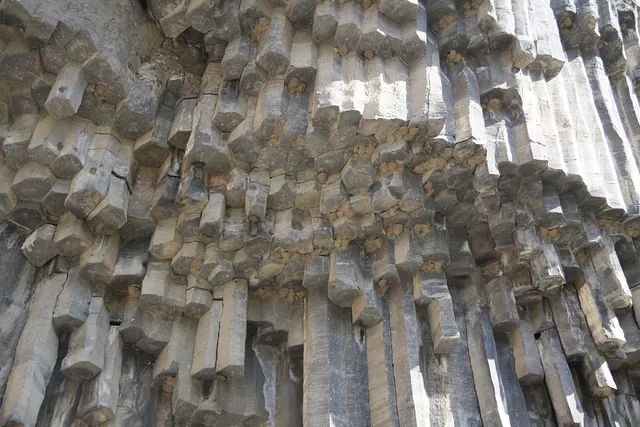
The Symphony of Stones lies lower in the same gorge: basalt columns tens of metres high, reached by a dirt track down from the village. In dry weather a normal car manages it slowly and carefully; after rain it is not worth the risk, and locals run visitors down in four-wheel drives.
Havuts Tar suits anyone willing to walk. The ruined monastic complex sits on the opposite side of the gorge, on a trail from Garni, 1.5 to 2 hours each way with almost no water or shade.
A workable shape for the day: leave Yerevan at 8:30, reach Geghard by 9:30 while it is still empty, Garni by noon, lunch in the village, then the Symphony of Stones and back in the city by 16:00.
Before you go
Geghard fits into half a day: 40 km of asphalt, an hour of driving, free entry and an hour on site. The decision that matters is the time of day rather than the transport, because arriving before eleven or after five means seeing the rock chambers without a queue at the gavit door. Cash, grippy shoes and a jacket handle the practical side. A car makes the link with Garni and the Symphony of Stones straightforward, with no taxi bargaining on the roadside.