
Dilijan: the drive from Yerevan, the monasteries and the seasons
Dilijan 95 km from Yerevan: tunnel or pass, Haghartsin and Goshavank monasteries, Parz Lake, weather, prices and driving times. A guide for a trip by car.
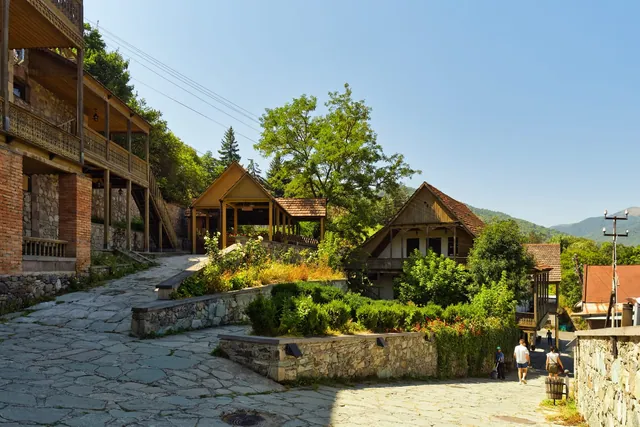
Dilijan sits 95 km from Yerevan, and the drive takes about an hour and a half along the M4 highway, over the Sevan pass and through the tunnel. It is a forest town at roughly 1,300 m, and in summer it runs 5–8 °C cooler than the capital. The main points around it are Haghartsin, Goshavank and Parz Lake.
How long it takes to drive from Yerevan to Dilijan
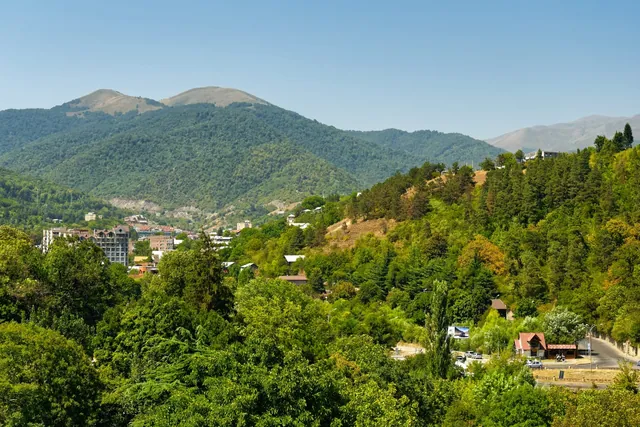
The town lies in Tavush province, in the valley of the Aghstev river, on the northern slope of the Sevan range. The surrounding peaks rise above 2,000 m, and the slopes are covered in beech and oak forest. In summer the shade here works more reliably than air conditioning.
The road from Yerevan runs along the M4 past Sevan: 65 km to Sevanavank, and another 35 km from there to Dilijan over the pass and through the tunnel. That timing assumes no traffic on the way out of the city; after ten in the morning the trucks come thick on the climb towards Sevan, and an hour and a half easily turns into two.
Everything beyond that is measured from Dilijan itself: 18 km to Haghartsin Monastery, 21 km to Goshavank in the village of Gosh, 11 km to Parz Lake, 35 km to Ijevan. The distances are short, but the roads are narrow and full of bends, so the average speed works out at about 40 km/h.
A day route is easy to put together in the route planner; the spots around the town are also on the map of places.
The tunnel or the old road over the pass
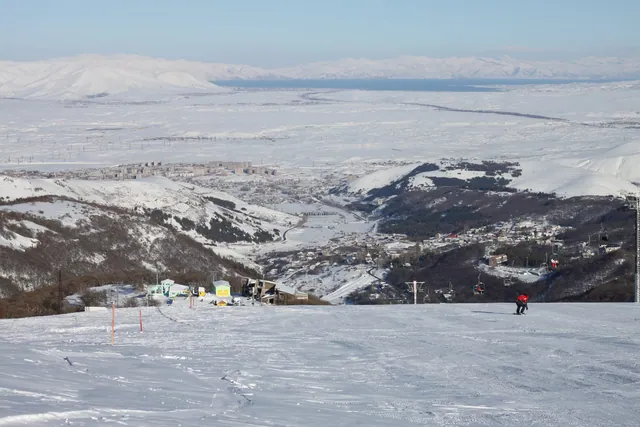
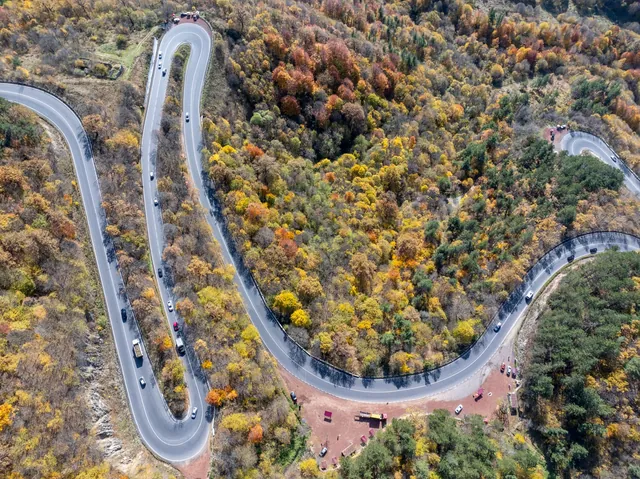
There are two ways down from the Sevan side into the valley. The main one goes through the Dilijan tunnel, about 2 km long: straight, lit and open year-round. The second, the old road over the Semyonovka pass at 2,114 m, adds around 20 minutes and a dozen hairpin turns, but from the top you see the whole bowl of Sevan at once.
I usually drive down through the tunnel and, if the day is clear and it is not winter, come back over the pass: the difference in time is small, and the picture is completely different. In winter that choice disappears. Snow lies up there from November to April, clearing the road is a low priority, and in bad weather it can be closed. None of this affects the trip itself: the tunnel duplicates the pass and stays open, so you will get to Dilijan either way. Checking road status on the traffic police resources is worth it only if you are going specifically for the views from the top.
What to keep in mind behind the wheel on this route:
- The elevation gain from Yerevan to the pass is about 1,100 m. The car loses response on the climb, and overtaking a truck on the hairpins is better left unplanned.
- Speed cameras stand both on the highway and at the entrances to villages, where the limit drops sharply. As a rough guide: 60 km/h inside settlements, 90 km/h outside them, but go by the signs.
- Petrol stations exist in the town of Sevan and at the entrance to Dilijan. On the pass itself there is almost no choice, so fill the tank in advance.
- CNG and LPG stations appear regularly along the M4, less often in the mountain section.
- The descent to Dilijan comes in long, drawn-out stretches. Brakes overheat, and a lower gear helps.
What to see in Dilijan itself
The historic centre is compact. Sharambeyan Street has been restored as an old quarter: carved balconies, ceramic and woodcarving workshops, a couple of cafés. An hour covers it.
In the centre stands a monument to the characters from the film "Mimino", with the famous line about the local water. The mineral springs really did make the town's reputation: sanatoriums have worked here since Soviet times, and some of the buildings are still in use. Dilijan counted as a climatic resort, and the logic was simple: forest, higher humidity than Yerevan, moderate summer heat.
One more point on the map is UWC Dilijan, the international college that opened in 2014. Tourists are not let inside, but the campus is clearly visible from the road to Ijevan.
You need cash in town. Dilijan has ATMs, and hotels and most cafés take cards, but in the villages around, payment goes in drams. Over several trips to Gosh I never once saw an ATM or a card terminal there.
Haghartsin and Goshavank
The two monasteries around the town are nothing like each other, and both are worth the drive.
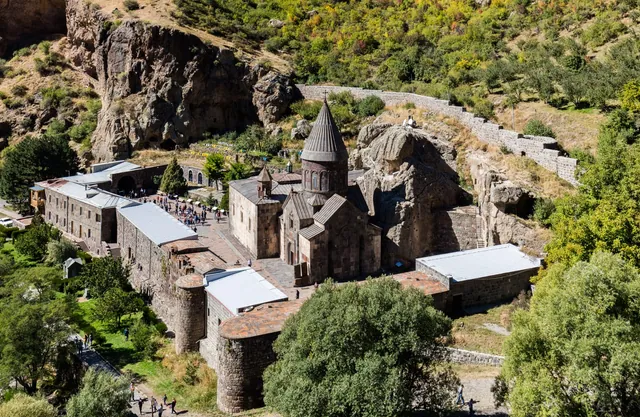
Haghartsin stands in the forest about 18 km from the centre. The turn off the M4 is east of town, then some 7 km up a narrow asphalt road among the trees. The complex was founded in the 10th century, and the main church, Surb Astvatsatsin, dates to 1281. Restoration of the complex finished in 2013, which is why the masonry looks unusually fresh. A 13th-century refectory and the remains of an old khachkar field survive nearby.
Goshavank is in the village of Gosh, roughly 21 km from Dilijan. The monastery was founded in 1188 and is linked to the name of Mkhitar Gosh, author of the Armenian law code. The main detail here is not the architecture as a whole but a single khachkar of 1291 by the master Poghos: the carving is so fine that from a distance it reads as lace. It stands by the wall of the church of Surb Grigor Lusavorich.
Entry to both monasteries is free, with parking by the walls. There are no ticket offices and no opening times; go by daylight. The road to Gosh runs through the village and the asphalt is broken in places, but a saloon car gets through without trouble.
Parz Lake and the national park trails
Dilijan National Park covers about 240 km² and takes in almost all the slopes around the town. Marked trails run inside it, and a section of the Transcaucasian Trail passes through the park.
Parz Lake lies 11 km from town at around 1,400 m. The last kilometres are forest road, with a middling surface. There are cafés at the water, boats and a zipline, and summer weekends get busy. A walking trail of about 8 km runs from Parz Lake to the village of Gosh; people often do it one way and leave the car at the lake.
Two small monasteries, Jukhtak Vank and Matosavank, can be reached on foot straight from Dilijan. The climb takes 30–40 minutes one way. Once I set off in trainers the day after rain and turned back halfway: the trail is clay and slides more on the way down than on the way up. Boots with a decent tread settle the question here.
Coverage drops almost immediately on the forest sections. Download offline maps in town, while the signal holds.
When to go to Dilijan
The season here is longer than in the high mountains, but the weather differs from Yerevan's noticeably.
- May and June. Everything green, the rivers full, rain frequent. (In late April the grass was already up in town, while snow still lay on the verges at the pass.)
- July and August. Around 25 °C by day, distinctly cooler in the evening. Hotels fill up, and people from Yerevan come here to escape the heat.
- October. The best month for the colour of the forest and for visibility. Days are shorter, and by five in the afternoon the valley is already in dusk.
- November to March. Quiet and cheap, some cafés closed. The roads to the monasteries are cleared, but after a snowfall the climb to Haghartsin is better put off by a day.
Rain falls more often here than in Yerevan, and the difference in precipitation is considerable. A windbreaker and a spare pair of shoes in the boot are not wasted even in July.
Is it worth renting a car just for Dilijan
Reaching the town itself is easy enough without a car. The difference starts where the highway ends. Prices are approximate for 2026, at about 390 AMD to the dollar; check before the trip:
- Marshrutka from Yerevan's Northern Bus Station. Roughly 1,500–2,000 AMD (about 4–5 USD) one way, departing when full. It takes you to central Dilijan; for the monasteries you then have to find transport.
- Taxi through an app. On the order of 15,000–20,000 AMD one way. Catching a car back out of town is harder than from Yerevan.
- Group tour. Usually Sevan plus Dilijan plus Haghartsin, about 15,000–25,000 AMD per person. You get 40–50 minutes at each stop.
- Car rental. Lets you fit Haghartsin, Goshavank and Parz Lake into one day without being tied to a timetable.
Car rental in Yerevan is better priced for two days at once: Dilijan joins up naturally with Sevan on the way there and with Ijevan or Vanadzor on the way back. If you are planning the turn-off to Parz Lake and forest roads, check the contract for whether leaving the asphalt is allowed.
The main road north runs through Dilijan to the Bagratashen crossing on the border with Georgia. From town to the crossing is about 100 km along the M4 via Ijevan.
Frequently asked questions
Is one day enough for Dilijan from Yerevan? Yes, if you leave early. The standard day route: out at 8:00, Sevanavank on the way, lunch in Dilijan, Haghartsin and Goshavank in the afternoon, back before dark. That is about 240 km of driving. Parz Lake and the walking trails will not fit into the same day.
Where to stay the night in Dilijan? The choice runs from guest houses in the residential streets to hotels on Sharambeyan and buildings of the former sanatoriums. In July, August and over long weekends rooms go early. In autumn and winter there are usually vacancies, though some of the smaller places close for the off season.
What local food to try? Cafés in the valley often serve river trout, jingyalov hats made with wild greens, homemade cheese and lavash from the tonir. A typical bill in a simple café is around 3,000–6,000 AMD per person, higher in hotel restaurants. In the villages cash is more reliable than a card.
Can you drive to Dilijan in winter in an ordinary car? The road through the tunnel is passable year-round, and after snowfall it is cleared first. Tyres have to be winter ones; that is a requirement for the season, not a suggestion. The old road over the pass is best ruled out entirely in winter.
What matters most
Dilijan is convenient because it fits both into a single day from Yerevan and into an unhurried two with a night. The minimum set for a day: the tunnel, the town, Haghartsin, Goshavank. If you stay longer, add Parz Lake and the national park trails, which take time and proper shoes. Bring cash in drams, a windbreaker and a full tank: the signal goes in the forest, cards do not work in the villages, and there are no petrol stations on the pass.