
Khor Virap: how to get there from Yerevan and what to see
Khor Virap 40 km from Yerevan: the drive along the M2, the climb down into the pit, when Ararat is visible and what the trip costs by rental car.
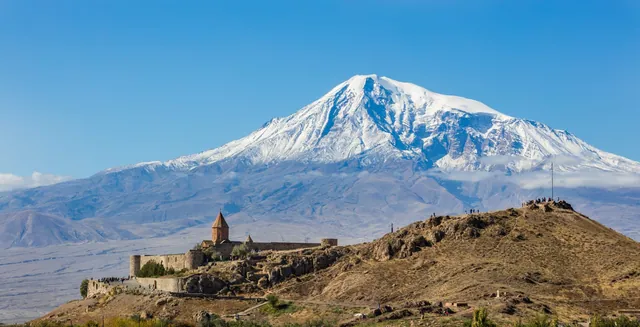
Khor Virap stands 40 km south of Yerevan, and the drive takes 45–60 minutes along the M2 highway plus one turn at the village of Pokr Vedi. There are two reasons to come here: the underground cell beneath the chapel, and the view of Ararat, which is closer from this spot than from anywhere else in the country. Entry is free, and so is the parking under the walls.
What Khor Virap is and why people come
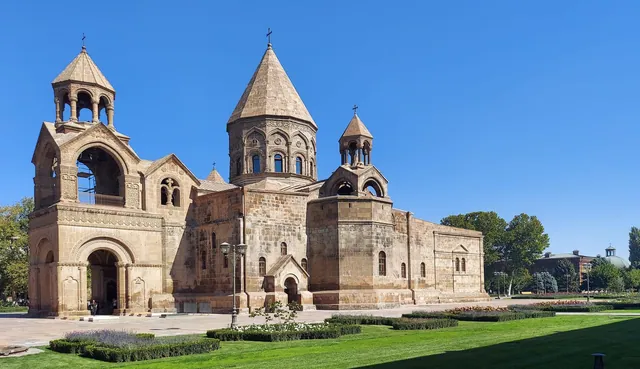
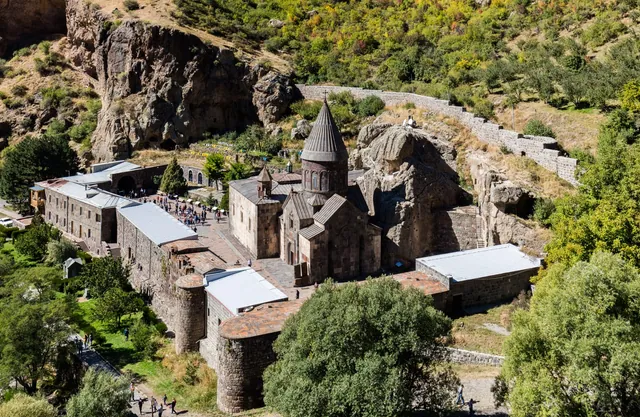
Khor Virap is a working monastery of the Armenian Apostolic Church on a low hill in the middle of the Ararat plain. The name translates from Armenian roughly as “deep dungeon”, and that is a literal description of what lies under the floor of one of the chapels.
Beneath the chapel, a pit about 6 metres deep is cut into the rock. Church tradition holds that Gregory the Illuminator spent thirteen years in it, imprisoned there by King Trdat III. In 301 Armenia adopted Christianity as its state religion, and Gregory became the first catholicos. The hill itself is far older than the monastery: this was the site of ancient Artashat, capital of the Armenian kingdom, founded in the 2nd century BC. The pit was part of the fortress buildings.
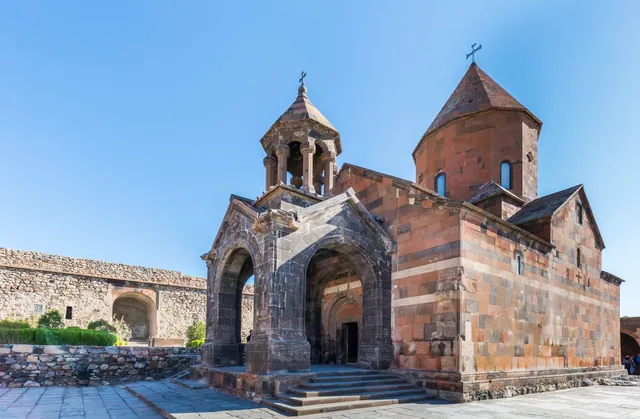
The buildings you see now are younger than the legend. The main church, Surb Astvatsatsin, was built in 1662, and the chapel of Surb Grigor above the pit stands on the site of an earlier seventh-century church. A low fortress wall runs around the complex, with a courtyard inside and a village cemetery along the eastern wall.
The second reason to come is purely visual. The summit of Masis (5,137 m) is around 30 km away in a straight line, with Sis (3,896 m) a little to the left. Masis and Sis are the two peaks of one massif, the one known in English as Ararat.
The mountain itself lies beyond a closed land border, and there is no way to reach its slopes from the Armenian side. Khor Virap remains the nearest accessible viewpoint, which is exactly why postcards, weddings and half of Armenian travel Instagram are shot here.
From the hill you can also see the border strip: the Araks river runs about a kilometre to the south. This is a border zone. There is no need to put a drone up here, and your phone may well pick up a foreign operator and slip quietly into roaming.
How to drive from Yerevan to Khor Virap
The route is simple and barely needs a navigator. From central Yerevan you head south, pass through the town of Masis and join the M2 highway (Yerevan – Yeraskh), follow it for roughly 25–30 km and turn right at the sign for Pokr Vedi. From there it is about 5–6 km through vineyards and fish farms to the foot of the hill.
The M2 is a decent road: four lanes in places, two in others, with an even surface. The turn-off to the monastery is narrow, single-lane each way, patched in a couple of spots and unmarked. Farm machinery and herds on the road are normal here, especially in the morning and towards evening.
Once I took a shortcut suggested by the navigator and ended up on a dirt track between fields. It finished at an irrigation canal with no bridge, and getting back took fifteen minutes. The sign for the M2 is perfectly visible, and there is no need to look for alternative routes.
A word on cameras. Speed enforcement on the M2 is dense: the limit outside settlements is usually 90 km/h and 60 km/h in villages, and the signs marking the start of a village apply literally. The fine goes to the owner of the car, which means the rental company, and is passed on to the renter after the fact. Check current limits and amounts on the website of the Armenian Police; this is a guide, not a legal reference.
Parking is free, right under the monastery wall, two or three minutes on foot uphill from there. At weekends and in the hour before sunset the spaces are taken by tour coaches, and you end up parking a little further down the slope.
The points around the monastery are easy to gather in the route planner; the site itself is also on the map of places.
Distances and driving times
| From | Distance | Driving time |
|---|---|---|
| Central Yerevan | about 40 km | 45–60 min |
| Zvartnots Airport | about 50 km | 50–70 min |
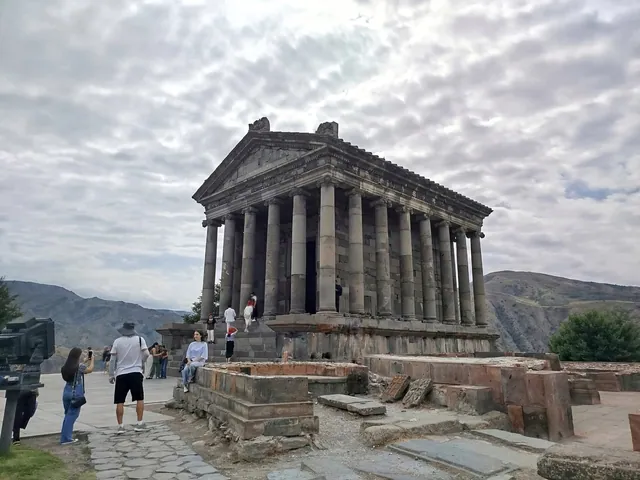
| Garni | about 55 km | 1 h 10 min |
| Areni | about 65 km | 1 h |
| Noravank | about 80 km | 1 h 15 min |
| Sevan, the town | about 105 km | 1 h 45 min |
These times are for daytime driving without traffic. Leaving Yerevan in the morning rush hour, add twenty minutes, and the same again coming back in the evening.
Going down into the pit: what to know
The entrance to the cell is in the chapel of Surb Grigor, to the right of the main church. There is a metal lid in the floor, and under it a narrow vertical ladder of iron staples and rods. You climb down backwards, holding the rails with both hands.
I usually go down first, before a group has gathered at the chapel, and wait a couple of minutes at the bottom. Two people cannot pass each other on the ladder, and traffic in both directions is a regular thing here: someone is already climbing up while someone else has started down from above.
At the bottom is a small round chamber about four metres across, with oil lamps, a small altar and icons. There is little air; it is stuffy in summer, cool and damp in winter. Looking around takes three or four minutes, and any longer is simply uncomfortable.
Practical limitations:
- A skirt, a dress or heels make the climb awkward and unsafe
- Your hands will be covered in dust and rust, so wet wipes come in handy
- Children under about seven or eight struggle on the ladder, and toddlers are not carried down
- If you are claustrophobic, better not to start: turning around halfway is not easy
- Leave backpacks and bags at the top, your hands need to be free
There is a second pit nearby, shallower and wider, with a comfortable staircase. Access to it is unrestricted, and it is often mistaken for the famous dungeon.
The monastery has no official opening hours. The grounds are accessible from early morning until dark, and the underground chamber is usually open from around 9:00 to 17:00–18:00, closing earlier in winter. Do not turn up right on sunset hoping to go down: the lid can be closed without warning.
When to visit Khor Virap to see Ararat
In the morning. The mountain is most often clear until 10 or 11, after which haze builds and the outline blurs by midday. Morning light also falls on the slope head-on; in the evening you are shooting into the sun and get a silhouette.
Visibility is best the day after rain or strong wind, when the dust has been blown off the plain. That works in any season, July included.
| Season | The view of Ararat | What to keep in mind |
|---|---|---|
| December–February | Clear days give the sharpest picture, but fog often covers the plain | Fog can sit until midday, and roads are slippery in the morning |
| March–May | Good visibility, clean air | Poppies on the hillsides in late April, plenty of school groups |
| June–August | Haze almost every day, the mountain looks pale | Heat up to +38, no shade on the hill |
| September–November | Excellent clarity after the first rains | Short days, dusk by five in the afternoon |
(I came here twice in February, and both times the fog over the plain held until the afternoon; the mountain never showed at all, even though Yerevan was sunny.)
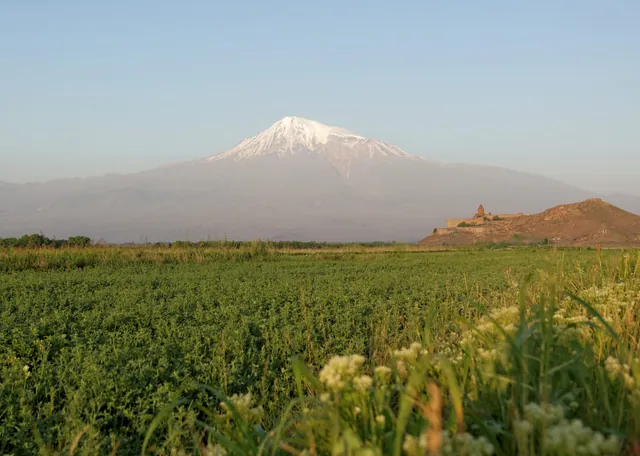
A couple more seasonal details. From April, storks perch on the poles along the road and the nests are visible straight from the highway. In summer the fish farms around Pokr Vedi draw herons, the water in the canals is drawn down, and there is noticeably more dust on the turn-off.
The weather forecast for Yerevan works badly here. The Ararat plain sits lower than the city and has its own picture: Yerevan is at roughly 1,000 m, the plain by the monastery at about 850 m. In summer the difference in temperature reaches three or four degrees, not in the plain's favour.
What there is on the monastery grounds
Entry is free, and there is a donation box by the gate. No tickets, no ticket office, no turnstiles.
The dress code is relaxed, but this is a working church: shoulders and knees are better covered, and a headscarf is not required for women in Armenian churches. Wraps are sometimes laid out at the entrance to the main church.
White doves are sold at the gate: releasing a bird over the plain is a local wedding and tourist tradition. Ask the price on the spot, as it is not fixed and is open to discussion. The same stalls sell water, dried fruit, pomegranate wine and souvenirs.
There is no café on the grounds. The nearest proper food is on the M2, in the fish restaurants near the villages of Masis and Sis, or in Vedi. 40–60 minutes is enough for the whole complex, or up to an hour and a half with a queue for the climb into the pit.
Money, fuel and mobile coverage
You need cash in drams. The stalls, the doves, donations, small parking change: all of it is cash only. Over several trips here I have never seen a working ATM either in Pokr Vedi or at the turn-off from the highway, so withdraw money in Yerevan or in Artashat.
Fuel is not a problem: petrol stations on the M2 are frequent, gas ones (CNG and LPG) included. Plenty of Armenian cars run on gas, and a rental car may well turn out to be bi-fuel, so check that when you pick it up. On the last 6 km to the monastery there are no stations at all.
A rough guide to costs: the Yerevan – Khor Virap – Yerevan loop is about 80 km, and at 7 l/100 km that comes to roughly 6 litres of petrol. At 2026 prices that is around 3,000–3,500 drams (about $8–9). Fuel prices change, so check on the spot.
Coverage on the plain is steady, and 4G reaches both the car park and the hill. Near the border your phone sometimes switches to a neighbouring country's network. Turn off data roaming in advance, or you will get a bill for ten minutes of looking at a map. An offline map is worth downloading anyway: it comes in useful further on, if you head towards Vayots Dzor.
Where to go next on the same day
Khor Virap is rarely a whole day's destination on its own: the visit is short and the drive is easy. The logical continuation runs south-east along the same M2.
- Areni, 65 km, about an hour. Wineries along the highway, tastings, the Areni-1 cave with its excavations. Some places take you without a booking, larger ones are better reserved.
- Noravank, 80 km, 1 h 15 min. The turn-off from the highway leads into a narrow gorge with red cliffs; the last 8 km are winding, but the asphalt is fine.
- The fish restaurants on the M2 between Masis and Ararat. Trout and crayfish from the local farms, with prices on a par with Yerevan.
The full loop from Yerevan to Khor Virap, Areni, Noravank and back is about 250 km and 8–9 hours with stops. You need to leave at seven in the morning, otherwise you will miss Ararat and reach Noravank as it closes.
In winter the route is passable end to end: there are no passes on it and the elevations are low. But check the climb to Noravank in advance during snowfall, as the narrow road in the gorge is not cleared instantly.
Rental car, taxi or marshrutka
| Option | Timing | Order of costs |
|---|---|---|
| Rental car | Full flexibility, a 6:30 start is realistic | Fuel around 3,000 AMD for the loop, plus the daily rate |
| Taxi from Yerevan | 45–60 min one way | Roughly 4,000–6,000 AMD one way, more with waiting for the return |
| Marshrutka to Pokr Vedi | Runs rarely, plus 2 km on foot to the hill | A few hundred drams, check the timetable at the bus station |
| Group tour | 4–5 hours, often combined with Noravank | Depends on the operator |
The main argument for a car here is not abstract freedom but the time of day. Tour coaches arrive by 10 or 11 in the morning, when the mountain is already in haze and a queue has built up at the ladder into the pit. Renting a car and setting off at half past six is cheaper than a taxi with waiting time, and it gives you that morning picture people come here for. Beyond that, you are tied to nothing further along the M2.
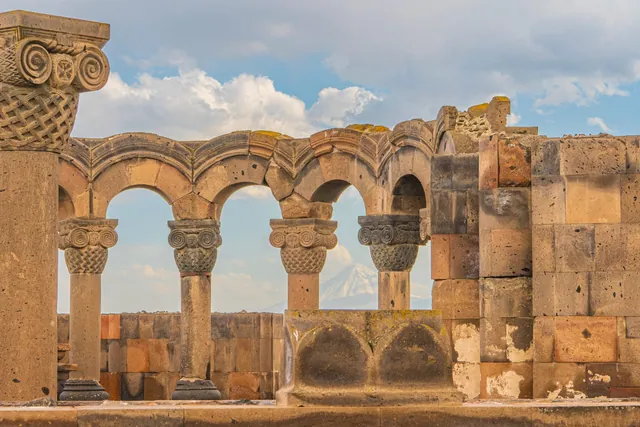
Car rental in Yerevan is available both in the city and at Zvartnots Airport, and it is about 50 km from the airport to the monastery, so you can stop here on your arrival day if your flight lands in the morning. The Zvartnots temple itself sits on that same western highway and takes about an hour.
Frequently asked questions
Do you have to pay to enter Khor Virap? No. Entry to the monastery grounds and the climb down into the pit are free, and there are no ticket offices or tickets. There is a donation box at the entrance, and the amount is up to you. The only things you pay for are souvenirs, water and the doves at the gate, all of it in cash drams.
How long does a visit to Khor Virap take? Allow 40–60 minutes for an unhurried look around: the main church, the chapel with the pit, a walk along the wall, photos from the hill. In high season and at weekends the queue for the ladder into the underground chamber adds another 20–30 minutes. With the drive from Yerevan and back, the trip takes 3–4 hours.
Can you go down into the pit with a child? The ladder is vertical, narrow, made of iron staples, with nothing to catch you. Children of around eight and up manage on their own; for younger ones the climb is unsuitable, as you cannot get through carrying them. If your child is small, one adult goes down while the other waits up in the courtyard, where there is somewhere to sit in the shade of the wall.
What should you wear for a trip to Khor Virap? Covered shoulders and knees for entering the church, comfortable shoes with non-slip soles for the ladder into the pit, and a windbreaker in any season: the wind on the open hill is stronger than down below. In summer a hat and water are essential, as there is almost no shade on the grounds.
Can you combine Khor Virap and Noravank in one day? Yes, that is the standard pairing. They are about 80 km apart along the M2, roughly 1 h 15 min of driving. Leave Yerevan at 7:00, Khor Virap by 8:00, Noravank by 11:00, then back with a stop in Areni. That comes to about 250 km and 8–9 hours.
What matters most
Khor Virap is a short trip with a high return: 40 km from Yerevan, an hour on the road, an hour on site. There is one rule that counts, and that is to leave early: after eleven Ararat is usually blurred by haze, and there is a queue at the entrance to the pit.
Take cash in drams and comfortable shoes for a vertical ladder, and fill up in the city. If your whole day is free, carry on along the same highway to Areni and Noravank; the detour is small, and the route folds into one logical loop.