
Garni Temple: how to get there from Yerevan and what to see
Garni Temple 28 km from Yerevan: the drive, the entry fee, the descent to the Symphony of Stones and pairing it with Geghard. Driving times, seasons and what to bring.
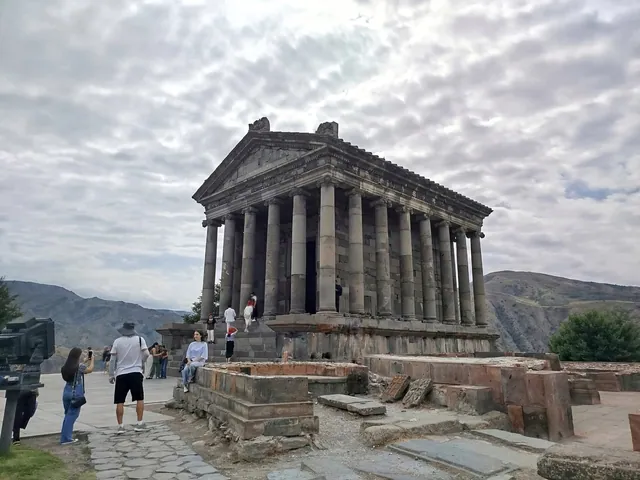
Garni Temple stands 28 km from Yerevan, and the drive takes about 40 minutes on asphalt. It is a first-century building, the only surviving Greco-Roman colonnade in the country. An hour covers the complex itself, and roughly the same again goes on the walk down into the gorge to the basalt columns.
What this place is actually called
Garni is a village in Kotayk province, east of the capital. The building on the promontory above the gorge goes by several names: Garni Temple, the pagan temple, the Temple of Mihr. The last one comes from the theory that it was dedicated to Mihr, the sun deity of the pre-Christian pantheon. There is no solid evidence for it, so guidebooks tend to stay neutral.
Officially the site holds the status of a historical and cultural museum-reserve, and the temple stands inside fortress walls. Hence the third name you will see on the signs: Garni Fortress.
Type Garni Temple into your navigator. A search for "Garni" takes you to the village as a whole, while the entrance to the complex is in its eastern part, with its own car park and ticket office.
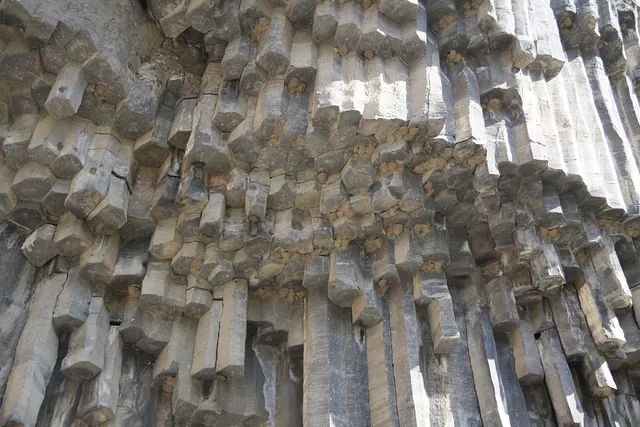
The basalt columns below, in the gorge of the Azat river, go by the name Symphony of Stones. It is a separate stop, you have to go down to it on your own, and the sign from the centre of the village is barely visible.
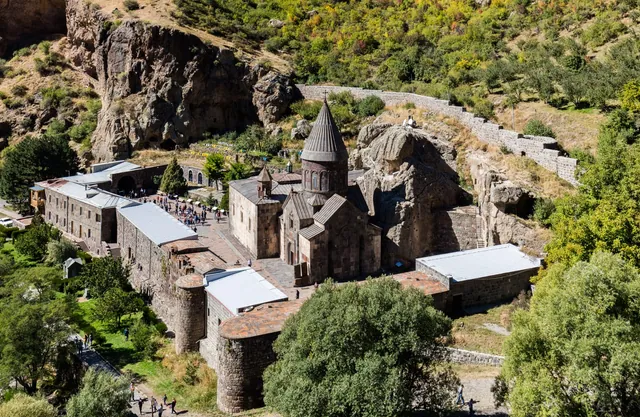
And one more mix-up that costs people half a day. Garni is regularly confused with Geghard. These are two different places 9 km apart, and it makes more sense to come here for both than to pick one instead of the other.
The points around the village are easy to gather in the route planner; the site itself is also on the map of places.
How long the drive from Yerevan to Garni takes
28 km, 35–45 minutes with no traffic. The road leaves through the eastern districts of Yerevan, climbs to Voghjaberd and then drops down to the village in switchbacks.
The asphalt is decent almost the whole way. It gets narrow on the switchbacks, where oncoming minibuses cut the corners. Hold your lane and do not build up speed on the descent: there are no barriers in places.
Cameras stand on the way out of the city and along the highway, and the network in Armenia is dense. The limit in settlements is 60 km/h, outside them usually 90. A camera fine goes to the owner of the car, which means the rental company, and it is passed on to the renter together with a processing fee. This is a guide, not a legal reference: check current rules and amounts on the traffic police website.
The difference between arriving at nine and at eleven is bigger than the map suggests. In my experience, by eleven there are three or four tour coaches in the car park at the entrance, and there is no room to move on the viewing platform.
Fill up in the city. There are few petrol stations along the way, and the choice in Garni itself is limited. A full tank covers the round trip with room to spare, including the descent into the gorge and Geghard.
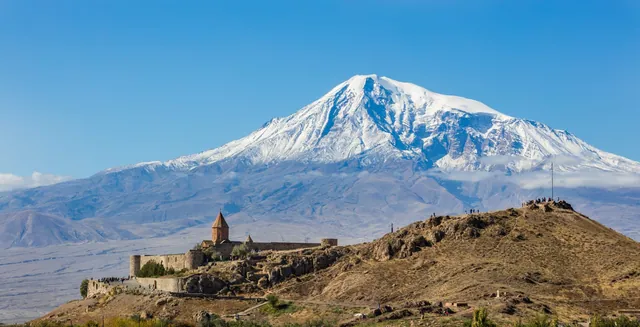
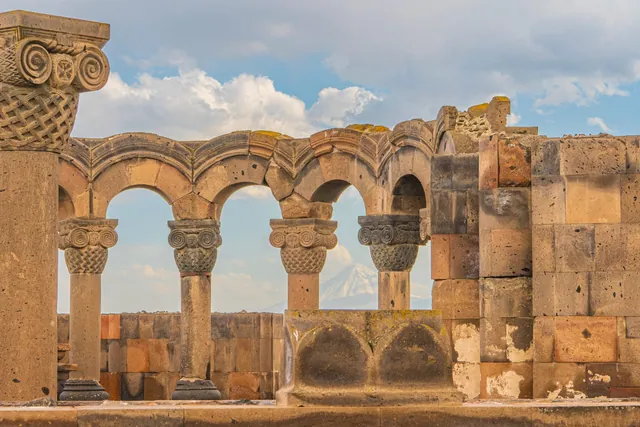
In clear weather you can see Ararat from the platform above the descent. In autumn and winter the mountain is usually hazed over until midday, so do not count on that shot to a schedule. If you want Ararat up close, it makes more sense to drive to Khor Virap. For a short stop closer to the city, see Zvartnots.
How to get to Garni without a car
There are several options, and what separates them is not so much the price as the number of stops you will manage to see.
| Option | Time on the road | Rough cost | What to keep in mind |
|---|---|---|---|
| Rental car | 40 minutes | at the rental rate | the gorge and Geghard the same day |
| Taxi through an app | 40 minutes | 3,000–5,000 AMD one way | catching a car back from the village is harder |
| Taxi with waiting | 4–6 hours | 15,000–25,000 AMD per car | the price is agreed before you set off |
| Marshrutka | 50–70 minutes | a few hundred drams | takes you to the village, not to the gorge |
| Group tour | a full day | from 8,000–10,000 AMD per person | fixed time at each stop |
Prices are approximate for 2026, so check before you travel.
A rental car pays off in exactly two cases: if you want to go down to the columns, and if you are planning Geghard. The marshrutka only takes you as far as the village, the last services back leave early, and you will have to walk to the Symphony of Stones: 25–30 minutes down, about forty back up. A taxi with a driver for the day costs much the same as a day of rental, but it ties you to someone else's timetable and to his idea of how long a monastery takes.
What to see inside the fortress
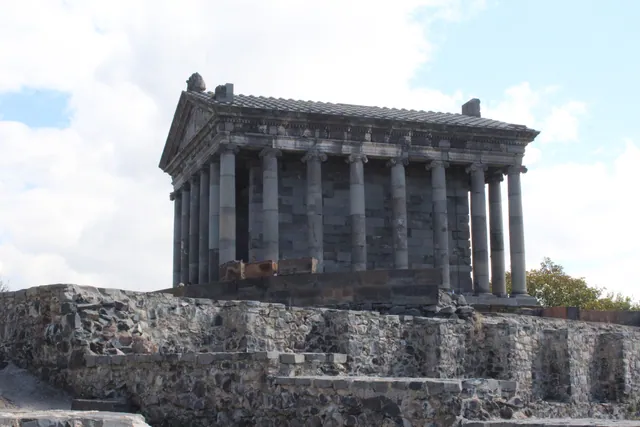
The temple was built in the first century and stood almost whole until the earthquake of 1679. What you see now was reassembled in 1969–1975 from the fallen blocks. The added sections are lighter than the original basalt and easy to tell apart by eye, especially on the columns. There are 24 of them, the order is Ionic, and the stairway has nine unusually high steps.
Inside there is one small chamber. There is nothing to look at in it; the whole value is on the outside.
Next to the temple, under a canopy, lie the foundations of a Roman bath with a mosaic floor and a Greek inscription. The mosaic sits behind glass, shooting into the light is pointless, so come round to the other side of the canopy.
Further along the grounds are the remains of the fortress walls and the foundations of the palace and a seventh-century church. Information boards are few, so a guide at the entrance or an audio guide downloaded in advance changes the experience of the place more than it might seem at first.
The edge of the promontory works as a viewing platform: below you see the Azat river, and opposite, on the slope, the ruins of Havuts Tar monastery. There is almost always a wind pulling along the gorge (in March I stood there in a T-shirt and regretted leaving my jacket in the car, even though it was +18 in Yerevan).
40–60 minutes is enough for an unhurried look at the complex. With a walk through the village, allow an hour and a half.
The Symphony of Stones: down into the gorge
A narrow road runs down from the village to the river, roughly 1.5–2 km of switchbacks with sharp turns. There is asphalt, broken up in places. It is wide enough for one car, and you pass in the lay-bys.
Once I drove down straight after rain in a low car and then spent a long time picking my way around washouts and scree spilled onto the verge. After a heavy downpour I do not go down there any more; walking is better.
At the bottom there is a car park by the water, a few cafés and a bridge. The basalt columns run along the gorge wall for several hundred metres, and at the most spectacular spots the wall reaches several dozen metres high. The lava here cooled slowly and split into almost regular hexagons, hence the resemblance to organ pipes and the name itself.
On foot it works out at 25–30 minutes down along the same road, and about forty back up the hill. In summer at midday the climb is hard going: there is practically no shade on the way.
From the columns a path leads up the gorge towards Havuts Tar. That is about an hour each way, with a ford across the Azat and stretches of loose scree. In spring, in high water, the ford is not always passable, and there is no bridge at that point.
Where to eat and stay the night
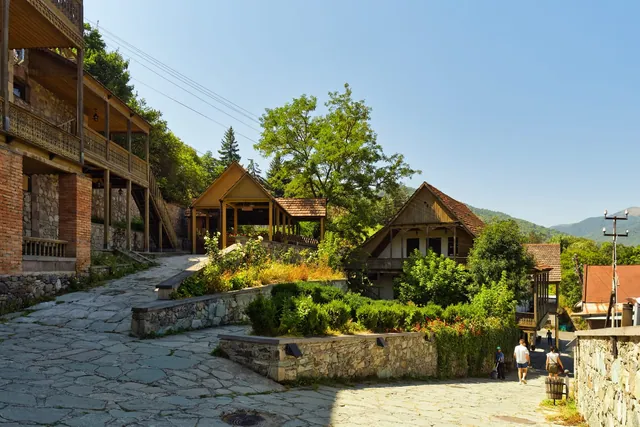
The village has several guest houses and family cafés, and some of them also take people who have simply come for lunch. The usual cooking is khorovats, tolma, homemade cheese and greens from the garden, in large portions. Lunch comes to about 5,000–8,000 AMD a head, and a night in a guest house is more often in the 10,000–20,000 AMD range for a room. The figures move with the season and run higher in summer.
Almost every yard that works with tourists will show you lavash being baked in a tonir. This is not a performance staged for visitors: the tonirs in Garni are in constant use, and the bread is sold afterwards. Lavash straight from the oven is cheap, and it makes sense to take some down into the gorge with you rather than eat at a café by the river.
A night in the village is worth it if you are heading further east or want to see the temple at sunrise, before the coaches. There is no point in staying for the temple alone: from Yerevan this is a half-day trip.
The village also has a working church, not far from the central square. It is noticeably plainer than the temple and Geghard, and it is mostly locals who go in.
Is it worth combining Garni and Geghard in one day
9 km, about 15 minutes on asphalt up the valley. The road is a dead end and finishes at the car park by the monastery, so there is nowhere to get lost.
Geghard is a monastery complex, part of it carved directly into the rock. It was added to the UNESCO list in 2000 together with the upper Azat valley. Entry is free. By the car park they sell dried fruit, nuts in grape juice and gata, at prices above the Yerevan markets.
Garni plus Geghard, starting out from Yerevan, takes 4–6 hours including the drive and the descent into the gorge. With lunch in the village that makes a full day, but not an overloaded one.
At the monastery it is sensible to cover shoulders and knees. Inside the carved halls it is dark and cool even in August, the change from outside is noticeable, and in one of the chambers light falls from above through an opening in the rock and you can hear water dripping.
When to go to Garni
The complex is open year-round. The village sits at about 1,400 m, roughly 400 m higher than Yerevan, so in summer it is a little easier to breathe here. There is almost no shade on the grounds, and you feel that as early as June.
April, May, September and October give the most comfortable temperatures and decent light for photographs. In July and August it is better to walk to the columns before eleven or after five in the evening.
In winter the road to the village is cleared, but the descent into the gorge is not always: ice holds on the switchbacks longer than on the highway. From December to February, check the state of the road before you set off. Four-wheel drive is not necessary, winter tyres are.
Groups arrive in a wave from ten until one. Before nine in the morning the grounds are quiet, and all you hear is the river below.
How much entry to Garni Temple costs and what to bring
A ticket for an adult foreign visitor is around 1,500 AMD (about 4 USD in 2026), with concessions for students and children. Prices are revised, so check at the ticket office. Opening hours are seasonal: in summer the complex stays open longer, in winter it closes noticeably earlier. If you are planning to arrive for sunset, check the timetable in advance.
Take cash in drams. Over several trips to Garni I have never found a working ATM in the village, and the cafés down below, the lavash oven and the gata sellers do not always take cards.
What to put in the car:
- cash in small notes
- water, at least a litre per person in summer
- shoes with grippy soles if you are planning the descent or the path
- a windbreaker or fleece: the gorge and the viewing platform are noticeably colder
- offline maps, downloaded in advance
- sun protection, as there is almost no shade on the grounds
Coverage in the village is steady, and it drops out at the bottom of the gorge and on the path to Havuts Tar.
What matters most
Garni is 28 km from Yerevan and under an hour behind the wheel. The complex itself takes about an hour, the descent to the Symphony of Stones another hour and a half, and with Geghard it adds up to an unhurried day of 4–6 hours. Without a car you will realistically see only the temple: no public transport goes to the columns or the monastery. Take cash, water and an extra layer, and after heavy rain do not drive down into the gorge in a low car.