
Symphony of Stones, Garni: how to get there by car
Symphony of Stones near Garni: 28 km from Yerevan, the 2 km descent into the Azat gorge, road conditions, parking, seasons and transport options.
The Symphony of Stones sits in the Azat river gorge below the village of Garni, about 28 km (17 miles) from central Yerevan. The paved road to the village takes around 40 minutes, and from there a rough track drops roughly two kilometres to the river. There is no ticket office and no entrance fee.
The spot is easy to open on the places map and to assemble in the route builder with the neighbouring stops.
What you actually see down there
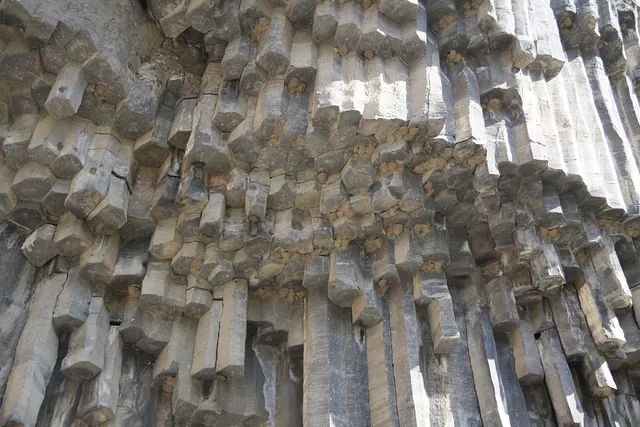
Above the river the gorge wall is built out of straight stone columns. Most have five or six sides. Some stand upright, others hang from above in bunches that look like organ pipes, which is where the local nickname, the basalt organ, comes from.
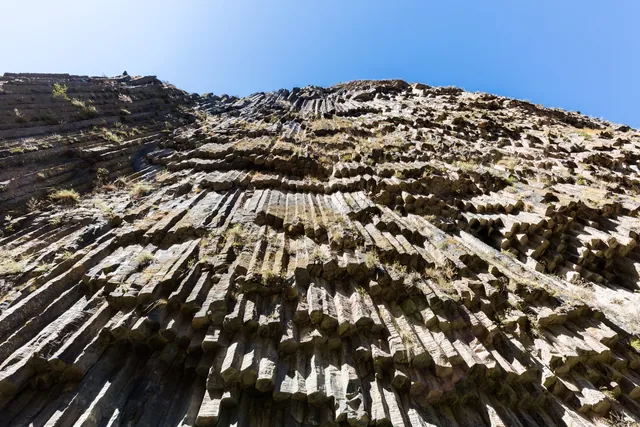
Sections of the wall reach several dozen metres. From the flat ground at the bottom you can watch the columns change angle along the riverbed: vertical in one stretch, fanned out in the next, almost horizontal directly overhead.
The upper Azat valley is on the UNESCO World Heritage list together with Geghard monastery. That status brings no infrastructure with it. There are no ticket booths, no railings above the water and no marked viewing platforms.
Why the rock split into columns
A lava flow from the Gegham highlands once filled this valley. It stopped, settled and began to cool. Cooling lava contracts, and contraction builds stress inside the hardening rock that has to be released as cracks.
The cracks take the cheapest route available. They start from many separate points and meet at roughly 120 degrees, and that network produces mostly hexagons, with some five and seven sided shapes mixed in. Each crack then grows downward, following the cooling front, and slices the flow into separate prisms through its whole thickness. Geologists call this columnar jointing. The same process built the basalt pavements of Ireland and Iceland.
Column thickness depends on how fast the heat escaped. Slower cooling produced fatter, more regular columns. In the Azat gorge the range is visible without any training: columns you could barely get your arms around stand next to ones no thicker than a pencil.
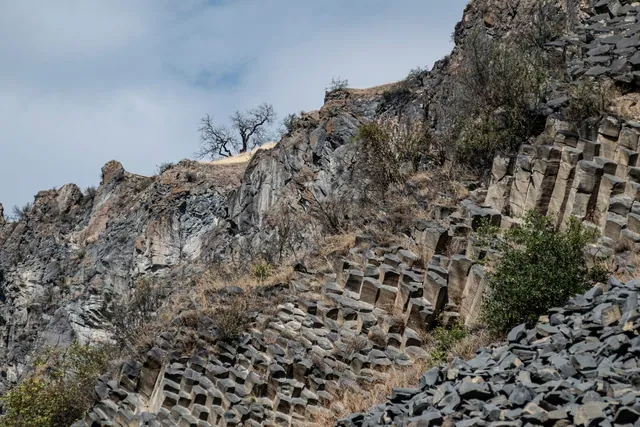
The tilt has the same explanation. Columns always grow perpendicular to the surface the flow was losing heat through. Where the lava settled on the flat valley floor they stand vertical. Where it pressed against a slope or wrapped around an obstacle, they swing sideways and fan out.
One thing was still missing. Over hundreds of thousands of years the Azat cut straight through the flow and opened it up like a cross section. What you see from the gorge floor is the inside of the lava mass rather than its surface. Broken prisms lie loose near the water, and they are the easiest place to look at the facets up close and get a sense of scale.
How far is the Symphony of Stones from Yerevan?
The drive from the city centre to Garni takes 35 to 50 minutes, depending on how quickly you clear Yerevan itself. Between eight and nine in the morning the eastern exit routes cost you an extra quarter of an hour.
Asphalt runs the whole way and the surface is in reasonable shape. Past the settlement of Voghjaberd the road reaches the edge of the plateau and turns into a series of switchbacks with blind corners, where overtaking makes very little sense. Speed cameras are dense on this direction, inside villages and on open stretches alike, and posted limits change often. Watch the signs rather than the traffic around you.
Garni lies about 400 metres higher than Yerevan. You feel the difference in temperature as you arrive.
The descent into the gorge: will a normal car make it?
A narrow road leaves the village centre past Garni Temple and drops toward the river. It runs about 2 km, and the surface is a mix of concrete, broken asphalt and loose stone. The gradient is serious and the width is mostly one car, with occasional pull-outs for passing.
In dry weather an ordinary sedan handles it if you go slowly and stay in first gear on the way down. Rain and winter change the picture completely: clay, ice on the shaded side, no barriers anywhere. Local drivers with 4x4s usually wait near the turn at the top and offer to run you down and back. The price is negotiable, so agree on it before you get in.
The first time I went, I left the car by the temple and walked down in July at about two in the afternoon. Going down took half an hour and felt easy. Climbing back up an open slope without a single tree took nearly an hour and a litre and a half of water. If you plan to walk, walk in the morning.
Where to park and where to walk
At the bottom the road opens onto flat ground beside the river. There is room to turn around and park, but not much of it. On weekend afternoons cars line the edge of the track and passing an oncoming vehicle gets awkward.
Everything past that point is on foot. Reaching the wall itself takes about five minutes, along the river over stones and the remains of the old track. A small bridge crosses the water, and from there a route climbs up the gorge toward the ruins of Havuts Tar monastery. That one is a proper half-day walk with real elevation gain and no signposts.
From experience, drive down before nine in the morning. The reason is not light or crowds. It is that a single-lane track is far easier to drive when nobody is coming up the other way.
How much time to plan
The Symphony of Stones itself takes less time than people expect. Five minutes from the parking area to the wall, then another forty or so to walk along the riverbed and look up. After that you either head back up or commit to the long route toward Havuts Tar.
A workable plan for a return trip from Yerevan to the gorge only: about 2.5 hours if you drive down, about 4 hours if you leave the car at the top and walk both ways. Add an hour for Garni Temple and two more for Geghard including the drive.
Build in a buffer for passing oncoming cars. On a Sunday afternoon one oncoming car in a tight spot on the descent can cost you fifteen minutes.
Best time of year to see the basalt columns
May through October is the easiest window for driving. In spring the Azat runs high, you cannot get right up to the wall everywhere, and the track gives less grip. Summer is more comfortable at the bottom than up on the plateau, since the gorge is narrow and loses the sun early.
Autumn is the best combination of road and temperature. In winter the asphalt to Garni is cleared, but nobody maintains the descent itself, and after snowfall it is not a place for a car without all-wheel drive (in November it was about three degrees colder down by the river than up at the temple, with a steady draught running along the water).
In the cold season it is worth asking about the state of the track before you set off, either in the village or with your rental company.
Can you get there without a car?
You can, with a caveat. Public transport only reaches the village, so the last stretch down to the Symphony of Stones is on foot or in somebody else's vehicle either way.
| Option | Time from Yerevan | Rough cost | Gets you to the bottom |
|---|---|---|---|
| Rental car | 35–50 min | depends on class and season | yes, in dry weather |
| Minibus to Garni | 50–70 min | a few hundred drams | no, village only |
| Ride-hailing taxi | 40 min | a few thousand drams one way | by arrangement |
| Garni + Geghard tour | half a day | fixed per person | usually not, parks at the top |
Minibuses leave from the eastern edge of Yerevan and run on a loose schedule, so check the timing the day before. The last useful return departure can be earlier than you assume. Getting a taxi out of the city is easy; getting one back from Garni is harder, and drivers will often ask to wait for you instead.
Garni, Geghard and what else is nearby
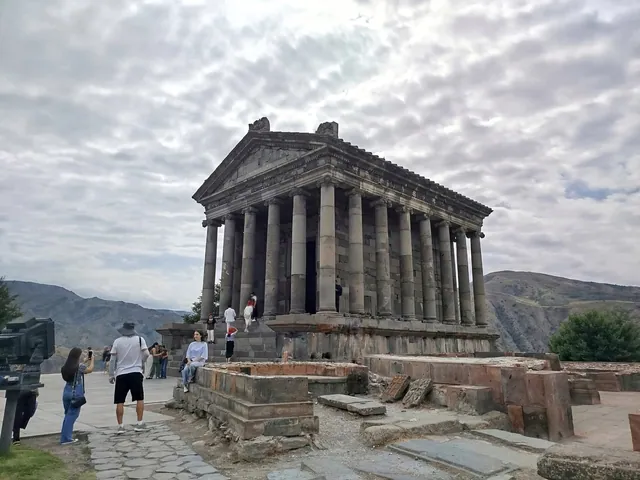
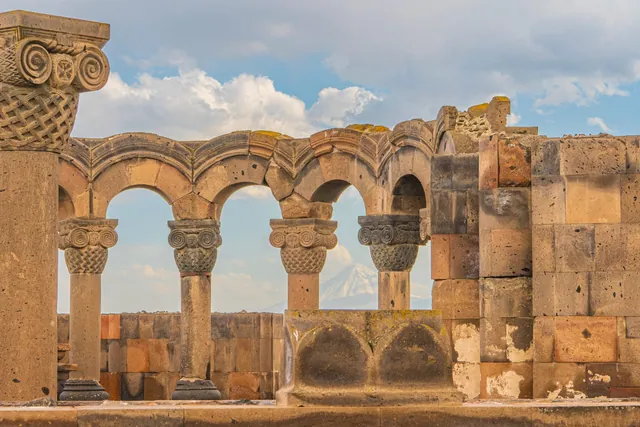
The pre-Christian temple at Garni is a fifteen minute walk from the turn-off to the descent, on its own ticketed site. Foreign visitors pay somewhere around 1,500 drams (roughly 4 USD), though rates and opening hours change, so check before the trip.
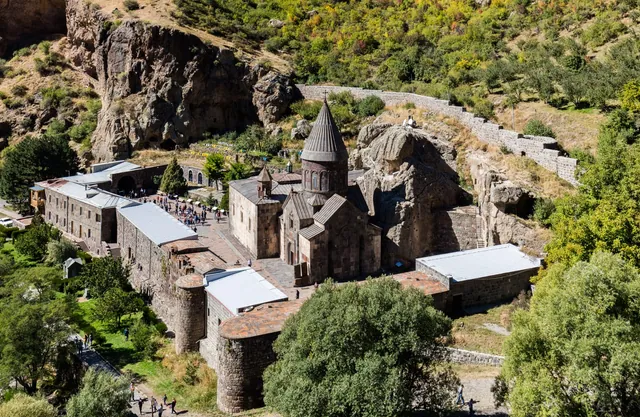
Geghard monastery is a further 9 km (6 miles) along the same road and is partly carved into the rock. A sensible one-day plan looks like this:
- leave Yerevan by eight in the morning;
- drive down to the Symphony of Stones, an hour or so at the bottom;
- back up to Garni temple;
- lunch in the village, where khorovats, the local grilled meat, is easy to find;
- Geghard, then back to Yerevan by evening.
I have never had a stable signal down by the river, so download offline maps and agree on a meeting point before you go down. Navigation apps find the spot by name, and the coordinates are accurate, but the route they draw for the last stretch sometimes ignores the actual drivable track.
What to bring
- Cash in drams. Cards are not accepted everywhere in the village, and at the bottom there is nothing to pay for except seasonal coffee.
- Shoes with grip. The stones near the water are wet and rounded.
- Water, at least a litre per person if you plan to walk.
- A charged phone and a downloaded offline map.
Before you go
The Symphony of Stones is one of the rare natural sites that sits forty minutes from a capital city and still has almost nothing built around it. The difficulty is not the distance but the last two kilometres: dry, they are fine for most cars; wet or icy, leave the car at the top. Go early, and pair it with Garni and Geghard in the same day.