
Gelati Monastery: David the Builder's tomb, a 12th-century mosaic and how to drive there from Kutaisi
Gelati Monastery near Kutaisi: history, the 12th-century mosaic of the Virgin, David the Builder's tomb, UNESCO status, driving from Kutaisi, Tbilisi and Batumi, dress code and nearby Motsameta.
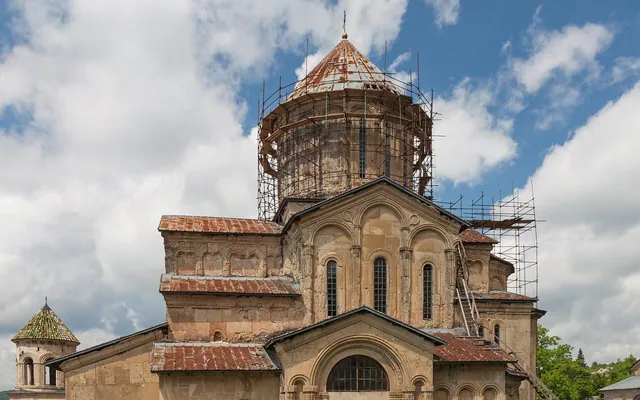
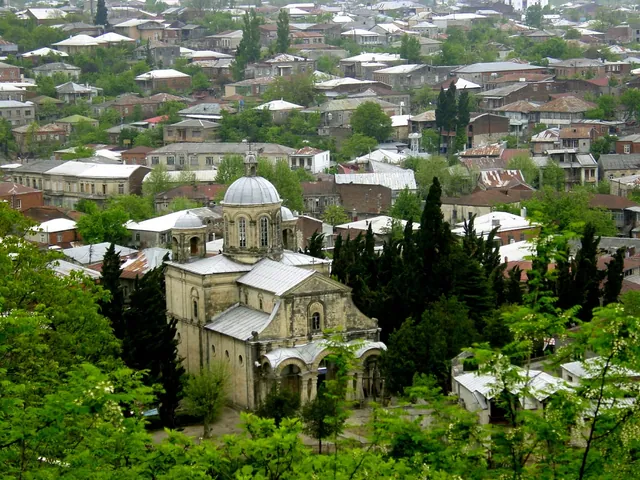
Gelati Monastery sits on a wooded hillside about 11 kilometres northeast of central Kutaisi. King David IV the Builder founded it in 1106, and he is buried here. The main church keeps a 12th-century mosaic, something that has almost vanished elsewhere in Georgia. Entry is free, the drive from town takes around twenty minutes, and an hour to an hour and a half is enough for the monastery itself. Below: what to look at inside, how to get there by car, and at the end, a word on neighbouring Motsameta.
What Gelati is
David the Builder conceived the place as a monastery, a royal burial ground and an academy all at once. The academy taught theology, philosophy, rhetoric, astronomy and geometry, and its scholars translated Greek treatises. A chronicler of the time called Gelati "a second Jerusalem of the whole East" and "a new Athens". Among the teachers were the philosopher Ioane Petritsi and Arsen Ikaltoeli, names every Georgian knows from school.
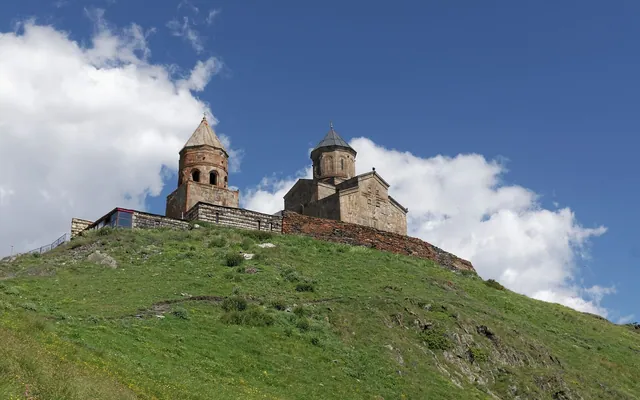
David died in 1125, before construction was finished. The main Church of the Nativity of the Virgin was consecrated under his son, King Demetre I, around 1130. In the 13th century the churches of St George and St Nicholas went up alongside it, together with a bell tower and other buildings. The monastery burned and was looted several times, including by the Turks in 1510, but it was rebuilt each time, and the core ensemble has survived intact.
Today it is a working monastery with a community of monks. Services are held here, the brothers live on site, and visitors are expected to behave accordingly.
UNESCO status: Gelati stayed, Bagrati didn't
In 1994 UNESCO inscribed "Bagrati Cathedral and Gelati Monastery" on the World Heritage List. In 2010 the site was moved to the List of World Heritage in Danger because of the reconstruction at Bagrati. Work on the Kutaisi cathedral was finished in 2012, complete with glass inserts and an exterior lift, and in 2017 Bagrati was removed from the listing. Gelati kept its status, the site is now simply called "Gelati Monastery", and it came off the "in danger" list at the same time.
So if an old guidebook shows Bagrati and Gelati under a single UNESCO number, that information is out of date. Bagrati itself is none the worse for it and still worth a visit; there's more on it in our piece on what to see in Kutaisi.
David the Builder's tomb
You enter through the gate first. David the Builder asked to be buried beneath the monastery's southern gate so that everyone who came in would step on his grave. The stone slab lies right in the passage, with a Georgian inscription. The gesture is usually explained as one of humility: the most revered king in Georgian history lies under the feet of any pilgrim.
In practice, many people now walk around the slab rather than over it. Locals often pause, cross themselves, and some leave flowers. If you don't know what the stone is, it's easy to walk past without noticing, so look down as soon as you're through the gate.
Next to the gate hangs a leaf of the iron gates of Ganja. Demetre I brought it back as a trophy after his campaign of 1139, and it has hung by his father's grave ever since. The huge wrought panel looks more like something from a military museum than part of a monastery.
The main church and the 12th-century mosaic
The Church of the Nativity of the Virgin is a cross-domed building of large, dressed yellow stone blocks with a tall drum. From outside it looks austere, with hardly any carving. Everything worth seeing is inside.
The mosaic fills the conch of the altar apse: the Virgin and Child on a gold ground, flanked by the archangels Michael and Gabriel. It is dated to roughly 1125–1130. Medieval Georgia rarely used mosaic, preferring to cover walls in frescoes, which is why the Gelati piece counts among the most important in the country. You view it from below and from a distance, and it shows best when sunlight comes through the drum windows. A phone with a good zoom or a small pair of binoculars makes the faces much easier to make out.
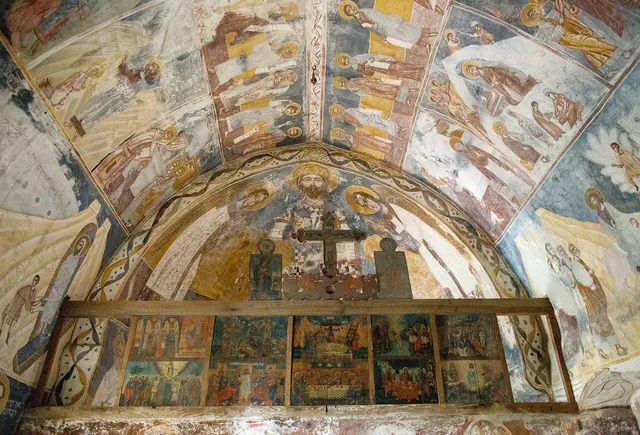
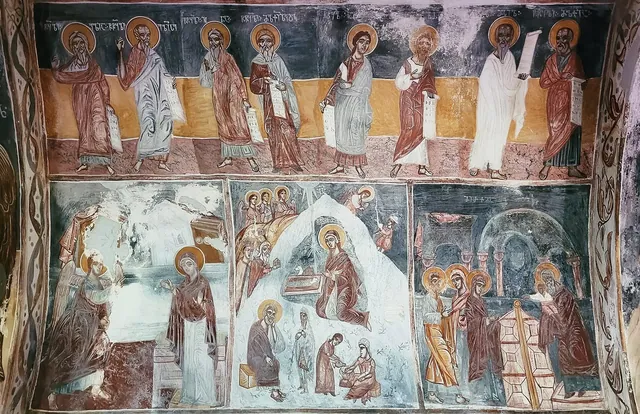
The rest of the walls are covered in frescoes from different periods, from the 12th to the 18th century. They include portraits of kings and churchmen, among them David the Builder himself holding a model of the church. The paintings have darkened badly and flaked in places, and restoration work has been going on in recent years. Be prepared for part of the interior to be under scaffolding or fenced off.
Photography without flash is usually allowed inside, but put the camera away during a service. If a monk or one of the women who look after the church asks you not to take pictures, don't argue.
What else to see on the grounds
The grounds are compact, and you can walk round everything in half an hour.
- Church of St George (13th century), east of the main church, with 16th-century frescoes.
- Church of St Nicholas, a small two-storey building of unusual shape: the lower level is open arches, and the church sits on top.
- The academy building, a long, plain rectangular structure on the west side. It stands empty now, but this is where lectures were given in the 12th century.
- The bell tower and remains of the monastery wall.
Walk over to the edge of the terrace behind the churches. From there you can see the Tskaltsiteli gorge and the hills of Imereti, and on a clear day mountains show up to the north. Mornings are often foggy, and the mist usually drains down the valley by mid-morning.
How to drive to Gelati
From Kutaisi
It's about 11 km from the centre, a 20–25 minute drive. Leave town heading northeast on the road towards Tkibuli, and after a few kilometres turn off at the Gelati sign. The last stretch winds through a village and woodland; the asphalt is fine and an ordinary car has no trouble. It gets narrow in places, especially on bends where tour buses come the other way. Take it slowly.
Search for "Gelati Monastery" in your navigation app; it comes up straight away.
From Kutaisi airport
From Kutaisi airport to the monastery is about 35 km, or 40–50 minutes through town or on the bypass. If your flight lands in the morning, you can pick up the car and go straight to Gelati before checking in: the grounds are usually open from early on.
From Tbilisi
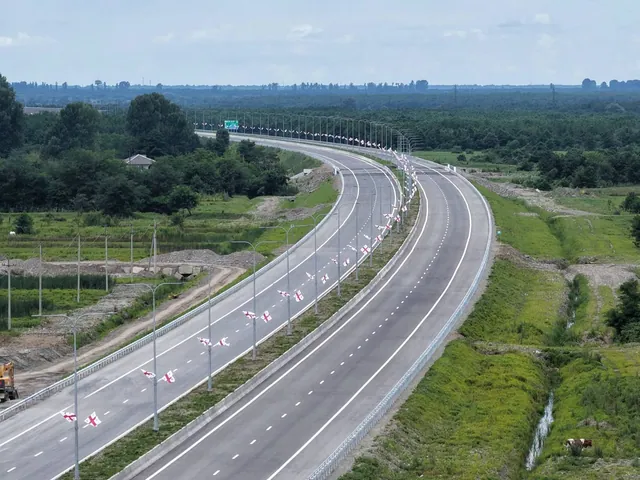
About 240 km along the E60 to Kutaisi, then another 11 to the monastery. Allow 3.5–4 hours with a short stop. The sensible plan is to spend the night in Kutaisi and drive up to Gelati in the morning, rather than trying to do Tbilisi–Gelati–Tbilisi in one day.
From Batumi
Kutaisi is about 150 km away, usually 2.5–3 hours depending on traffic leaving Batumi and around Samtredia. Gelati is doable from Batumi in a long day, but you'll have to set off early, and the drive back in the evening is tiring. It's easier with a night in Kutaisi or Tskaltubo.
Without a car
Marshrutkas run from central Kutaisi towards Gelati, but not often and not to any fixed timetable. The last stop is sometimes down in the village rather than at the gate, which leaves you a walk uphill. A taxi from town that waits for you and includes a stop at Motsameta is inexpensive; agree the price before you get in or book through an app.
Parking
There's a free car park in front of the gate, with stalls selling churchkhela, wine, honey and icons. On a weekday morning you'll find a space easily. On summer weekends and holidays the lot is full by midday, cars line the road, and buses turn round in the middle of it all. If you arrive at a time like that, leave the car further down the slope and walk up for a couple of minutes.
From the car park to the gate is a few minutes up a gentle incline.
Opening hours, entry and dress code
Entry: free. You can leave a donation in the church if you wish.
Hours: the monastery doesn't publish an official schedule. The grounds are usually open from morning to evening, roughly 8–9 am to 6–7 pm, longer in summer. The main church is sometimes closed during services or works. If you want to see the mosaic, come before lunch and check on the spot.
Dress code: women need a head covering and a skirt, men need long trousers, and everyone should have their shoulders covered. Headscarves and wrap skirts are usually left at the entrance. In hot weather it's simpler to arrive in something long and light.
How long to allow: an hour to an hour and a half for the monastery itself. With Motsameta and the drive from Kutaisi, it comes to half a day.
Toilet: there's one by the car park, but I wouldn't count on it at every time of year.
Gelati and Motsameta in one trip
Motsameta Monastery stands on a cliff above the Tskaltsiteli River, 6 km from Kutaisi, and the turn-off is on the same road that leads to Gelati. The two monasteries are 15–20 minutes apart by car, so people almost always visit them together.
Motsameta is small: one church on a promontory above a bend in the river, with a sheer drop below. It holds the relics of the brothers David and Constantine Mkheidze, 8th-century princes who were killed for refusing to convert to Islam. The name means exactly that, "place of the martyrs". There's a tradition of crawling three times under the reliquary and making a wish, and you'll almost certainly see someone doing it.
Half an hour is enough for Motsameta. Parking is tighter there, and the church is reached by a flight of steps down, which means climbing back up afterwards.
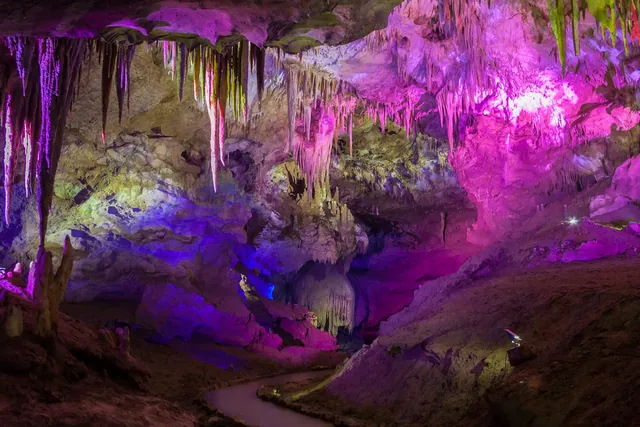
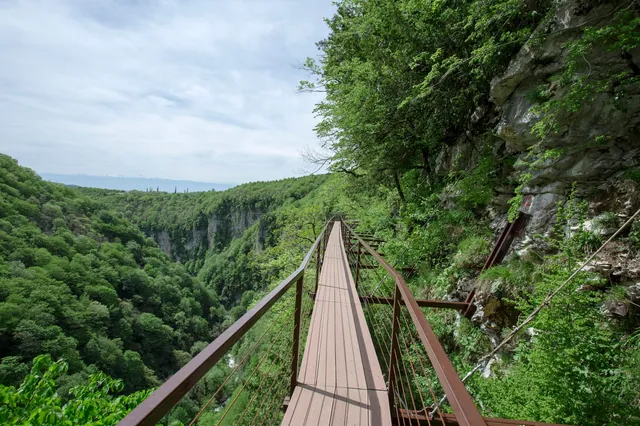
My usual order is Gelati in the morning, while it's quiet and the sun is in the drum windows, then Motsameta on the way back. If you want to end the day further afield, it's an easy drive west to the Prometheus Cave and Tskaltubo, or northwest to the Martvili and Okatse canyons. The cave and the two monasteries fit comfortably into one day. The canyons are better left for a separate one. That's exactly how the two Kutaisi days work in our 7-day Georgia road trip itinerary: Gelati and the cave first, then the canyons.
When to go
Gelati is open all year, and in winter there's hardly anyone around. In a normal Kutaisi winter the road is passable; snow rarely settles at this altitude and doesn't last, but after a night frost the forest switchbacks can be slippery in the shade.
Spring and autumn are the best seasons, in my view. In April and May the slopes around are bright green, and in October and early November the forest above the gorge turns yellow, which makes a fine backdrop for the monastery. Summer is cooler here than in Kutaisi, but by midday in July and August it's still hot, and the car park is packed. Come early.
Imereti is humid, and rain can arrive in any month. The mosaic is harder to see when it's raining because the light in the church is dim, so if you have a choice of days, pick a sunny one.
A few practical tips
- Bring cash in lari for candles and purchases by the car park. The stalls hardly ever have card terminals.
- Keep a headscarf or light shawl in the car if you're also visiting Motsameta and other churches. Your own is always more comfortable.
- Don't walk into the church with a tour group during a service; wait to one side. Services here aren't put on for tourists.
- The path up from the car park and the stone paving in the courtyard get slippery after rain, so shoes with a decent sole help.
In short
Gelati was built by David the Builder, who is also buried here. The apse keeps its 12th-century mosaic, and the monastery held on to its UNESCO status even after Bagrati was removed in 2017. It's 20 minutes from Kutaisi by car, entry is free, and an hour to an hour and a half on site is enough. Add Motsameta and you have a relaxed half day, with time left over for the cave or dinner in town.