
Ushguli: how to get there and what to see in the highest settlement in Svaneti
Ushguli in Svaneti: a community of four villages at around 2,100 m, a UNESCO site. Towers, Lamaria church, the Shkhara glacier, the 45–50 km road from Mestia, and how to check with your rental company whether you can drive it.
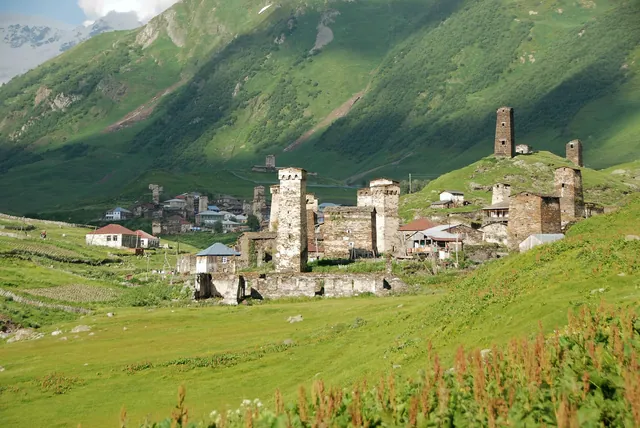
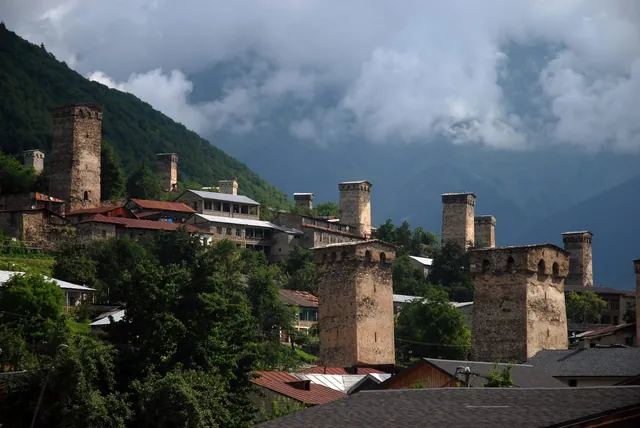
Ushguli sits at around 2,100 metres, in the upper reaches of the Inguri, directly below Shkhara. It is one of the highest permanently inhabited places in Europe and at the same time an ordinary working village: cows in the lane, hay under the sheds, smoke from the chimneys. The towers it all happens between are eight hundred years old.
The road here from Mestia has been paved, and with most rental companies the section is no longer under a hard ban. But the lists differ from firm to firm, so it is better to ask about permission for Mestia–Ushguli before you book, not when you hand the car back.
What Ushguli is and where it is
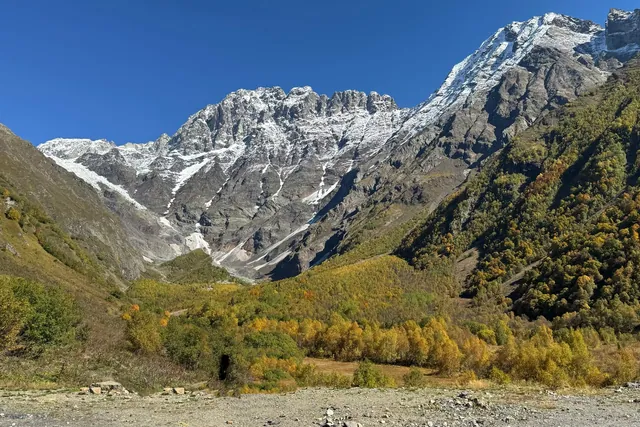
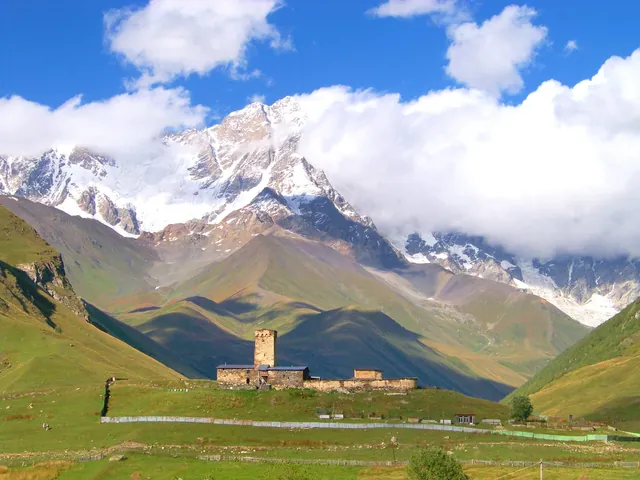
Ushguli is not a single village but a community of four: Zhibiani, Chvibiani, Chazhashi and Murkmeli. All of them lie in the upper Inguri, where the Svaneti and Main Caucasus ranges meet. Above the valley stands Shkhara, 5,193 metres, the highest point in Georgia.
Around 250–300 people live in the community. People have been here since time immemorial: archaeologists point to settlements long before the 9th century, the date given for the oldest surviving buildings. In 1996 the architectural landscape of Ushguli was inscribed on the UNESCO World Heritage List as part of the Upper Svaneti site.
The name, according to ethnographers, comes from the Svan ushishari guli, "fearless heart". Ushguli was indeed never conquered.
The Svan towers: why they were built
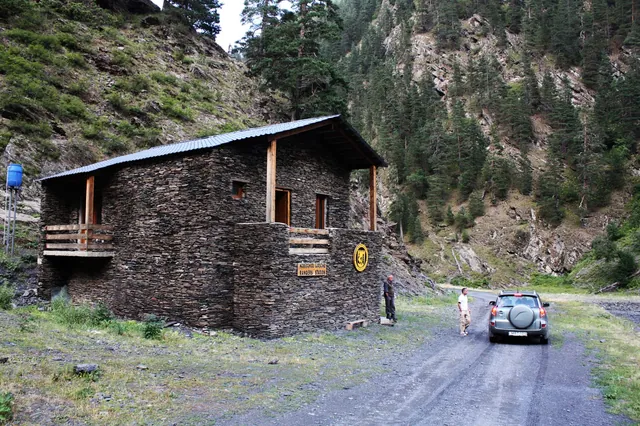
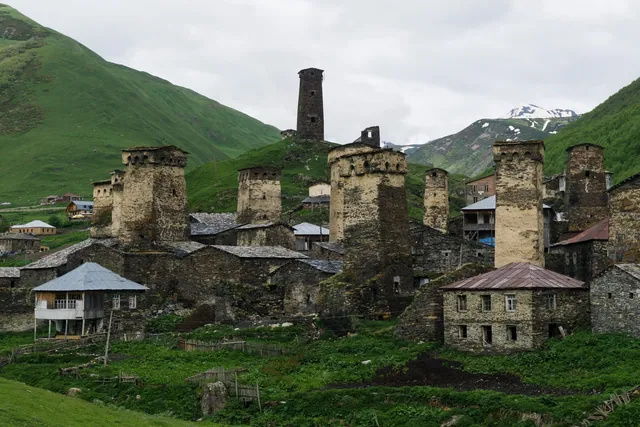
The towers here do not stand on a square behind an information board but in the yards, right up against the houses people live in. Square at the base, built from local stone, they give a silhouette you could not mistake for anything else.
They were built between the 9th and 13th centuries as refuges. During a raid the family climbed inside and could hold out for weeks: walls a metre thick and more, almost no windows, only narrow loopholes. The Svans call the towers "cats", for their independent character.
Chazhashi has particularly well-preserved towers under traditional slate slabs. On a separate hill above the community stands the Lower Chazhashi Castle, with several towers at once. The climb up takes about fifteen minutes and gives the best panorama over the whole of Ushguli. Higher up the slope is the Upper Chazhashi Castle, which locals consider Queen Tamar's summer residence. The Svans are certain she is buried here too, in Svaneti.
What to see in Ushguli
Lamaria church (Dormition of the Mother of God) on the hill above Zhibiani, at roughly 2,300 metres. The building is dated to the 10th–12th centuries and a working monastery for monks stands beside it today. The view from here over the valley and towards Shkhara is the best in the area, and it is exactly what brings people up the hill even when they never go inside churches.
Jgrag church (St George), 12th century, with frescoes from the 10th–13th centuries. Artistically the most valuable building in the community.
Queen Tamar's Tower, a big dark tower on its own hillock, has become the unofficial symbol of Ushguli. People climb it for the view from the top, but the stairs inside are old, so go up only if you are steady on your feet.
The Ethnographic Museum, entry 5 GEL. A small private collection: weapons, household objects, clothing, icons. Half an hour makes it clear how people lived here for several centuries running.
The Icon Museum, entry 3 GEL. Genuine images by local masters, some dated to the 10th–12th centuries.
Murkmeli has two churches, the Saviour and St Barbara, plus a dozen towers. Chvibiani counts as the centre of the community: the cafés, guesthouses and souvenir shops are there.
The Shkhara glacier
If you have even half a day in Ushguli, walk to the glacier. The route runs up the Inguri valley to the southern slope of Shkhara, roughly 7–8 kilometres one way. On foot, there and back, it works out at 5–7 hours with the climb.
The first part can be driven: local drivers run people up in off-roaders, and even more often you will be offered horses right in the village. After that it is your legs only. The track ends at about the five-kilometre mark, then the moraine begins: wet stones, streams across the path, glacial water. Trainers soak through on that stretch in ten minutes, so trekking boots are not overkill here.
Along the way there are alpine meadows, streams the colour of milk and the snow wall of Shkhara at the head of the valley. Cloud covers it often, so if the summit is clear in the morning, do not put the walk off until evening.
Glacier coordinates: 42.965834, 43.096931.
The Mestia–Ushguli road
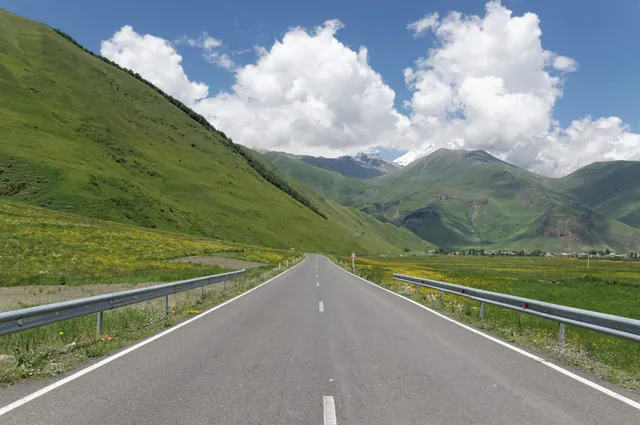
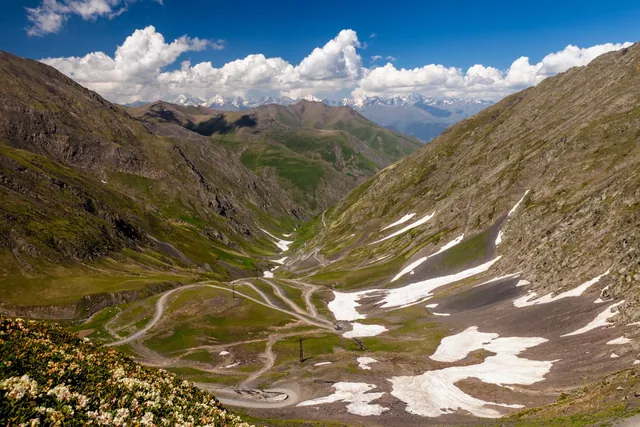
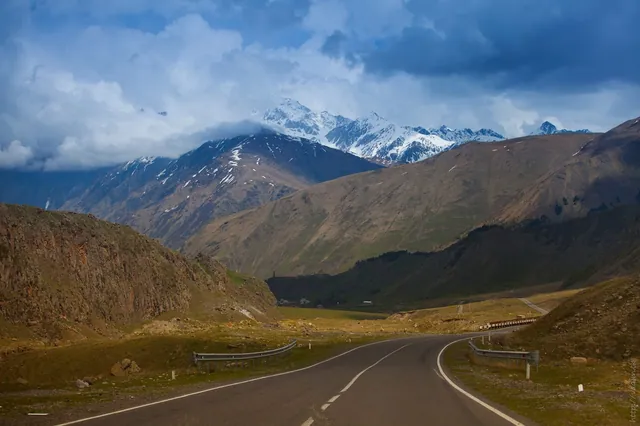
From Mestia to Ushguli is 45–50 kilometres, most often quoted as 47. By the 2024 season the road had been paved along almost its whole length, and driving time came down to a little over an hour, rarely an hour and a half. A few gravel sections remain, and after rain some spots wash out.
What happens to the road across the seasons:
- It is open roughly from May to October or November, with exact dates depending on the snow.
- In winter the section is regularly closed by snow and avalanches, sometimes for weeks. During that time only locals get to Ushguli.
- The second approach, from the Kutaisi side through Lentekhi and the Zagari Pass, works roughly from early June to early October. The road there is worse and it is not cleared at all in winter.
The asphalt changed how comfortable the drive is. Whatever restrictions your contract carries do not depend on the surface.
Can you drive to Ushguli in a rental car
Broadly yes, with most companies you can now. By the 2024–2025 season the asphalt reached almost the whole way, and many firms dropped or softened the ban on this section. But it is not a rule across the market: for some, Mestia–Ushguli is still closed in the contract, for others it is allowed with caveats, for others it is open with no special notes. The cars often carry GPS and the track gets checked when you return, so relying on someone else's "we drove it fine" is not enough. Ask your own rental company specifically about Ushguli, and about the Zagari Pass if you are planning the approach from Lentekhi. The wider picture on closed directions is in the guide to regions you cannot take a rental car.
If the section is closed in your contract, the working options are the same as before:
- A local driver from Mestia. A full day with the car comes to roughly 150–250 GEL, and a seat in a shared group is noticeably cheaper. Agree on how long you get on the ground in advance, otherwise the driver will decide for you.
- Marshrutka. In summer minibuses run between Mestia and Ushguli, about two hours on the road, fare somewhere around 30–50 GEL. The timetable floats, so check locally the day before.
- An organised tour. Comparable to a taxi in money, with the bonus that someone explains what you are looking at.
- The Mestia–Ushguli trek. Four days on foot with nights in guesthouses, no tent needed.
If you do have permission, an ordinary car or a crossover is usually enough for the summer season: the surface is no longer the off-road it was until recently. After rain the remaining gravel stretches are still unpleasant, but that is a question of driving carefully rather than of a body-on-frame 4x4.
A car is still the convenient way to do Svaneti as a whole. Car rental covers the road to Mestia and almost everything around it: Hatsvali, Tetnuldi, the approach to Chalaadi, the Mazeri valley. How the whole drive from the capital looks is set out in the Tbilisi–Svaneti route. In winter it makes sense to take all-wheel drive on winter tyres for the approach to Mestia. For Ushguli in winter this usually does not apply: the road is closed by snow and avalanches.
On the way, near the village of Bogreshi, a solitary Tower of Lovers stands above the Inguri. Whether you are driving yourself or going with a driver, build the stop into the plan in advance.
Stay the night or go back the same day
Most people come from Mestia for the day. The scheme holds up: an hour and a half there, several hours on the ground, an hour and a half back.
An overnight changes the trip more than you would expect. By day Ushguli is full of cars and groups, by evening they have gone and the village is left to itself. Then there is the light: the Chazhashi towers at sunset and at dawn, with Shkhara behind them, look nothing like they do at noon when everything is burnt out by the sun.
There are several guesthouses in the community. The service is simple, the cooking is home cooking, and dinner is usually with your hosts or in one of the couple of small cafés in Chvibiani. In summer it is better to book ahead, there are not many beds.
Practical information
Altitude. Around 2,100 metres. If you have come up from below and set off straight uphill to Lamaria, the first few hours can leave you short of breath. Nothing alarming, just do not push the pace.
When to go. From June to September the mountains are more often clear and the trails are dry. May and October are quieter and better for light, but colder, and the road is less predictable. The seasonal picture for the country as a whole is in the guide on when to visit Georgia.
What to bring. A warm layer even in July: after sunset it gets cold at this altitude. A rain jacket, trekking boots, sunscreen and sunglasses.
Money. Cards are rarely accepted and there is no ATM in Ushguli. You need cash lari for the museums, cafés, horses and souvenirs, so withdraw it in Mestia.
Connectivity. Mobile internet works about half the time. Download offline maps of Svaneti in advance.
Souvenirs. The local souvenir is Svan salt, a mix of salt with garlic, coriander, fenugreek and utskho-suneli. Ushguli has it, but the choice is wider and the prices lower at the market in Mestia.
Museums. Ethnographic 5 GEL, icon museum 3 GEL. Walking around the community and looking at the towers from outside is free.
In short
As a day out from Mestia, Ushguli fits neatly: the towers, Lamaria, a cup of coffee in Chvibiani and back. If you stay the night and walk to the glacier in the morning, the trip already feels like something else.
Two checks are enough before you set off: whether the road is open for the season, and what exactly your rental company has written about the Mestia–Ushguli section. The rest gets sorted out on the spot.