
Lake Shaori: the pearl of Racha worth seeing with your own eyes
Lake Shaori in Georgia is a reservoir in the Racha mountains at 1,100 m. How to get there by rental car and what to see nearby: Mount Tskhrajvari, Nikortsminda, Ambrolauri. A complete guide.
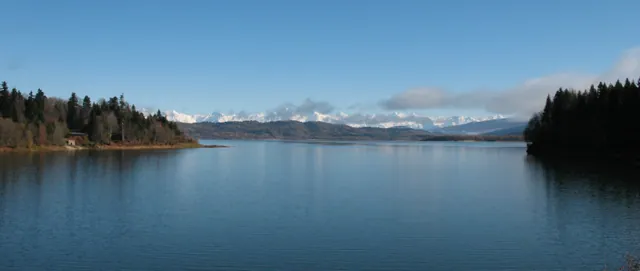
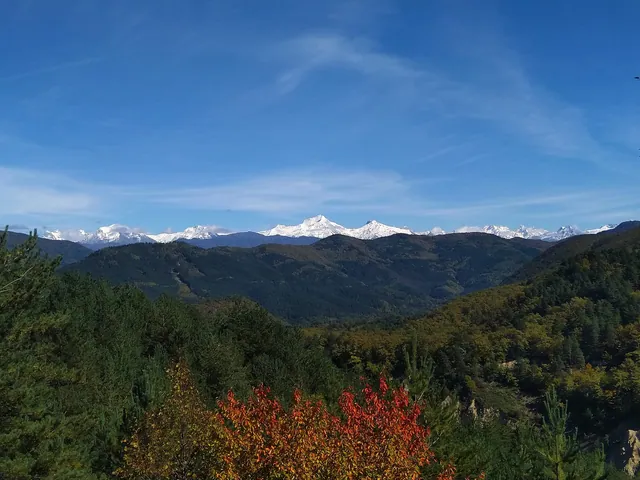
If you haven't heard of Lake Shaori, chances are you simply haven't made it to Racha yet. Here, among conifer forests and alpine meadows, the mountain air smells of mint and rhododendrons, and on a clear day the Caucasus range is reflected in the water. It is one of the most scenic places in Georgia, and foreign travellers know almost nothing about it.
Locals sometimes call this area "Georgian Switzerland": there are no tour buses, no queues and no crowds at the viewpoints. There is a car, a mountain road and a lake that appears suddenly, right after the Nakerala Pass, blue and green at the same time.
What Lake Shaori is and why it's man-made
Strictly speaking, Shaori is a reservoir. It was created in the 1950s after the Shaori hydroelectric power station was launched in the basin of the mountain river Rioni. The plant still runs and is the highest-head hydropower station in Georgia, producing around 149 million kWh a year.
Its "artificial" origin doesn't make the lake any less beautiful. Over the decades it has become part of the mountain landscape: the banks have grown over with forest, fish have settled in the water, and seen from above, the reservoir looks like a huge sea monster with a forked tail.
The figures are impressive: 7.1 km long, up to 2.7 km wide and up to 14.5 m deep. The total volume is around 90 million cubic metres. Shaori is the largest body of water in Lower Racha.
The lake is surrounded by the Nakerala ridge. Its slopes are covered with dense conifer and mixed forest, and alpine meadows begin higher up. The place has its own microclimate: even on the hottest day, when the valley is at +30, it is cool by the water and sometimes properly cold. Bring a warm layer. I'd keep one in the car whatever the forecast says.
What to do at the lake
Start with the obvious. Two bridges cross the reservoir, and from one of them you can see the snowy peaks of the Caucasus in sunny weather. The lake looks different from every spot: from the bridge the water is blue and calm, near the shore it turns dark green and lively.
It is especially beautiful in spring, when rhododendrons bloom on the slopes, and in autumn, when the gold and crimson of the forest is reflected in the water.

There are a few small beach spots along the shores of Shaori. People swim here in summer: the water is cool but refreshing. You can have a picnic on the shore or pick mushrooms and berries in the forest. The place is almost untouched and facilities are minimal, which is more of a plus if you value quiet.
Anglers won't leave disappointed either, as the lake has plenty of fish. A quiet morning by the water with a rod is one of the best ways to spend time in this part of the country. To me, Shaori is at its best early in the morning, before anyone else is on the shore.
Mount Tskhrajvari: Nine Crosses above the clouds
If Shaori is the eyes of this route, Tskhrajvari is its soul.
Not far from the lake, at 1,565 metres above sea level, rises a mountain with an unusual name. Tskhrajvari means "Nine Crosses" in Georgian, and that is exactly how many iron crosses stand on its summit, in memory of people who died in various wars. Next to the crosses are the ruins of an old church whose age nobody knows for sure.
A road leads to the mountain from the Nakerala Pass. By car you can get about a kilometre in, and from there it's on foot through the forest for roughly two more kilometres. The trail passes through thickets of Colchic boxwood, mint, oregano and mountain lavender. The last metres before the summit are the steepest, with a scramble up rocky steps. It's worth it.
From the top of Tskhrajvari the view stretches a full 360 degrees: the Imereti valley, the Tkibuli reservoir and the Caucasus ridges all unfold in front of you at once, like a giant map. It is a special place, the kind where you want to stay silent.

The walk from the parking spot to the summit takes about 30–40 minutes each way. Wear non-slip shoes with good foot support. In fog or after rain the trail gets slippery, so keep that in mind when planning. I wouldn't rush the climb, and I'd leave spare time for the summit: there's no point hurrying on the last rocky metres.
What to see nearby: Nikortsminda and Ambrolauri
A trip to Shaori combines naturally with other sights in Racha.
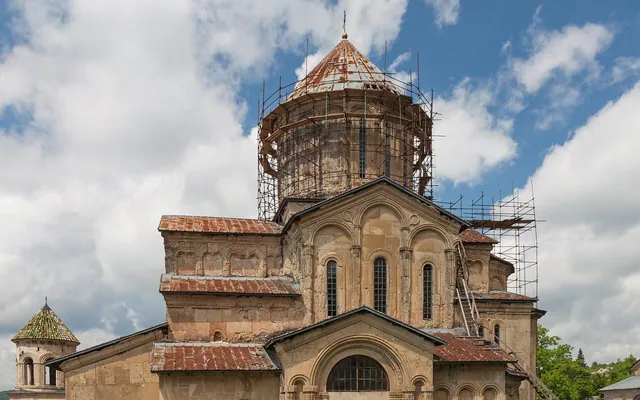
Nikortsminda is a medieval cathedral from the 11th century, built under Bagrat III, the first king of unified Georgia. It stands about 14 km from Ambrolauri. The carving on the facade and dome has survived since the church was built, and the frescoes inside date from the 16th century. It is the only church in Racha from the "Golden Age" of Georgian architecture and one of the most beautiful in the whole country.
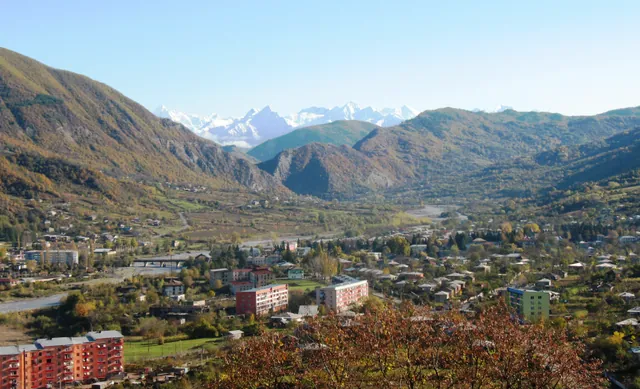
Ambrolauri is a small, cosy town, the administrative centre of the region and its unofficial "wine capital". This is where the famous Racha wine Khvanchkara is made. You can drop into the local market, try homemade cheese and simply stroll along the Rioni embankment.
How to get to Lake Shaori: only with your own wheels
The honest answer to the main question: without a car, getting here is awkward.
The lake lies where two regions meet, Imereti and Racha, and formally belongs to Racha-Lechkhumi. From Kutaisi to Shaori it's about 50 km via Tkibuli. That sounds close, but the mountain road over the Nakerala Pass takes at least an hour and a half. From Tbilisi it's around 5 hours' drive.
Public transport exists but is very irregular. Minibuses run from Kutaisi to Tkibuli, and beyond that things are unpredictable. Don't count on it as a reliable option.
A taxi works but is expensive: the return trip, waiting at the lake and detours to the sights add up to a considerable sum.
Renting a car is the best choice. You leave when you want, stop where you want and don't have to hurry anywhere. The road over the pass is a pleasure in itself: hairpins above the drop, mist in the mountains, views that take your breath away. With a rental car you can turn off to Tskhrajvari on a whim, stay at the lake until sunset, call in at Nikortsminda and still reach Ambrolauri the same day.
Car rental in Georgia is available in all major cities: Tbilisi, Kutaisi, Batumi. Prices are reasonable, and the roads in the region are perfectly passable in an ordinary passenger car. For complete peace of mind, a small crossover or simply a car with good ground clearance will do.
When to go
May–June: rhododendrons in bloom, fresh air, bright greenery. One of the best options.
July–August: high season, though in terms of weather rather than crowds (there aren't any). It's warm and you can swim. Evenings by the lake are cool.
September–October: golden autumn in the mountains. The forest blazes amber and red. Probably the most photogenic time of year.
Winter: the lake doesn't freeze, but mountain roads can be difficult. Only for experienced drivers with a suitable car.
What to bring
- A warm layer (a must, even in summer)
- Non-slip shoes if you plan to climb Tskhrajvari
- Cash: ATMs and card terminals are rare in Racha
- Food and water for the road
- A charged phone with offline maps (Maps.me or OsmAnd work well)
In short: why go
Shaori isn't a place you visit just to tick it off a list. Here Georgia shows itself without filters: wild nature, mountain air, silence. Especially if you combine the lake with the climb up Tskhrajvari, a stop at Nikortsminda and a glass of Khvanchkara in Ambrolauri.
The full route fits into one busy day from Kutaisi or two relaxed days from Tbilisi. You will definitely need a car.