
Bodbe Monastery: A Guide to Kakheti's Most Revered Shrine
The Monastery of Saint Nino at Bodbe is Georgia's main place of pilgrimage. Opening hours, what to see and how to get there from Tbilisi by rental car. A complete guide.
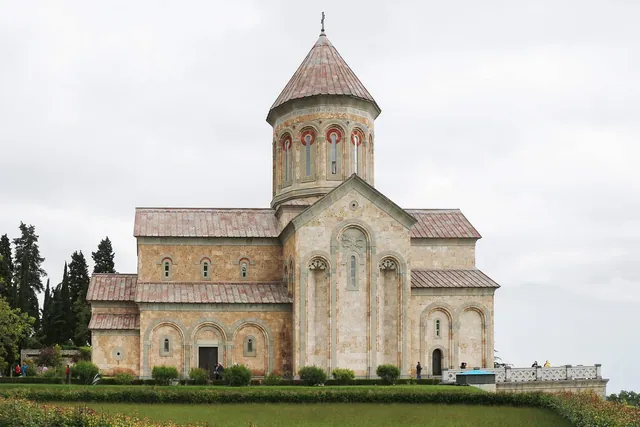
The Monastery of Saint Nino at Bodbe has stood on a slope of the Gombori hills above the Alazani Valley for more than a thousand years. Every day pilgrims and travellers from dozens of countries come here. Some come to pray at the relics of the saint who changed the course of an entire country. Others simply want to stand quietly among the cypresses and look out at the Greater Caucasus in the distance. The photos you take here turn out beautifully, but that is rarely the reason people come to Bodbe. Below is everything that will be useful before your visit.
Who Was Saint Nino, and Why Bodbe Matters
To understand what the monastery means, you need to know who the woman resting here was. Saint Nino was born in the late 3rd century in Cappadocia (in present-day Turkey). According to tradition, she was a relative of the Patriarch of Jerusalem and a cousin of Saint George the Victorious, one of the most revered saints in Georgia.
In the early 4th century Nino came to pagan Iberia, as eastern Georgia was then called. She settled in the garden of the royal gardener in Mtskheta and began to preach. According to tradition, she healed Queen Nana, the wife of King Mirian, and the queen converted to Christianity. The king himself was at first hostile to the preacher, but legend says he was struck blind at the very moment he plotted harm against her. After his sight returned through Nino's prayers, King Mirian accepted Christianity together with his whole court, around 326 AD.
After the conversion of the country, Nino went to Bodbe, a hilly corner of Kakheti. She spent the last years of her life here in fasting and prayer, and she died here too: in 335 or 347, depending on the source. Tradition holds that when King Mirian tried to carry her body to Mtskheta, neither a hundred men nor a team of oxen could move the coffin. Nino was buried where her tent had stood. The monastery grew up on that spot.
History of the Monastery: From Coronations to a Soviet Hospital
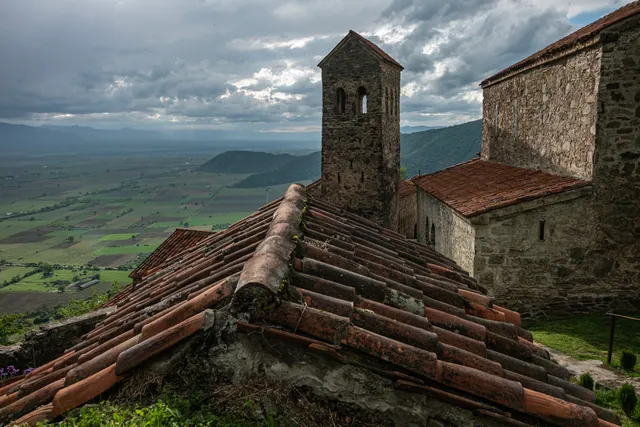
The first small church over Saint Nino's grave was built on King Mirian's orders in the early 4th century. The present monastery building dates to the 9th–11th centuries, although the complex was rebuilt more than once, most thoroughly in the 17th and 19th centuries.
In the Middle Ages Bodbe became one of the main spiritual and cultural centres of Kakheti. The kings of Kakheti were crowned here. For a long time the Diocese of Bodbe was the wealthiest in Georgia.
In 1605 the monastery was destroyed by the Persian Shah Abbas I. In 1837, after the Russian administration abolished the autocephaly of the Georgian Church, the Diocese of Bodbe was dissolved and the monastery fell into decline.
The turning point came in 1888–1889: after a visit by Emperor Alexander III the monastery was restored, and in 1889 a convent opened here that is still active today. In Soviet times the monastery was closed and turned into a hospital. The famous icon of the Iveron Mother of God was used as an operating table, and the scalpel marks on it can still be seen. Monastic life resumed in 1991. In 2006 Bodbe was added to Georgia's list of immovable cultural monuments of national importance.
What to See at the Monastery
The monastery complex at Bodbe is compact, but there is plenty to see.
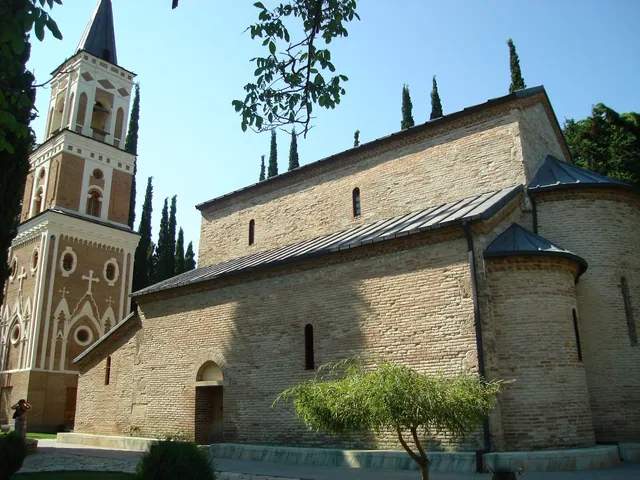
St George's Cathedral is the main church of the monastery, a three-nave basilica from the 9th century. Saint Nino's relics rest beneath the altar of this cathedral. Photography at the altar is not allowed.
The bell tower is a three-storey 19th-century building in a Russian-European style, next to the cathedral.
The Church of Saints Zabulon and Susanna is a small church dedicated to Saint Nino's parents, who were canonised in 1996. It stands in the lower part of the gorge, next to the holy spring.
The Cathedral of Saint Nino is a new monumental building, constructed in 2011–2019. Its triconch design follows the plan of the medieval Bagrati Cathedral in Kutaisi.
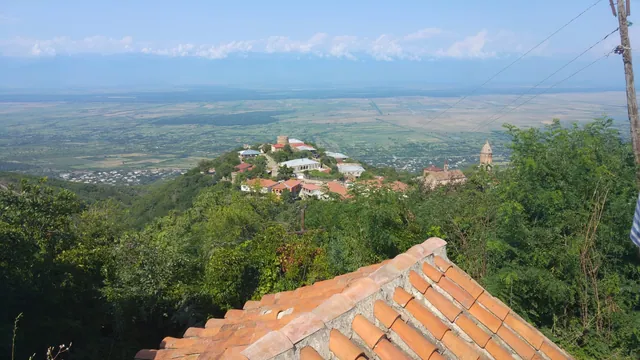
The viewing platform looks out over the Alazani Valley and the Greater Caucasus range. It is one of the best views in the region.
The gardens and vineyards are well-kept grounds with flower beds, shrubs and cypress avenues.
Saint Nino's Spring: Healing Waters in the Gorge
The holy spring deserves a separate mention, since many pilgrims come for it. It lies northeast of the monastery in a small gorge. According to tradition, the spring rose from the ground through Nino's prayers, and its water is considered healing. Many people fill bottles to take with them, and those who wish can immerse themselves in the bathing pools.
Two ways lead to the spring: a footpath of about 600 metres (downhill along the slope) or a roundabout road of about 3 kilometres. Next to the spring there is a small church and a bathhouse. I prefer to walk down the path and then take the climb back up slowly, at my own pace.
Practical Information: Visiting Bodbe Monastery
Opening hours: daily, roughly 9:00 to 18:00. Access may be restricted during the liturgy.
Admission: free.
Dress code: required. Women should cover their head and shoulders and wear a skirt (wraps are available at the entrance). Men should not wear shorts.
Photography: allowed on the grounds, not allowed at the altar.
Time needed: 1.5–2 hours for the complex and the walk to the spring.
There is a refectory and a souvenir shop on the grounds.
Getting to Bodbe Monastery by Rental Car
The monastery is 2 kilometres from Sighnaghi in Kakheti, about 110–115 km from Tbilisi. That is roughly a 1.5–2 hour drive on the highway.
A rental car is the most convenient way to reach Bodbe. There is no direct public transport to the monastery. Minibuses from Tbilisi run to Sighnaghi (from Samgori bus station, about 2.5 hours, around 10 GEL), but from the town there are still 2 km left to the monastery. Bodbe is also almost always combined with a trip around Kakheti: Sighnaghi, Telavi, Alaverdi Monastery, the wine villages. With your own car you can plan the route any way you like.
The road from Tbilisi to the monastery is simple and in good condition: the highway runs east across the plain, then the climb to Sighnaghi begins. About 110 km, roughly 1.5–2 hours. Navigation apps take you right up to the entrance.
It is easiest to book a car in advance online: there is no need to go anywhere or stand in a queue, and everything is done on the website in a few minutes. You can browse available cars on MY.DRIVE.
The alternative is a taxi from Tbilisi (about 80–120 GEL one way) or an organised tour. With a rental car, though, you gain flexibility and, as a rule, save money.
Bodbe and Sighnaghi: Two Places, One Route
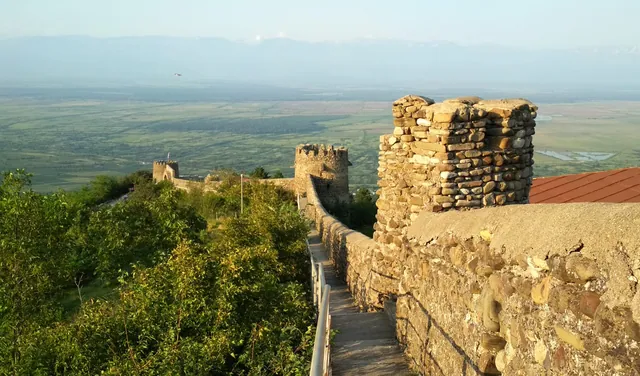
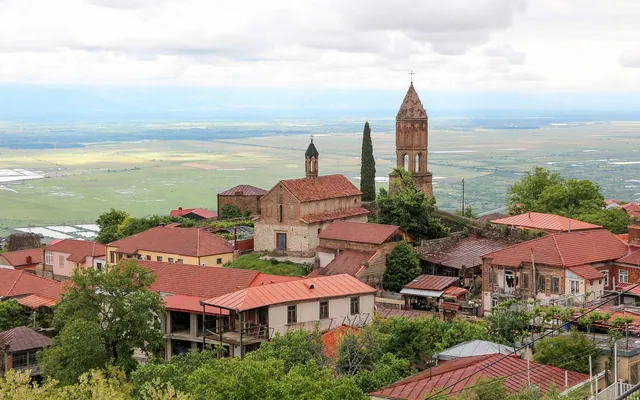
The monastery and the nearby town of Sighnaghi go well together. Sighnaghi is a small hill town with a well-preserved 18th-century fortress wall, tiled roofs and views over the Alazani Valley. It is called the "City of Love" because the local registry office is open around the clock. The two are only 2 km apart, less than five minutes by car. I would put the monastery in the morning and leave a walk around Sighnaghi for the afternoon. There is more about the town in our Sighnaghi guide.
Tips Before You Go
Come on a weekday or early on a weekend morning: on Saturdays and Sundays it gets crowded, with weddings and pilgrim groups.
Wear comfortable shoes, as the path to the spring is fairly steep.
Don't rush. Many visitors who planned on half an hour end up staying much longer. I never plan anything with a fixed time straight after Bodbe.
Bring cash: the souvenir shop may not accept cards.
Bodbe, Where Georgian History Becomes Tangible
Several thousand years of Georgian history meet at Bodbe: the country's conversion to Christianity, the coronations of medieval kings, the upheavals of the Soviet era and the revival that followed. Pick up a rental car, leave Tbilisi, and an hour and a half later you are standing at the gates of one of the country's most important shrines.