
David Gareja Monastery: how to get there by car
A 6th-century cave monastery 70 km from Tbilisi: 19 complexes cut into the cliffs, 12th-century frescoes and the Rainbow Hills. Driving from Tbilisi, Telavi and Batumi, the access situation at Udabno, and everything worth knowing before you set off.
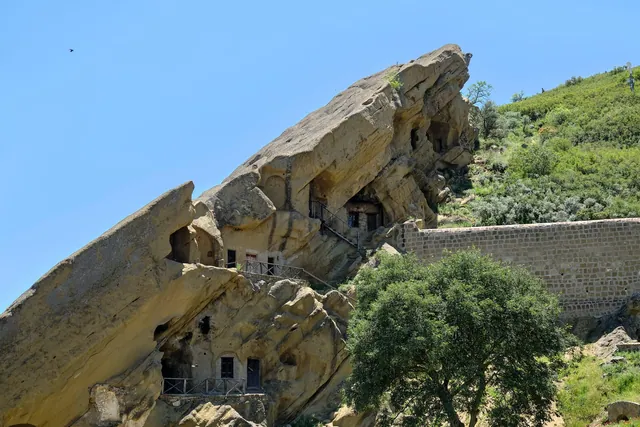
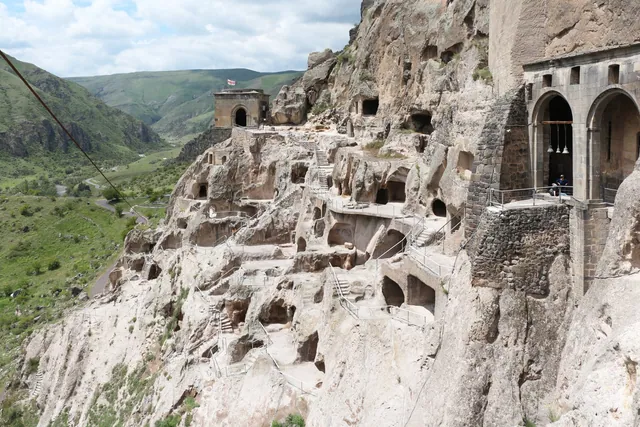
David Gareja is a 6th-century monastery complex hewn into the cliffs on the border between Georgia and Azerbaijan, 70 km southeast of Tbilisi. It's one of the few places in the country where history, landscape and a sense of complete solitude work on you all at once rather than in turn.
There is no public transport out here. Getting there without a car is theoretically possible, but it turns into a quest of transfers and haggling — the place stands deliberately far from everything.
What David Gareja is
In the first half of the 6th century the monk David Garejeli — one of the thirteen Assyrian Fathers who came to Georgia to preach Christianity — settled in a natural cave in the middle of the Gareja semi-desert. His disciple Lucian was with him. They lived on roots and the milk of wild deer. It sounds like hagiographic exaggeration right up until you stand there yourself: there really is nothing to eat around here.
Later David's disciples, Dodo and Lucian, founded their own monasteries nearby. Over fifteen centuries this grew into 19 cave monasteries strung out along roughly 25 km of the Gareja Ridge: churches, cells, refectories, storerooms — all chiselled straight into the rock.
On the walls are frescoes from the 12th and 13th centuries, preserved remarkably well: King David the Builder, Queen Tamar, Demetrius the Self-Sacrificer. And inscriptions in four languages — Georgian, Armenian, Arabic and Greek. More than forty of them in a single complex.
The golden age was the 11th–13th centuries, the era of unified Georgia: the monastery ran its own school of fresco painting and held thousands of manuscripts. After that the story follows a familiar script — the Mongol raids of 1265, Tamerlane's invasions, the devastation by the Iranian Safavids in 1616–1617. The Soviets closed the monastery in 1921. Monastic life only returned in 1991.
What you can visit right now
This is worth reading before you get into the car.
The main part of the complex — the Lavra of David — lies on Georgian territory and is open to visitors. The monastery is active; monks live here to this day. Entry is free, modest dress is required.
Udabno Monastery, home to the most famous frescoes, sits up on the crest of the ridge — and that crest remains the subject of a territorial dispute between Georgia and Azerbaijan. Access is periodically restricted by Azerbaijani border guards. As of 2025–2026 the situation is unstable: sometimes people are let through, sometimes not. It's worth spending five minutes before the trip checking the current status in local travellers' communities.
Plan your day so it doesn't fall apart if Udabno turns out to be closed. Usually it doesn't.
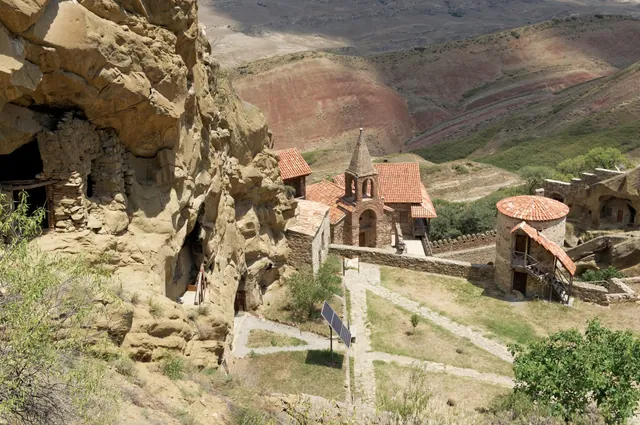
Because the Rainbow Hills begin right next to the parking area — mounds banded in colour by Miocene and Pliocene marine sediments. Pink, ochre, grey-green and white, layered like a cross-section. Nobody ever closes those, and they're a reason to come in their own right.
Getting there from Tbilisi
The most popular option. About 70 km by road, 1 hour 15 minutes to 1 hour 30 minutes on the way.
Route: Tbilisi → Sagarejo → Udabno → David Gareja
You take the Kakheti Highway (S5) towards Sagarejo — a new four-lane section opened there in 2024, so the road is fast and comfortable. Past Sagarejo you turn south through the village of Udabno and carry straight on to the monastery car park. Asphalt the whole way, no dirt road. An ordinary hatchback handles it without a single caveat.
We left Tbilisi around half past seven in the morning, and that turned out to be the best decision of the day: the city was still asleep, the new four-lane road was almost empty, and that low morning light was standing over the Kakhetian hills. We reached the monastery ahead of the heat and ahead of the first minibuses.
There is an alternative, via Rustavi and Gardabani. Maps and old guidebooks sometimes suggest it, and it's the main trap of the day. The road is broken up, full of deep potholes, turns to mud in the rain and demands four-wheel drive. Our navigator kept stubbornly pulling us that way — "a few kilometres shorter". If you see your route leaving Tbilisi to the south instead of east, redo it via Sagarejo: faster, and without the adventure.
Set off early, ideally before 9 a.m. In summer it's already hot at the monastery in the morning, and after midday it becomes stifling and hard going. On top of that, weekday morning traffic out of Tbilisi adds another 15–20 minutes.
There and back from Tbilisi comes to around 140 km — a comfortable format for a day trip out of the city.
Getting there from Telavi and Kakheti
Direct from Telavi it's about 100–110 km and 1 hour 30 minutes to 2 hours of driving, through the same Sagarejo and the same good asphalt.
If you're already touring Kakheti, folding Gareja into the route makes sense: one loop takes in Sighnaghi and Telavi, Alaverdi and Gareja over two or three days.
From Sighnaghi, contrary to expectations, it doesn't get any closer — the distance is roughly the same as from Tbilisi. So the standard advice still stands: drive from the capital.
Getting there from Batumi
Around 415–420 km and 5.5–6 hours behind the wheel. That's a proper relocation, not a day trip.
The sensible logic is to drive via Tbilisi, spend the night there and head to Gareja the next day. Or build the monastery into a Batumi–Tbilisi route, setting aside a morning half-day for it.
Trying to do "Batumi — Gareja — Batumi" in one day isn't worth it: the detour is too big, and what you'll mostly see is highway.
What to do on site
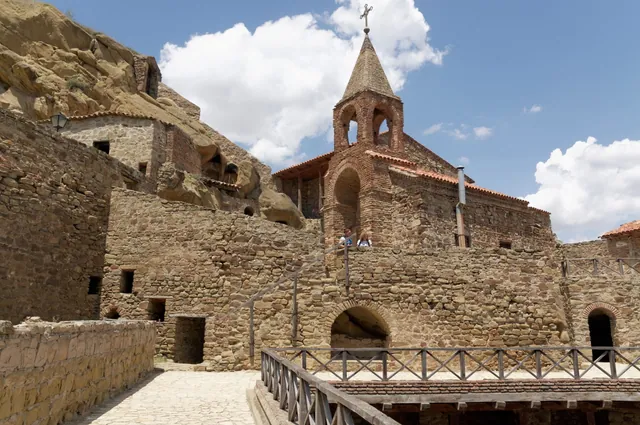
Start with the Lavra of David down below: the little courtyards, the terraces, the cells in the limestone, the spring. It's shady and lived-in here — people have been walking these steps every day for fifteen hundred years.
Then climb up towards the ridge and the Rainbow Hills. The ascent is rocky but short, and at the top begins the thing people come here for: the steppe runs off to the horizon in waves of ochre and grey, and the striped hills change colour along with the light.
We came up to the hills closer to ten in the morning — and what surprised us most wasn't the view but the silence: no cars, no birds, just wind over stone. An hour up there passes without you noticing.
Before you go: practical details
When to come. April–June and September–October. In high summer, July and August, the semi-desert sits at 35–40 °C with almost no shade — the climb to the ridge at noon turns into an ordeal. Winter is cold with a hard wind. In spring the landscape is a different thing entirely: the hills go briefly green, and that's worth seeing.
How much time you need. A minimum of 3 hours on site: walking the Lavra, climbing to the Rainbow Hills, and simply sitting on the ridge. If Udabno is open, allow 4–5 hours. Less than three hours here is pointless: you'll arrive, photograph the cliffs and leave with the feeling that you missed something.
What to bring:
- Water — at least 1.5 litres per person. There is no café and no shop on site.
- Comfortable shoes: the path to the hills is rocky and dusty, flip-flops are not an option.
- Covered clothing for the monastery.
- Cash, including small change: the toilet costs 0.50 GEL.
- A hat and something windproof. There's almost always a wind on the ridge.
We forgot the sunscreen — the one thing we regretted all day. Open ground, pale stone and zero shade do their work even in May.
Fuel. The last petrol station is in Sagarejo or Udabno. There's nothing after that, so fill the tank in advance and don't count on luck.
Mobile coverage. Magti works on the road and on site, with 4G for almost the whole way.
Opening hours. The monastery is open daily and there are no official time restrictions. But it's still better to arrive in the morning.
One more small thing nobody writes about: in the warm season this is steppe, with all its inhabitants, snakes included. Nothing alarming — just watch where you put your feet on the rocks and where you sit down for a break.
Bottom line
David Gareja is not "just a monastery". It's a cave city in the desert, 12th-century frescoes, a live border with Azerbaijan, and a landscape that always sounds duller in writing than it looks in person.
The only convenient way here is by car: an hour and a half from Tbilisi on good asphalt via Sagarejo, about two hours from Kakheti. Check the access status for Udabno before you leave, fill the tank, take water and start early.
The rest sorts itself out — it's hard to hurry there.