
Nekresi Monastery in Kakheti: An Ancient Sanctuary Above the Alazani Valley
Nekresi Monastery is one of the oldest in Georgia. How to get there by rental car, what to see inside, the frescoes, the view over the Alazani Valley, and practical information.
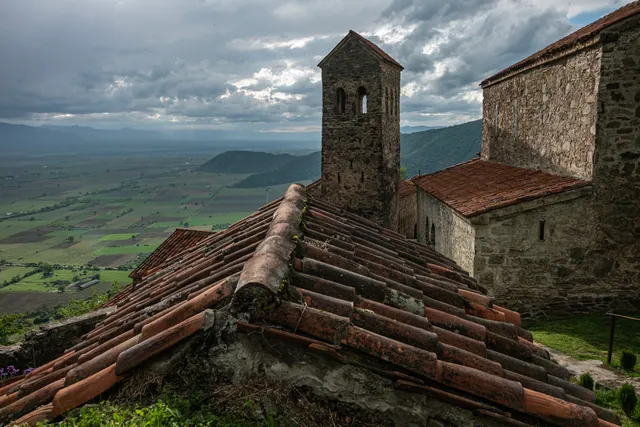
Nekresi Monastery stands on a wooded hill above the Alazani Valley. When you reach the top, the first thing you notice isn't tired legs but the silence, and a feeling that time moves more slowly here. Vineyards spread green below, the ridges of the Caucasus turn blue in the distance, and right beside you stand walls that are fifteen hundred years old.
Nekresi is less famous than Mtskheta or Vardzia, yet people rarely leave it unmoved. It suits travellers who want Georgia without the tourist packaging, with history you can feel and a monastery that is still active.
Where Nekresi Monastery Is and How to Get There
The monastery complex is in the Kvareli Municipality of Kakheti, about 11 km from the town of Kvareli and 35 km from Telavi. From Tbilisi it is about 130 km.
Landmark address: the village of Shilda, at the turnoff to the monastery from the Kvareli–Telavi road. GPS coordinates: 41.972322, 45.760102.
The easiest way to get here is by rental car. Comfort is only part of it. Nekresi lies away from the main tourist routes, and public transport barely serves it. Minibuses between Kvareli and Telavi pass the monastery turnoff, but once you get off you face about 3 km on foot along a dirt road that climbs the whole way. In summer heat that is a real ordeal. With a rental car the problem disappears: you drive to the foot of the hill, park by the complex office, and all that's left is a short, pleasant walk up.
The alternative to renting is a taxi from Kvareli, which is fairly inexpensive. But if you want to see several Kakheti sights in one day (very doable here), a car gives you complete freedom over the route. Gremi fortress (7 km), the wonderful Alaverdi and Sighnaghi are all close to Nekresi, and it's easy to combine them into a single day behind the wheel.
One important detail: in season, cars are only allowed as far as the police post at the foot of the hill. From there you can walk to the top or take a special shuttle bus that runs every 30–40 minutes (much more often at weekends). The fare is nominal.

History: Where Christianity in Kakheti Began
Nekresi is one of the oldest monasteries in Georgia. Its story begins in the 6th century, when one of the Thirteen Assyrian Fathers, the monk Abibos of Nekresi (also known as Aviv or Abo), came to Kakheti. These thirteen missionaries from Syria founded Georgian monasticism: they spread out across the country and established monasteries that grew into spiritual and cultural centres.
Abibos chose the hill above the Alazani Valley for a reason. Below it lay the large and busy city of Nekresi, one of the most important centres of Kakheti, and the monastery was meant to be its spiritual heart. When Abibos became bishop, his residence was here. For several centuries the monastery remained the cultural and religious centre of the whole region: monks studied theology, copied manuscripts and made wine.
Abibos is remembered as the monastery's founder and also as a martyr. According to tradition, he fought the Zoroastrian influence that spread through the region with Persian expansion, and once openly put out the sacred Zoroastrian fire with water. For this he was seized and executed.
Since then the monastery has been through a great deal: enemy raids, plundering and long periods of neglect. After the collapse of the USSR it became active again, and monastic life resumed here in 2000.
The city of Nekresi, which once stood at the foot of the hill, has vanished. Only ruins remain, and they are easy to see from the height of the monastery walls.
What to See: Architecture and Buildings of the Complex
The complex is small, but every building on its grounds has its own history. The area open to visitors includes five structures built in different eras.
Church of St John the Baptist (4th century): the oldest building in the complex and, by some accounts, one of the oldest churches in Georgia. From outside it is tiny and almost unremarkable, a small rectangular block of rough stone. Inside there are no paintings, only bare dressed stone, a few icons on the walls and a candle stand. The austerity is complete, and that is exactly why the place makes such a strong impression. I wouldn't rush through this church in a minute: it's worth standing in the silence for a little while.
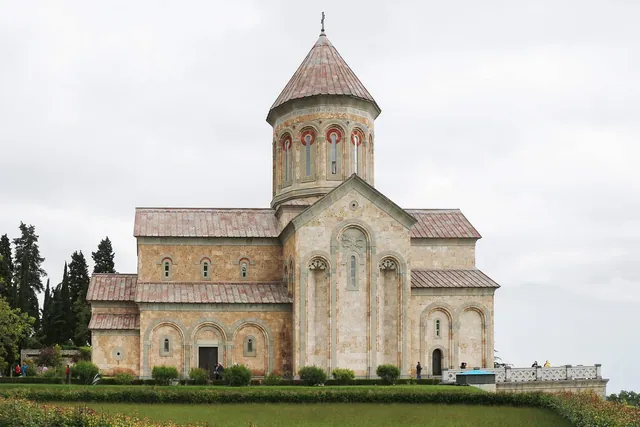
Church of the Most Holy Mother of God (8th century): the main church of the monastery, a three-nave basilica. Unlike St John's, it has kept its frescoes and wall paintings, the earliest examples of Georgian painting in this area. On some frescoes you can see inscriptions scratched over the ancient images in Soviet times. Inside are stasidia, special wooden stalls typical of Orthodox churches in Greece, Cyprus and Bulgaria and very rarely found in Georgian churches.
The "Square Church" (9th century): a small church with an almost square plan, a characteristic example of medieval Georgian architecture.
The Tower (16th century): a defensive structure, a reminder that in troubled times the monastery often became a fortified refuge.
The Bishop's Palace: today a small exhibition hall with icons and paintings on biblical themes.
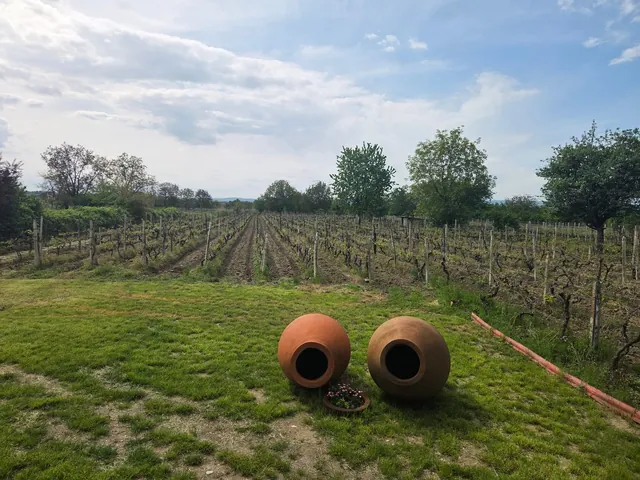
The Marani (wine store): an open gallery with hollows in the floor for qvevri, the traditional clay jars in which Georgian monks aged wine. It is living evidence of the centuries-old tradition of monastic winemaking in Kakheti.
The legend of the pigs deserves a mention of its own. According to tradition, during a Muslim attack the monks once let a herd of pigs out through the gates, and the attackers retreated. Ever since, pigs at Nekresi have been regarded as the animals that saved the monastery.

The View from the Hill: Worth the Climb
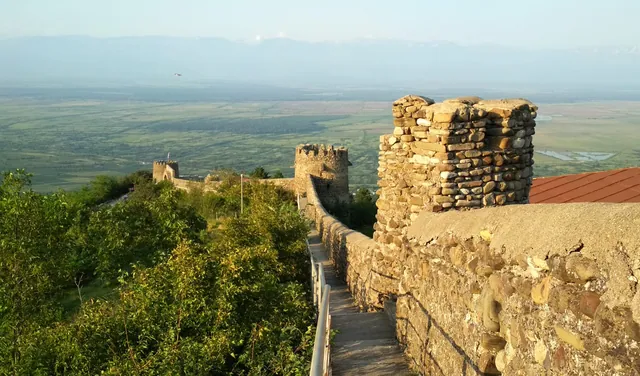
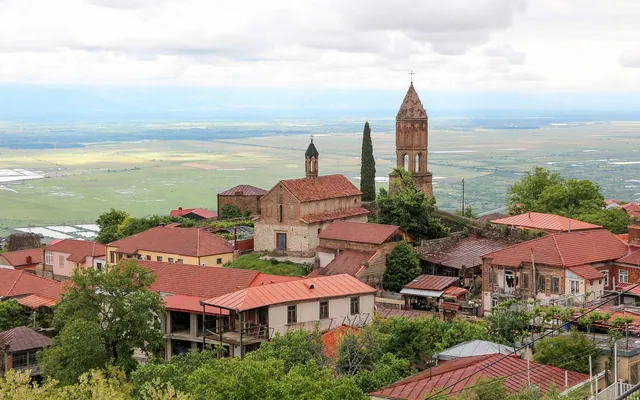
Even if you come to Nekresi only for the view, you won't regret it. The monastery hill offers what may be one of the most beautiful panoramas in Kakheti: the endless vineyards of the Alazani Valley, neat villages and, on the horizon, the spurs of the Caucasus range. On a clear day you can see very far. Early in the morning the valley lies in a milky haze, at midday it glows green, and at sunset it burns warm gold. My favourite is the morning haze, when the valley is just starting to emerge from it.
You want to photograph this place endlessly, and at the same time simply stand and look.
Practical Information
Opening hours: 10:00 to 19:00.
Admission: free.
Dress code: this is an active monastery. Women are advised to cover their heads and wear a skirt (you can bring a scarf). All visitors should have their shoulders and knees covered.
Photography: allowed on the open grounds. Inside the churches, ask the monks first.
Time needed: 1–2 hours including the climb and descent if you walk. By car to the lower car park plus the shuttle to the top, about an hour.
When to go: spring (April–May) and autumn (September–October) are the best times. Summer is hot, and walking up at midday is hard. In winter the road can be difficult to pass.
What to bring: water, comfortable shoes and a sun hat. I'd bring water even if you plan to take the shuttle up: in the sun near the top you'll need it soon enough.
Nekresi and Nearby Sights: A Day in Kakheti
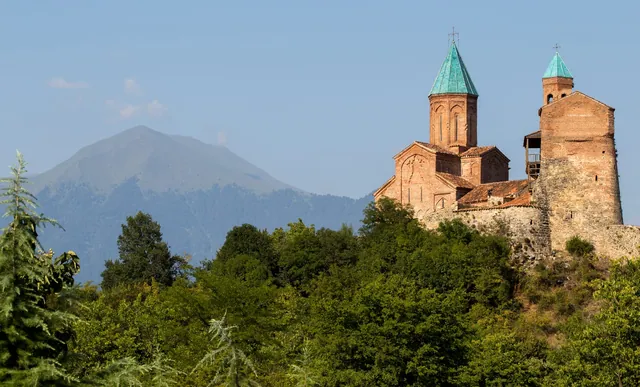
Nekresi fits easily into a route through eastern Kakheti. A few kilometres away is the 16th-century castle-fortress of Gremi, another gem of the region. A little further lies the town of Kvareli, with the well-known Kindzmarauli winery and a scenic tunnel cut into the rock. Towards Telavi stands Alaverdi Monastery, one of the largest cathedrals in Georgia.
It makes sense to cover all of this in one day by rental car. That way you don't depend on minibus timetables and decide for yourself how long to spend at each place. Roads in Kakheti are good, traffic outside the towns is light, and the scenery along the way is worth the trip in itself.
The atmosphere of Nekresi is hard to put into words. It's simpler to climb this hill once, stand at the edge of the slope and look down at the valley for a long time.