
Tbilisi to Racha by car: the route, the stops and what to see
Driving from Tbilisi to Racha: two roads, how long it takes, where to stop, Nikortsminda, Shaori, Khvanchkara, Oni and Gebi. When to go and what to expect at the wheel.
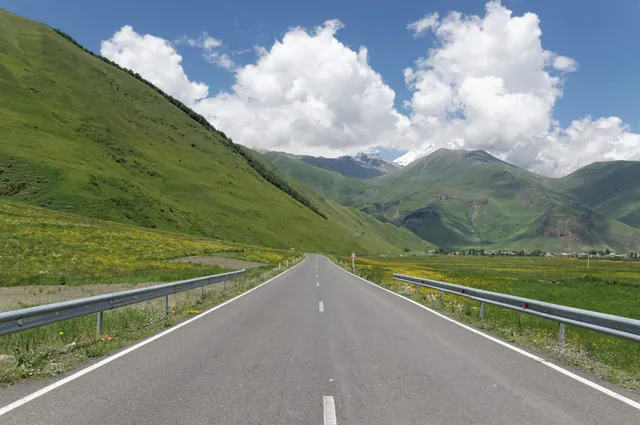
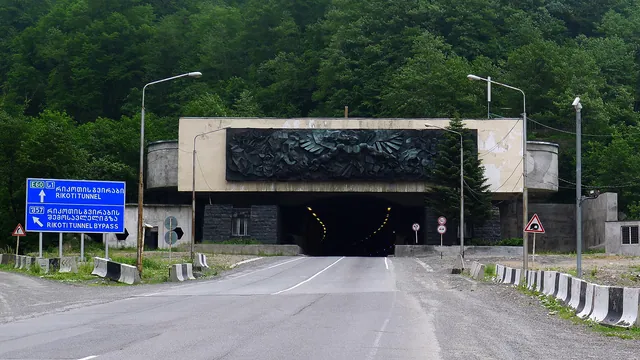
The drive from Tbilisi to Racha comes to about 250 km and 4.5–5 hours at the wheel: motorway over the Rikoti Pass first, then the climb through Tkibuli and the Nakerala Pass. As far as Ambrolauri and Oni the tarmac is fine and an ordinary saloon handles it without drama. The difficulties start higher up the gorge, beyond Oni, and that part is worth driving deliberately.
Racha is still one of the quietest mountain regions in the country. There are no Kazbegi queues here and none of the logistical puzzle of Tusheti, but there is a thousand-year-old cathedral, a wine that cannot be made anywhere else, and gorges where five cars pass in a whole day.
How long it takes and which road to choose
Three roads lead into Racha, and they solve different problems.
Via Tkibuli and the Nakerala Pass. The classic option: Tbilisi, motorway to Zestaponi, the turn north near Terjola, then Tkibuli, the switchbacks up to the pass, Lake Shaori, Nikortsminda, Ambrolauri. Roughly 250 km and 4.5–5 hours without stops. Tarmac the whole way, and the most scenic part falls in the last 70 km.
Via Sachkhere and Shkmeri. In September 2021 a new road opened, 51.5 km long, running from Sachkhere through the villages of Sareki, Kvemo Khevi, Uzunta, Shkmeri, Bokva, Kvashkhieti and Zudali. It joins the Ambrolauri to Oni road 5 km from Oni and 21 km from Ambrolauri. The surface is asphalt concrete, and most of the way runs through the wooded Kheori gorge at 1,000–1,500 m. This option suits you if Upper Racha is the goal rather than Ambrolauri, and if you want to call in at Chiatura and the Katskhi Pillar along the way.
Via Kutaisi and Alpana. The road up the Rioni gorge from Kutaisi. It makes more sense as the way back, with a detour into Lechkhumi, Tsageri and the vineyards of Tvishi. The surface on some sections has been changeable, so before setting off it is worth asking your guesthouse hosts about the current state: they drive it constantly and know the picture better than any map.
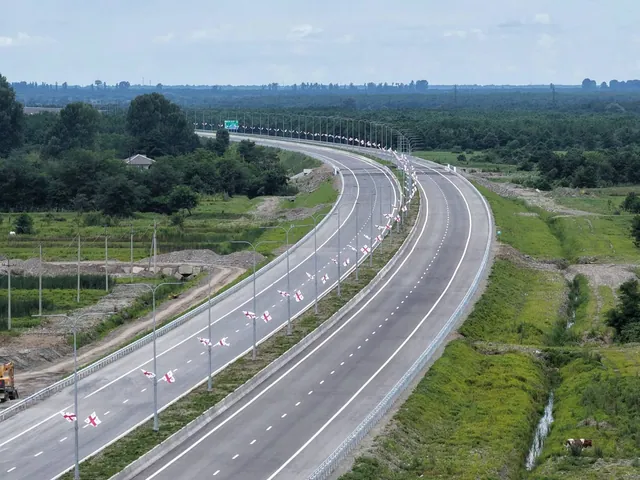
Since December 2025 the whole express section through Rikoti has been open: 51.6 km, 51 tunnels and 97 bridges. The queue of lorries that used to swallow an hour and a half is a thing of the past. The first 160 km to the turn north now go noticeably faster than they did a couple of years ago.
If it is your first time in Racha, take the first option. It gives you the whole picture at once: plain, mining town, pass, lake, cathedral, wine. The second makes sense on the way back or on a second trip, when you have seen the main things and want the mountains without the detours.
A few numbers for planning:
- Tbilisi to the Tkibuli turn: about 180 km, 2–2.5 hours on the motorway
- Tkibuli to Ambrolauri: about 60 km, but an hour and a half, because of the switchbacks and the stops
- Ambrolauri to Oni: 30 km, 40 minutes
- Oni to Gebi: 35 km, a little over an hour, and on foot from there
Average speed in Racha drops to 40–50 km/h, and that is a normal working pace rather than a sign of a bad road. Planning the day by distance here is pointless; count in hours.
The Tbilisi to Racha route via Nakerala: what to see on the way
Ubisa
The Monastery of St George stands off the new motorway, in the Kharagauli district, and requires a turn off the express road. The church was founded in the ninth century, the free-standing tower dates from the twelfth, and the interior paintings were done in the fourteenth century by the master Damiane. The frescoes are dark and deep, nothing like the bright Nikortsminda. The detour takes about forty minutes including the stop.
The Tkibuli reservoir
Mining Tkibuli looks exactly the way a Soviet coal town looks thirty years on. There is not much to see there, but the reservoir on the way out is a good place for the first long stop: water, mountains on the far shore, a couple of cafés.
The Nakerala Pass
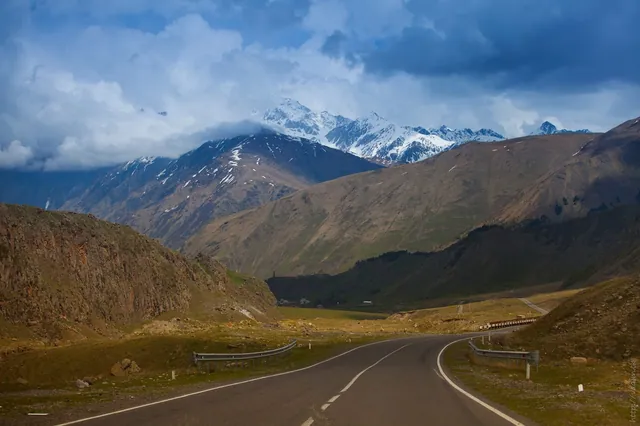
Then the climb begins. The switchbacks are short but tight, with blind corners and a drop on one side. The pass sits at around 1,200 m. At the top there is a viewpoint looking back over the Imereti plain, and there is almost always wind. From Nakerala you can turn off towards the summit of Tskhratskaro with its Church of the Nine Crosses, but the track up there is dirt, and after rain I would not take a saloon on it.
Lake Shaori
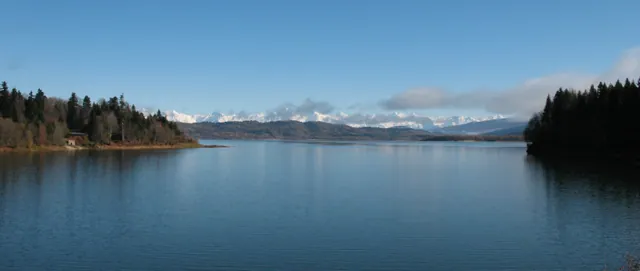
A few kilometres beyond the pass, Shaori opens up on the left. It is not a natural lake but a reservoir built in Soviet times, and the water level moves noticeably with the season. In June the water stands high, the shore is green and the mountains reflect whole. At the end of August I walked a hundred metres of cracked silt to reach the waterline, and the photographs came out completely different. Several turnings lead down to the lake; the best view is from the far, northern side.
Nikortsminda
Fourteen kilometres southwest of Ambrolauri stands the cathedral that many people come to Racha for in the first place. Nikortsminda was built in 1010–1014, under King Bagrat III. Inside are paintings from the sixteenth and seventeenth centuries; outside, stone carving: ornament, beasts both real and invented, biblical scenes. The devastating earthquake of 1991, which crippled half the churches of Racha, barely touched Nikortsminda. The bell tower beside it is much younger, second half of the nineteenth century. The cathedral is on Georgia's UNESCO tentative list.
Inside it is worth staying longer than it seems at the door. The dome rests on a drum with twelve windows, and the light falling through them shifts the picture on the walls through the day: one thing reads in the morning, another towards evening. The facade carving is a subject of its own, and you can spend half an hour simply walking around the building looking at griffins, lions and vine scrolls.
The cathedral is active, services are held, and women need a headscarf and a skirt or something to tie around the hips. There is usually a spare set at the entrance. Entry is free and nobody charges for photographs inside, but you will not be allowed to use flash.
I drove straight past the turning the first time. There is a sign, but it is small, and coming downhill you see it for about two seconds, so it is better to drop a pin in the navigation beforehand.
The Chiatura and Sachkhere option
If you take the second road, two strong sights come up on the way.
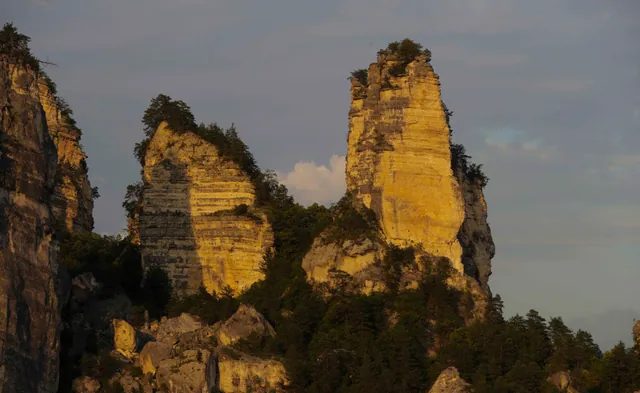
The Katskhi Pillar stands not far from Chiatura: a limestone monolith around 40 metres high with a tiny church on top. Visitors are not allowed up, so you look from below, from the church complex at the foot. It is a strange and memorable sight all the same.
Chiatura is a manganese town with cable cars instead of buses. A significant share of the world's manganese ore reserves is concentrated in the surrounding area, and the whole town was built around mining: houses cling to the sheer walls of the Kvirila gorge, and the link between districts rests on the cableways. Some of the lines have been rebuilt and put back into service, others stand rusting on the slopes. What is actually running on a given day is more reliably established on the spot. The rock-cut monastery of Mgvimevi is also within the town limits.
Chiatura is not for everyone. It is not a postcard place but a living industrial town of Soviet architecture, mosaics and rust. If that texture interests you, allow a couple of hours. If not, drive past without regret.
Then comes the new road through Shkmeri. It is empty, narrow, with long stretches of forest without signal and without fuel. In summer and autumn it drives easily. Winter is another matter: the altitude up there is serious, and it is not cleared the way the main route over Nakerala is, so in the cold season I would not plan this option without fresh word from locals.
Ambrolauri: what to do in the regional capital
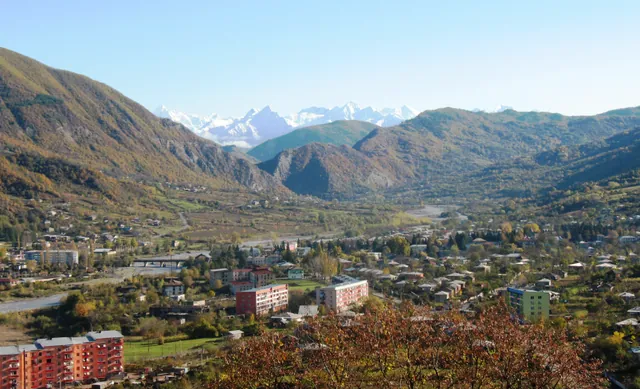
Ambrolauri is officially a town and in practice a village of around 2,000 people, the administrative centre of Racha-Lechkhumi and Kvemo Svaneti. It sits on the Rioni, where three roads meet: to Oni, to Tkibuli and to Tsageri.
There is not much to see here, and that is fine. Ambrolauri works as a base: there are ATMs, a pharmacy, food shops, several cafés and petrol stations. In the centre stands a monument to a bottle of Khvanchkara, which everyone who arrives photographs. There is a working wine house with tastings and a small museum.
The practical case for sleeping here is simple: from Ambrolauri it is equally convenient to drive down to Khvanchkara and Nikortsminda and up to Oni and further into the mountains. The radii are short, 30–60 km one way.
A separate word about money. Cards are taken in the hotels and in some Ambrolauri cafés, but in the villages, at the winemakers' and at the market it is cash. There are ATMs in Ambrolauri and Oni and none higher up the gorge, so it makes sense to draw lari once and with a margin.
Where to stay in Racha
The choice of base decides half the route.
Ambrolauri suits anyone coming for wine, churches and an unhurried pace. It has the widest choice of accommodation, decent cafés and shops, and it is close to Khvanchkara and Nikortsminda.
Oni and Utsera are convenient if the mountains are the main goal. The drive from Oni to Glola and Gebi is a third shorter than from Ambrolauri, and a morning start on a trek from here happens an hour earlier.
Glola means village-format guesthouses: a few rooms, a shared kitchen, dinner at home by arrangement. The standard is simple, the view from the window is expensive. In summer free beds are scarce, so book ahead.
A word apart about Tvishi and Tsageri in neighbouring Lechkhumi: if you are coming back via Alpana, a night there takes the pressure off the last day and adds another wine zone to the trip. On the way you can call in at the Sairme Pillars.
Khvanchkara and the wine of Racha
Khvanchkara is a village in the Ambrolauri municipality and at the same time the name of a wine made from two indigenous grapes: Aleksandrouli and Mujuretuli. Both grow in a narrow band along the Rioni gorge, and it is the combination of altitude, humidity and sun that gives the profile you cannot repeat anywhere else. The name has been protected as an appellation since 2012.
The wine comes out naturally semi-sweet: fermentation stops of its own accord because of the cold nights, with no sugar added. Strength is usually 10.5–12%. Before the revolution it was called Kipiani wine, after the Kipiani princes, and it was renamed in the thirties.
Useful things to know as a buyer:
- Real Khvanchkara is made only from grapes of this microzone, volumes are small, and anything sold cheaply in supermarkets outside the region most often has nothing to do with it
- The villages around Ambrolauri have plenty of family wineries pouring from qvevri. Home wine costs roughly 30–50 GEL a litre, and those figures are approximate and shift from harvest to harvest
- The harvest falls in late October and November, later than in Kakheti
- Besides Khvanchkara, Racha makes the white Tetra and dry wines from the same grapes
The first time, I brought five litres out of Racha in plastic bottles. One of them swelled before we reached Zestaponi, because home wine goes on living. Now I buy only in glass and carry it upright in the boot, packed around with something soft.
Tastings are almost all home affairs, without a website or online booking. You arrange them by phone or through your guesthouse hosts, and that is normal practice.
Barakoni and the village of Tsesi
Seven or eight kilometres from Ambrolauri on the Oni road, on the edge of the village of Tsesi, the church of Barakoni stands right by the carriageway. It is impossible to miss: you see it from a distance, on a bluff where the Rioni and the Lukhuni meet.
Barakoni was built by the architect Avtandil Shulavreli in 1753 for the Rachan prince Rostom. The story behind it is not a pretty one: Rostom was in rivalry with the king of Imereti, and it ended with the king having him blinded. The scale of the church and the abundance of carving on the facade are largely about that rivalry.
On the hill opposite are the ruins of the fortress of Minda-tsikhe. The local version has Queen Tamar spending her childhood there, but there is little to confirm it, so the legend is best treated as a legend.
Oni, Utsera and the mineral water
Oni lies higher up the gorge, about 30 km from Ambrolauri. The town is small and noticeably more worn than Ambrolauri.
The main thing to see here is the synagogue of the late nineteenth century, one of the oldest in Georgia. The Jewish community of Oni was large and Rothschild put up the money for the building, but today there is virtually no community left and the building has remained. Next to it is a local history museum with more than fifteen thousand items in its collections.
Ten kilometres from Oni is Utsera, a spa village at around 1,100 m where some thirty mineral springs of three types are counted. The water is ferruginous with a distinct taste, and locals fill jerrycans with it right by the road. Bringing a bottle along makes sense.
This is where to fill up. Higher up the gorge there are practically no pumps, and I once set off for Gebi with a quarter of a tank on the assumption that something would turn up along the way. It did not. I drove back on the warning light and have filled the tank right up in Oni ever since, even when I plan to be back the same day. For chains and prices, see the guide to petrol stations in Georgia.
Upper Racha: Glola, Chiora, Gebi and what is in Shovi now
This is the most beautiful and the most demanding part of the region.
Glola stands at around 1,300 m, some 25 km from Oni, in the upper reaches of the Chanchakhi. Medieval descriptions call it a fortified town with towers and churches. What survives of that today are the churches of the Exaltation of the Cross and of John the Baptist, and the remains of fortifications on the hill above the river. There are guesthouses here, a handful of them and simple.
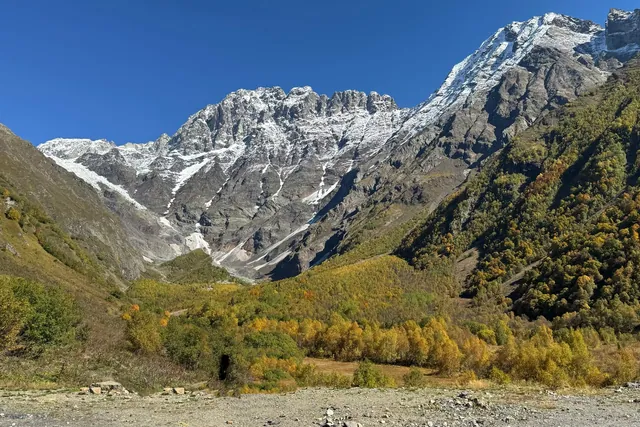
Chiora and Gebi lie higher still. Gebi is 35 km northeast of Oni at 1,399 m, and about three hundred people live there. The treks start from here, and this is where the proper road ends. After years of mudflows, the village of Gona further up the gorge is reachable on foot only.
Shovi. This has to be said plainly. On 3 August 2023 a glacial debris flow came down onto the resort, 32 people died and the infrastructure was almost entirely destroyed. The authorities decided not to rebuild the resort in its former shape, and part of the area remains under access restrictions. The valley is still beautiful and people still drive there, but going "to see the resort" no longer makes sense: there is no resort. It is more sensible to sleep in Glola, Utsera or Oni.
There is a practical conclusion in this that applies to all of Upper Racha. Debris flows do happen in these gorges, usually after heavy rain in the mountains. If it pours two days running, plans for the upper gorges are better postponed, and the forecast to read is the one for the specific point in the mountains, not the one for Ambrolauri.
Treks
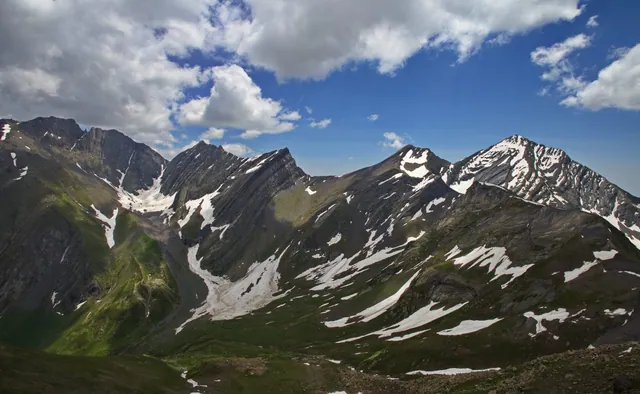
- The Buba Glacier. A day route, roughly 7–8 km one way, climbing to about 2,500 m, 7–8 hours there and back. It follows the Bubistskali river, and the glacier comes into view towards the end
- Lake Udziro. At 2,800 m, the route is about 18 km and takes two days; the section before the pass is steep and loose. Not one for a first mountain walk
- Short walks from Gebi. There are 4–5 hour options with modest ascent, along the river, with log crossings
The mountain season runs from May to October, and it is genuinely comfortable from June to September. The mountain trip checklist is useful before you set off.
How to get to Racha without a car
There are two options, each with its caveats.
By plane. Ambrolauri has an airport of its own, served by the Georgian carrier Vanilla Sky (also trading as Service Air). Flights leave not from Tbilisi international but from Natakhtari airfield, about half an hour north of the city, towards Mtskheta. The aircraft is small, an L-410 with 19 seats, and the time in the air is around 40–50 minutes. Fares are subsidised, roughly from 90 GEL one way, and the figures are approximate and change. The schedule is seasonal, there are few flights, and it gets amended without warning, so check it on the airline's own site rather than on aggregators.
I once set out to buy tickets for that flight a week ahead and did not get them. Nineteen seats go faster than you would think, especially in summer.
One more detail that is rarely written about: flights on aircraft like these are cancelled for weather more often than ordinary ones. Better not to schedule the return tight against an international connection.
By marshrutka. Minibuses run from Tbilisi's Didube bus station to Ambrolauri and Oni. The trip takes about 5.5 hours and a ticket costs roughly 20–25 GEL. Departures are mostly in the morning; getting out in the evening is difficult. It is a workable way to reach the region, but not a way to see it.
Getting around inside Racha is a separate problem. Local minibuses between Ambrolauri, Oni and the surrounding villages exist, but they run once or twice a day, mainly early in the morning, and fitting Nikortsminda, Khvanchkara and Barakoni around them in one day does not work. To the upper villages, Glola and Gebi, transport is irregular and seasonal. The realistic options without your own car: agree a day with a local taxi driver (usually 150–250 GEL for the car, negotiated on the spot), or rent a car in Tbilisi or Kutaisi and drive yourself. For the wider picture, see how to get around Georgia.
The combination that works best is to fly into Ambrolauri and come back overland, or the other way round. That saves you one long leg and you still see the road over Nakerala.
What to expect at the wheel
Class of car. Any saloon will reach Ambrolauri, Oni and Khvanchkara. People take a crossover here not for capability but for comfort: on the Nakerala switchbacks you sit higher, the body rolls less, and passengers get carsick less. You feel the difference in the fourth hour on the road. To get your head around the classes, see which car to choose and jeep or sedan.
Dirt roads. Above Gebi, up to Tskhratskaro and on most of the secondary turnings the roads are unsurfaced. Rental contracts usually restrict off-road driving, so if such sections are in the plan, the terms need talking through in advance. On MY.DRIVE the restrictions and the final price are visible on the car's page before you book, with no phone calls needed.
Fuel. A full tank in Ambrolauri or Oni. There are no stations higher up the gorge.
Signal. In the Rioni valley, in Ambrolauri and in Oni the internet works fine. In the side gorges it drops out for whole stretches. Download the maps offline, and since insurance in Georgia is electronic and there is no physical policy in the car, it makes sense to keep the rental contract in your phone's memory too, not only in the cloud.
Borders. Upper Racha reaches the occupation line with South Ossetia. There is no need to head off north from Gebi and Shovi on dirt tracks, and the Mamison Pass does not work as a through route. More on this in the guide to regions you cannot drive a rental to.
In winter the road over Nakerala is usually passable, but tyres matter: you cannot go up into the mountains on summer tyres in winter. The upper villages are effectively cut off by snow from November to April.
Do you need an off-roader for a trip to Racha
For the standard route, no. Nikortsminda, Shaori, Ambrolauri, Khvanchkara, Barakoni, Oni, Utsera, Glola and Gebi are all reachable on tarmac, and an ordinary saloon gets there.
An off-roader or a car with high ground clearance is needed in three cases: the climb to Tskhratskaro, the turnings to distant villages and hamlets, and drop-offs at the start of mountain trails above road level. All of those mean dirt roads, and dirt roads are almost always excluded from standard rental terms, so the question is settled not by the choice of car but by a conversation with the rental company before you book.
Can you get to Racha in winter
To Ambrolauri and Nikortsminda, usually yes. The road over Nakerala is cleared and there is traffic on it year-round, but the pass can close during heavy snowfall, and that is resolved within a few hours.
People get through to Oni in winter too. Glola, Chiora and Gebi, though, are effectively cut off from November to April: the snow there is serious and clearing secondary roads is not a priority. The new road through Shkmeri in the cold season is a separate question; its altitude and low traffic make it an unreliable winter option.
The key winter requirement for the car is tyres. Summer tyres are unacceptable in the Georgian mountains in winter, all-season will do in some cases, winter is preferable. Check what is fitted to the particular car before you leave, not on the switchbacks.
When to go
May and June. Everything is green, the alpine meadows are in flower, Shaori is at its fullest, the rivers are high. There is still snow lying at altitude.
July and August. 25–30 °C in the valleys, noticeably cooler up top. This is the season of Georgian domestic tourism and the guesthouses in Utsera and Glola fill up. In August it was twenty-eight degrees in Ambrolauri, and in the evening in Glola I sat on the veranda in a jacket. The difference with altitude is sharp here, and a warm layer is needed even at the height of summer.
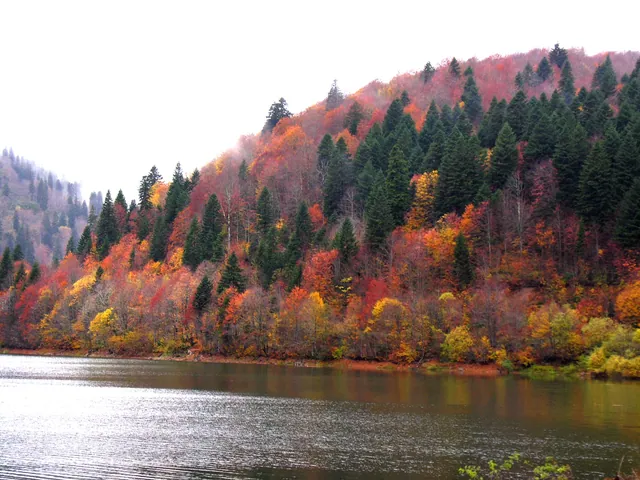
September and October. The best time. Fewer people, clear air, the forest turning yellow, the harvest under way. Khvanchkara is pressed in late October and in November. For the seasonal picture, see where to go in autumn and when to visit Georgia.
November to April. Ambrolauri and Nikortsminda are reachable, Upper Racha is not. People come here in winter for the quiet and the snow, not for routes.
What to eat
Rachan cooking differs from Kakhetian and Imeretian, and it differs noticeably.
- Rachan lobiani. Bread with beans and local ham inside. Sold in the bakeries of Ambrolauri, and better bought hot
- Rachan lori. Cured ham, salty and dense. Sold at the market and in private houses, rarely vacuum-packed. The first time, I carried it to Tbilisi in nothing but a bag, in July, and the car smelled of smoked meat for a couple of days afterwards. Now I bring a cool bag with me
- Shkmeruli. Chicken in a garlic and milk sauce, named after the village of Shkmeri in Racha, the one the new road from Sachkhere runs through
- Lobio in a clay pot, mchadi, matsoni and mountain honey
Restaurants in the usual sense are few in Racha. The main format is dinner at home in a guesthouse, arranged in the morning or the day before, and it usually costs 20–35 GEL a head, figures approximate. The portions are sized so that finishing them is impossible; that is the local norm.
Between Ambrolauri and Gebi there are almost no decent places to eat along the road. If you are heading into the mountains for the whole day, food is easier taken with you from Ambrolauri: lobiani, cheese, tomatoes, water. Oni has a couple of cafés, but their hours are unpredictable.
A three-day route
Day 1. Tbilisi → Ambrolauri. Morning departure, motorway through Rikoti, a stop at Ubisa, lunch around Tkibuli, the climb to Nakerala, Shaori, Nikortsminda. Night in Ambrolauri. About 250 km.
Day 2. Around Ambrolauri. Khvanchkara and a tasting, Barakoni at Tsesi, Oni with the synagogue and the museum, the mineral springs at Utsera. Night in Oni, or in Glola if you are heading into the mountains in the morning. Roughly 100–140 km on the loop.
Day 3. Upper Racha or the drive back. Option one: Glola, Chiora, Gebi and a short walk into the mountains, plus one more night. Option two: back via Tsageri and Alpana with a detour into Lechkhumi and Tvishi, coming out at Kutaisi.
If you only have two days, it is more honest to drop Upper Racha from the programme altogether than to try to fit everything in. The roads here are short in kilometres and long in hours.
The short version
Racha takes one long leg to reach and breaks down into three unhurried days. There is tarmac as far as Oni, and beyond that begins territory that needs weather, a fuel reserve and a sober look at your plans. The best months are September and October, the worst November to April if the mountains are the point rather than the quiet. Come here for an eleventh-century cathedral, a wine that exists nowhere else, and gorges where you can go a whole day without meeting another car.