
Akhaltsikhe and Rabati Castle: What to See, Where to Stay and How to Get There
Akhaltsikhe — Rabati Castle, Sapara Monastery, with Vardzia and Borjomi an hour away. Roads from Tbilisi, Batumi and Kutaisi, prices, when to visit and a two-day route by car.
Akhaltsikhe gets cast by almost everyone as a staging post: you pull in to stretch your legs on the way to Vardzia, photograph the fortress from the car park and drive on. We did exactly the same thing the first time — and then came back on a separate trip, with an overnight stay, because we'd worked out one simple thing: Vardzia, Sapara, Zarzma and Borjomi are scattered through the mountains in such a way that there is exactly one convenient point between them — and that point is Akhaltsikhe.
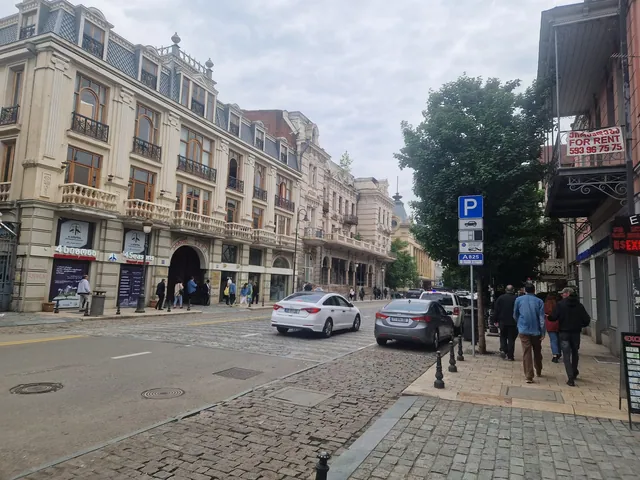
The town is small, some fifteen thousand people, the administrative centre of Samtskhe-Javakheti. It sits high enough that on a summer evening you already want a jumper, and above the rooftops hangs a floodlit fortress the size of half an old town. It isn't worth coming here for a walk through the streets alone — but for everything within an hour of them, it very much is.
Rabati Castle: tickets, what to see, and an honest verdict
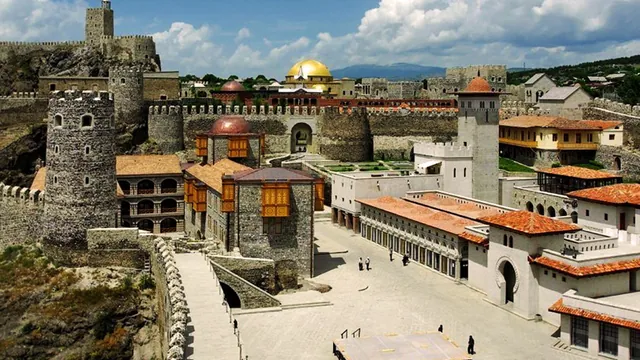
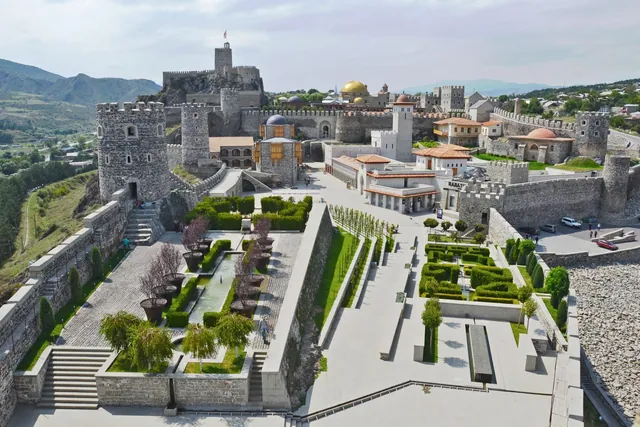
Rabati isn't ruins with an information board. It's a quarter of roughly 7 hectares enclosed by medieval walls, and inside it people live, cafés trade and rooms are let. The first fortifications appeared here as early as the 9th century, but the present look is the result of a 2012 reconstruction that cost 34 million GEL.
The site splits into two parts.
The lower fortress — free to enter. A hotel, restaurants, souvenir shops, a vineyard garden, smooth cobbles. The mood is more resort than history, but this is where you get the best angle on the upper section.
The upper fortress — 7 GEL, with tickets sold at the main gate of the lower part. Inside are Jakeli Castle (13th century), the Ahmediye Mosque with its golden domes (16th century, the Ottoman period), the Christian Church of St Marina, the Samtskhe-Javakheti regional museum and the pasha's mausoleum. From the castle roof a panorama opens over the whole complex and the town in the valley — and that's the point at which it becomes obvious why the fortress was put in this exact spot.
Now, honestly, about the complaint Rabati attracts most often: it looks new. The joints in the masonry are neat, the lawns are trimmed, and in places it feels like the set of a historical drama. If you came for authenticity, for stone that hands touched in the 13th century, Rabati will disappoint you, and you'd be better off driving straight to Zarzma or Sapara. But take the complex for what it is — very large, very coherent, with a mosque and a church two hundred metres apart — and it holds you for an hour and a half or two without effort. The Muslim and Christian layers here aren't neighbouring museum rooms, they are literally neighbours across a courtyard, and that says more about Samtskhe-Javakheti than any display panel.
Allow an hour and a half to two hours for both parts. In the evening the walls are floodlit, and if you're staying in town, a walk after sunset earns a separate half hour of its own: there's almost nobody about, the light is warm, and the fortress finally stops looking freshly built.
Akhaltsikhe is noticeably cheaper than Borjomi for both accommodation and food. If you're planning several days in the region, it's easier to base yourself here and go over to Borjomi for the day.
Sapara: the ten kilometres that make a second day worth it
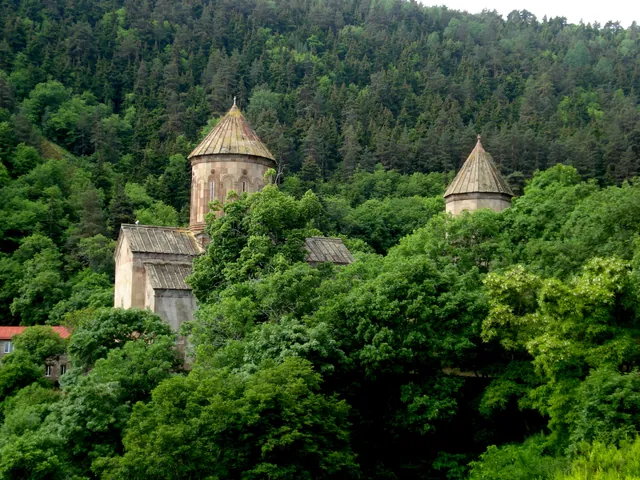
An active monastery in a mountain gorge, 10 km from the centre of Akhaltsikhe, its oldest buildings dating from the 10th century. In mileage that's nothing; in feel it's a completely different trip.
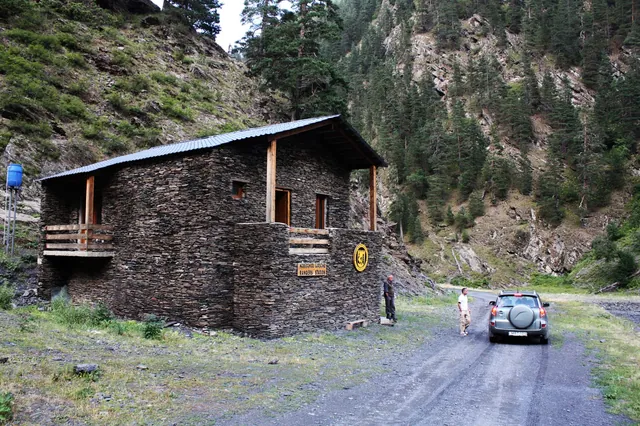
The road is narrow, steep in places, and the final stretch is dirt. An ordinary car copes fine, but slowly: allow around forty minutes for those ten kilometres, given how often you'll stop. There are passing places on the switchbacks for oncoming traffic, but you need to spot them well in advance.
At the top there's a quiet that Rabati can't have by definition. The monastery is a working one: services are held, visitors are met calmly, but this is not a museum and you should behave accordingly — shoulders and knees covered, no photography inside the church without permission. We arrived at ten in the morning and for a good twenty minutes we were the only people there, not counting a monk sweeping the yard. After the restored fortress the contrast is almost physical: dark stone, frescoes, the smell of wax, and forest down both sides of the gorge.
What else is nearby
Akhaltsikhe's real wealth isn't in the town itself but within a sixty-kilometre radius:
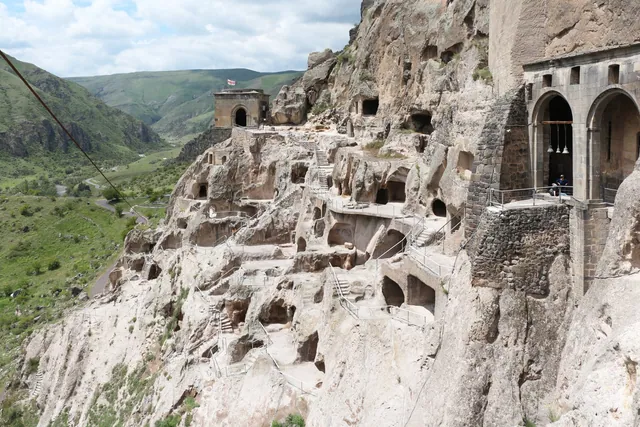
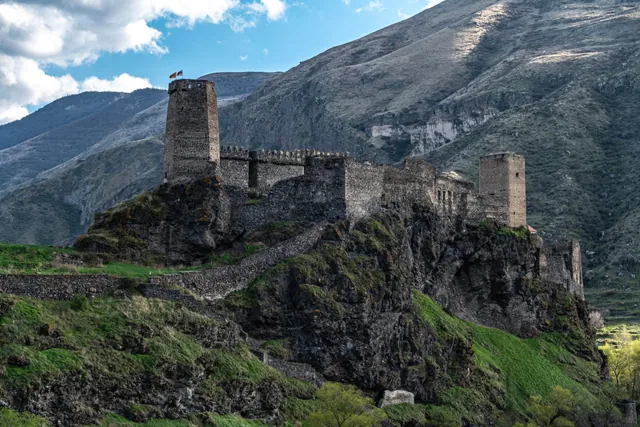
- Vardzia — a 12th-century cave monastery city carved into the cliff above the Mtkvari. 62 km, about an hour and a half each way, asphalt the whole distance. Khertvisi stands on the way — a fortress right at the confluence of two rivers, a twenty-minute stop and one of the best shots on the route.
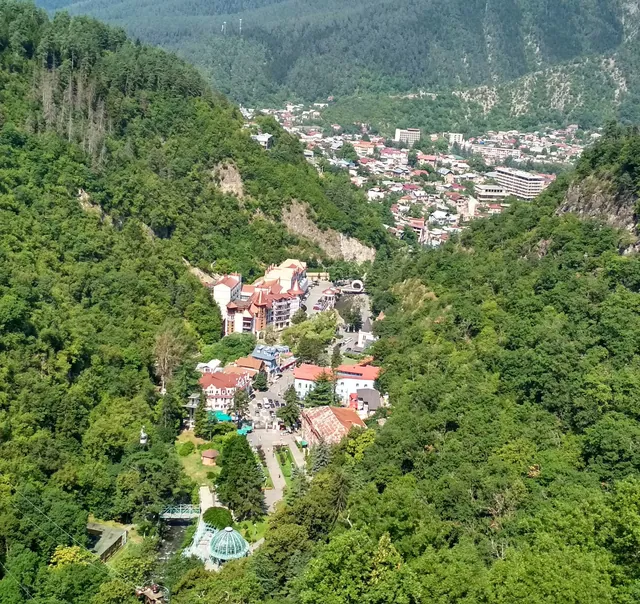
- Borjomi — 48 km, an hour's drive. Drinking pavilions, the park, the national park next door.
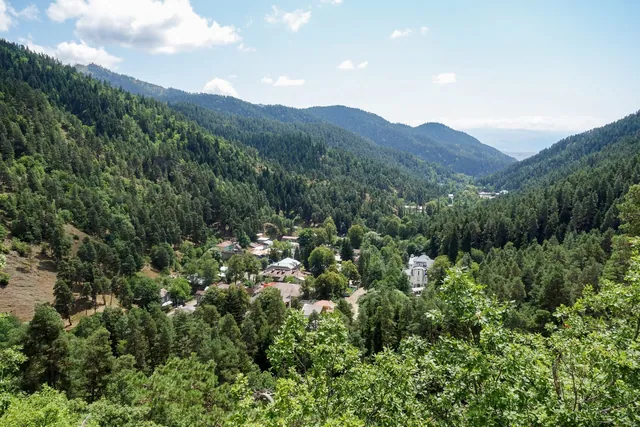
- Zarzma Monastery — around 35 km via Adigeni. Frescoes from the 9th–14th centuries and practically zero tourists.
- Abastumani — 28 km, a former climatic resort with an observatory up on the mountain. A good half-day option if you've already seen Vardzia.
Getting there: the roads and what happens on them
Akhaltsikhe is one of those towns that minibuses officially serve, but everything interesting around it stays shut without a car. Covering Rabati, Sapara and Vardzia in one or two days without bending your plans to a timetable is realistic only in your own car or a rental.
The easiest place to rent a car is Tbilisi — the choice is wider there, and setting off early enough to reach the fortress as it opens is entirely doable. You can pick a car and arrange the rental with delivery around Tbilisi at mydrive.club.
From Tbilisi
207 km, about 3 hours without stops.
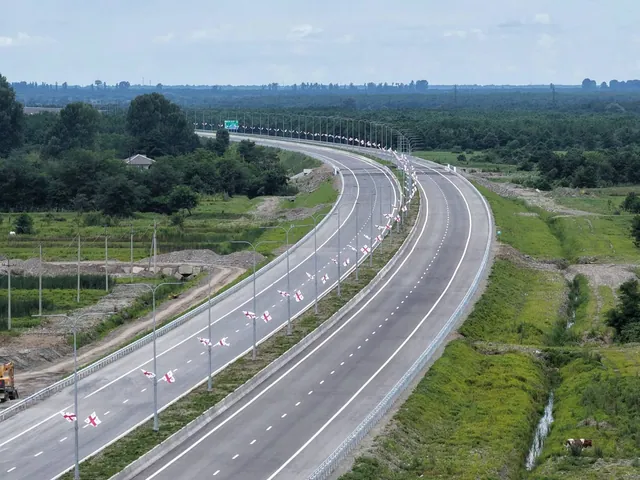
The route: the motorway towards Batumi (E60), then the turn for Gori, Khashuri, Borjomi and on south. The surface is good the whole way, and Mtskheta with Jvari Monastery and Gori sit right on the highway — if you started early, one stop costs you nothing.
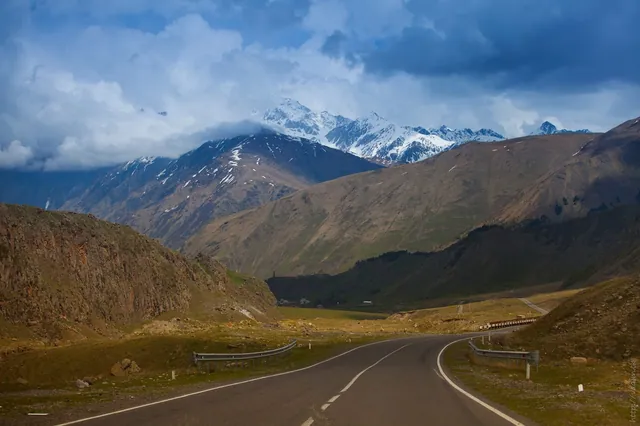
The interesting part begins after Borjomi. The road climbs out of the gorge onto an open plateau, the forest ends, and around you is bare highland with long views and a very tangible crosswind. Lorries and minibuses feel it; in a car, just hold the wheel more firmly and don't be startled by gusts on the exposed sections. There are plenty of lay-bys, and you'll certainly want a shot or two here.
From Batumi
~160 km, about 3 hours.
One important detail: the map will show you a short cut over the Goderdzi Pass. Don't. The asphalt ends at Khulo, and after that it's gravel and switchbacks: in an ordinary car that's slow and uncomfortable, and in winter the pass is closed altogether. The correct route runs via Kutaisi: Batumi → Kutaisi → Khashuri → Akhaltsikhe, the E692, with a decent surface.
From Kutaisi
123 km, about 2 hours — the shortest option from any of the big cities. There's a mountain section with switchbacks around Abastumani: nothing difficult, but your average speed drops noticeably there and it's worth building into the timings.
Borjomi → Akhaltsikhe
48 km, about an hour. If you're coming from Borjomi, it's literally on the way and doesn't need a day of its own.
A two-day route from Tbilisi
The one-day version exists — and we honestly think it's a bad one: nine hours of activity for an hour and a half in a fortress. There are plenty of day trips from Tbilisi that don't involve Akhaltsikhe. This works far better:
Day one. An early departure, a short stop in Borjomi, Akhaltsikhe by lunchtime. Rabati — an hour and a half to two hours. Check in, dinner in town, an evening walk to the floodlit walls.
Day two. Sapara first thing (2–3 hours including the drive), then on through Khertvisi to Vardzia — another two or three hours there. Back to Tbilisi in the evening, or a second night here if you're carrying on towards Borjomi and Bakuriani.
If you only have one full day in the region, take Rabati plus Sapara and leave Vardzia for a separate trip. You can try to squeeze both into a single day, but it turns into a race, and Vardzia doesn't take kindly to racing.
Practical notes
- Parking at Rabati — right in front of the gates, free. There are always spaces in the morning; by midday in season it gets tight.
- Fuel — Wissol, Lukoil and Gulf turn up regularly on all the main routes, and Akhaltsikhe itself has several stations within the town. Fill up here before heading for Vardzia: further south the network thins out. If you're unsure about Georgian fuel grades, we have a separate breakdown of filling stations in Georgia.
- Best time to visit — before 10:00 or after 16:00: fewer groups, softer light, cooler in summer. In the middle of the day there's no shade at all on Rabati's open walls.
- In winter — Rabati is open year-round, and the roads from Tbilisi and from Batumi via Kutaisi stay passable. Check the forecast anyway: the plateau after Borjomi gets blown with snow.
- Cash — cards don't always work in cafés and at small outlets, so a couple of dozen lari in your pocket won't go amiss.
Is it worth the trip
It is — provided you're not coming for forty minutes. Akhaltsikhe doesn't win the beauty contest against Vardzia or the atmosphere contest against Borjomi, but it's the only place in this corner of Georgia that works as a base: everything is within an hour, accommodation is cheaper than at its neighbours, and in the evening there's somewhere to go out. Given that time, Rabati turns from "a fortress that looks too new" into a legible story about a town where a mosque and a church stand in each other's courtyard.
And the main thing we kept coming back for isn't the fortress but the roads leading away from it: ten kilometres into the gorge to Sapara, sixty across the plateau to Vardzia, forty-eight to Borjomi. All of that joins up only with a car. With one, Samtskhe-Javakheti falls into a two-day route; without one, into a set of excursions with waiting in between.