
Khertvisi Fortress: History, How to Get There, What's Nearby
Khertvisi Fortress on the way to Vardzia: history, how to get there from Tbilisi, nearby sights, and how much time to plan for a visit.
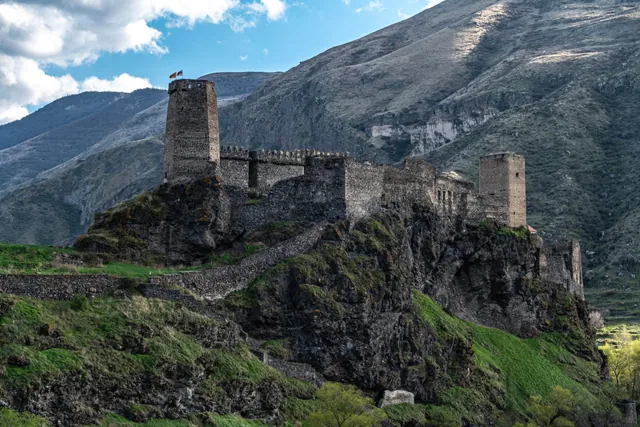
Khertvisi Fortress sits on a cliff where the Mtkvari and Paravani rivers meet, in Aspindza Municipality, Samtskhe-Javakheti region, about 210 km (130 miles) from Tbilisi. It's one of the oldest fortresses in Georgia: the first written mentions date to the 10th–11th centuries, and the surviving walls were built in 1354–1356. Entry is free, the road there is paved the whole way, and Khertvisi sits right on the route to Vardzia, so most travelers see it as a stop along the way rather than a separate trip.
A brief history
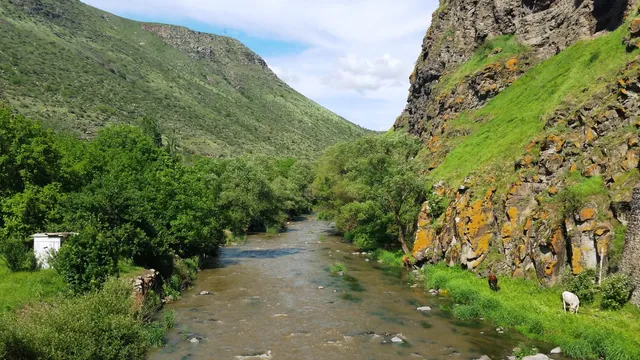
The site wasn't chosen at random. The rock sits in a narrow choke point of the canyon, exactly where the Paravani flows into the Mtkvari, and in the past this was the only place to move an army or a trade caravan from the Mtkvari valley south toward Javakheti and beyond, first toward the Byzantine border, later toward the Ottomans. The river cuts off access from three sides, so a relatively small garrison could control everything moving through the gorge. Khertvisi wasn't built as a shelter for local residents; it was a customs and military checkpoint. Whoever held this rock controlled the entire southern stretch of the route.
Khertvisi guarded the trade road through the Mtkvari gorge toward what is now Turkey, which is why different powers fought over it for centuries. The church on the grounds was built in 985, and the current fortifications went up in the mid-14th century, commissioned by Zakaria Kamkamishvili. According to a legend recorded by the chronicler Leonti Mroveli, Alexander the Great passed through here during his eastern campaign. Historians don't back up that version, but the story has stuck around locally.
In the 10th–11th centuries, Khertvisi was the center of the wider Meskheti region, and by the 12th century a town had grown up around it, with a market and a settled population, not just a garrison. The Mongols destroyed the fortress in the 13th century, and it stayed weakened for close to two hundred years. From the late 13th to the 15th century, Khertvisi belonged to the Jakeli family, who ruled the Samtskhe-Saatabago principality and used it as one of their strongholds. The Ottomans arrived in southern Georgia in the 16th century and held Khertvisi for close to three centuries, turning it into the administrative center of a small district, collecting taxes from there and controlling movement on the road toward Akhaltsikhe and further south. The Georgian general Giorgi Saakadze briefly retook it in 1624, and King Erekle II did the same in 1771, but the Ottomans regained control both times. Khertvisi was finally freed from Ottoman rule in 1828, after the Russo-Turkish War, and a Russian garrison was stationed there through the end of the 19th century, by which point the fortress functioned less as a defensive structure and more as a watch post on the new border. Since 2007, Khertvisi has been on UNESCO's tentative list together with Vardzia.
What to see inside
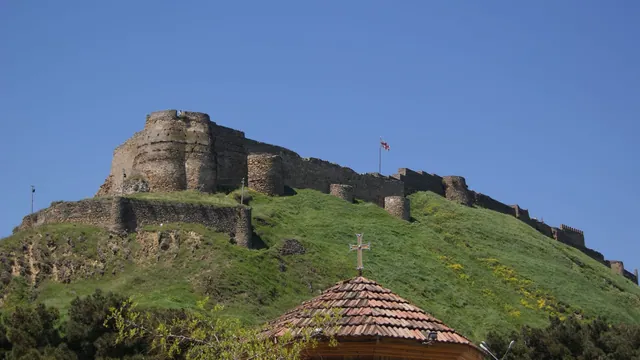
The complex has a citadel on top of the rock and a lower yard wrapping around it on the south and east sides. Inside, you'll find the remains of a watchtower, a keep, and a small single-hall church of St. George dating to the 10th century. Tunnels were cut into the rock beneath the fortress to bring up water from the river during sieges, and part of that passage is still visible today.
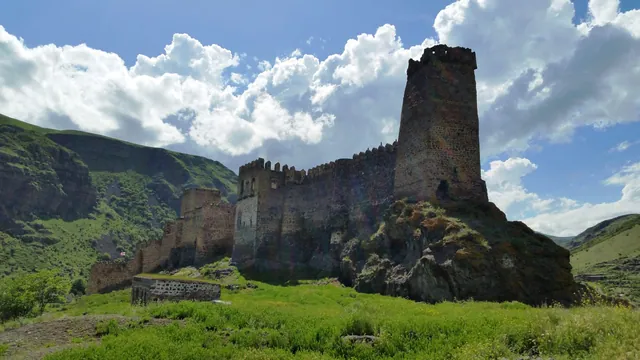
There's been almost no restoration, so the fortress looks genuinely old: crumbling walls, cracked stonework, grass growing between the stones. The citadel stands on a narrow rock ledge, there's no approach at all from the northeast side, and the slope drops straight into the canyon; you notice this if you walk to the edge of the grounds. The top gives you a view over the canyon and the confluence of the two rivers, and the best full shot of the fortress itself comes from the suspension bridge over the Mtkvari, a short walk from the entrance, from where you can see how the walls seem to grow straight out of the cliff.
Getting there from Tbilisi
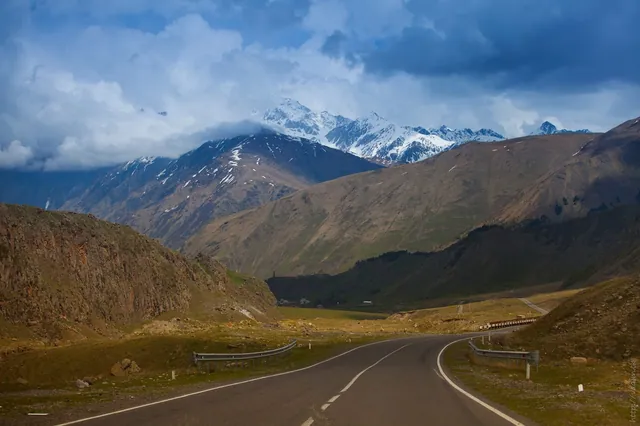
It's about 210 km (130 miles) from Tbilisi to Khertvisi, and the drive via Gori, Borjomi, and Akhaltsikhe takes 3.5–4 hours. The road is paved the whole way with few switchbacks, and the stretch from Akhaltsikhe to Khertvisi runs along the Mtkvari valley, generally considered one of the more scenic drives in southern Georgia.
There's no direct route from Tbilisi to the fortress itself: you'd first take a marshrutka or train to Akhaltsikhe, then switch to a local minivan heading to Vardzia, which passes through Khertvisi a few times a day on a fixed schedule. It works, but it means building your day around limited departures, and it leaves little time at the fortress.
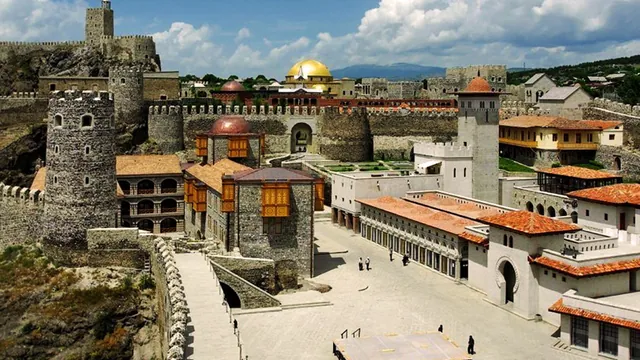
You can also take a taxi from Akhaltsikhe, but if you're hitting several places in one day, say the fortress, Vardzia, and Rabati Castle, the cost of separate taxi rides adds up fast and typically exceeds a day's car rental. A rental car makes the whole loop simpler: leave Tbilisi early, stop at the fortress for an hour or so with no fixed schedule to work around, then continue into the valley to Vardzia or loop back through Akhaltsikhe, stopping at Rabati Castle or Borjomi on the way. One day covers three or four stops instead of just one.
Khertvisi and Vardzia
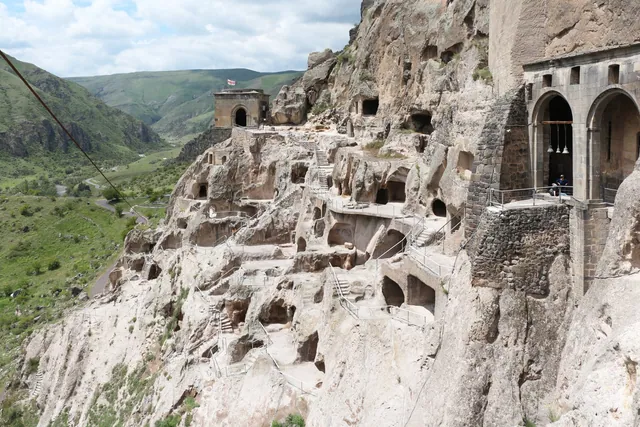
It's 16 km (10 miles) from Khertvisi to Vardzia, a paved road, about 20 minutes by car. Most travelers combine both in a single day: see the fortress first, then continue into the valley to the cave city. If you're planning the route yourself, budget an hour to 90 minutes for Khertvisi and at least two hours for Vardzia separately; there's a fair amount of walking through tunnels and terraces there.
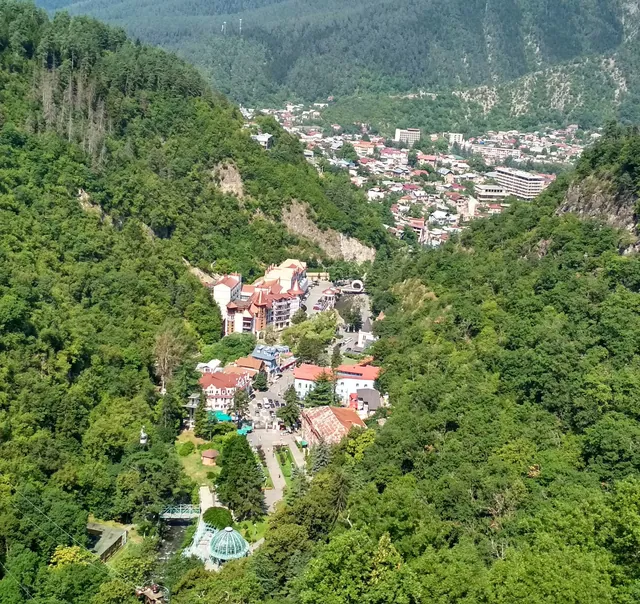
Tmogvi Fortress and the Vanis Kvabebi cave monastery are both nearby and easy to fold into the same route through the valley. In the other direction, 45 km (28 miles) away, is Akhaltsikhe with Rabati Castle, and about 90 km (56 miles) further, closer to Tbilisi, Borjomi with its spa park. You can technically fit Khertvisi, Vardzia, and Akhaltsikhe into one day, but most of it will go to driving rather than sightseeing. For a slower pace, staying overnight in Akhaltsikhe or Borjomi and splitting the route over two days works better.
Good to know
- Entry: free, the fortress is open daily, roughly 9 AM to 6 PM
- Parking: free, at the base of the hill in Khertvisi village
- The walk up: a footpath from the village, about 10–15 minutes uphill on uneven ground
- Footwear: closed, comfortable shoes; some of the stones are loose or slippery
- Time needed: 45–90 minutes, including the climb and photos from the bridge
Bottom line
Khertvisi is worth seeing on the way to Vardzia rather than as a destination on its own; it's a stop of an hour or so, not a full day out. The fortress is easy to spot from the road, the climb up is short, and entry is free, while the best full view of it comes not from inside but from the suspension bridge over the Mtkvari.
If your day also includes Vardzia, Tmogvi, Rabati, or Vanis Kvabebi, it's worth mapping out the order of stops in advance instead of working around marshrutka timetables. The one-way drive from Tbilisi runs close to 4 hours, so it's worth leaving early and budgeting time for stops, not just for the road itself.