
Vardzia: the cave monastery above the Mtkvari and the road to it
A 12th-century cave city in Samtskhe-Javakheti: history, what to see inside, how a visit works, minibus times from Akhaltsikhe and the drive from Tbilisi by car.
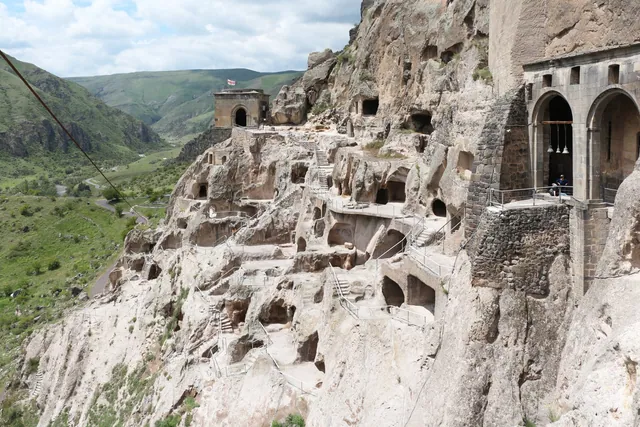
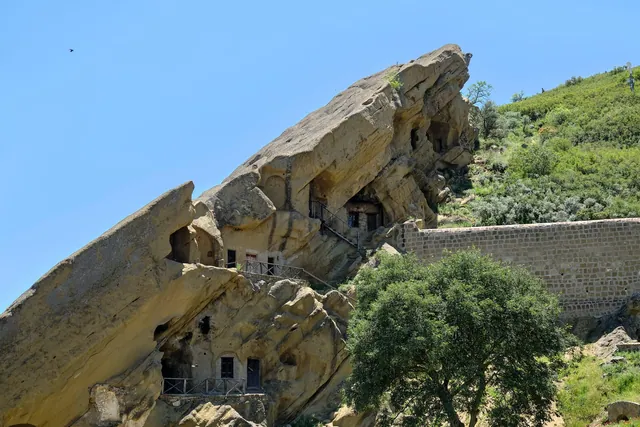
Vardzia is cut into a sheer tuff cliff above the Mtkvari in the south of Georgia, 270 km from Tbilisi. These are not mothballed ruins: monks live in the caves, the liturgy is served in the main church, and 12th-century frescoes survive on the walls. More than six hundred chambers, thirteen levels of height and a labyrinth of passages inside the stone.
From the road along the Mtkvari the cliff is visible a long way off, and the caves on it read like a honeycomb in cross-section. The scale is hard to read, though. Until you get up to the first terraces it looks like a few dozen grottoes rather than a city where several thousand people lived.
How a city appeared inside a cliff
Construction began in the second half of the 12th century under King George III. The sheer tuff cliff in the Mtkvari valley, in the Samtskhe-Javakheti region, suited an impregnable fortress better than anywhere else around: three narrow openings at the base of the rock led inside, and from the outside they were almost impossible to find.
The cliff was not the only reason for the choice. The Mtkvari valley worked here as a corridor: the road from central Georgia ran along it to the south, towards Javakheti and on to the borders of the Muslim world. Whoever held this stretch controlled the route and the approaches to it. A garrison inside the stone was next to impossible to dislodge by siege: shooting at it was pointless, there was nowhere to come at it from, and the stores and the water were inside the cliff.
The peak came under Queen Tamar, the daughter of George III, from 1184 to 1205. The monastery-fortress turned into a full cave city: churches, storerooms, a treasury, refectories, baths, a library. Several thousand people lived here. In 1185 the monastery was consecrated in honour of the Dormition of the Mother of God.
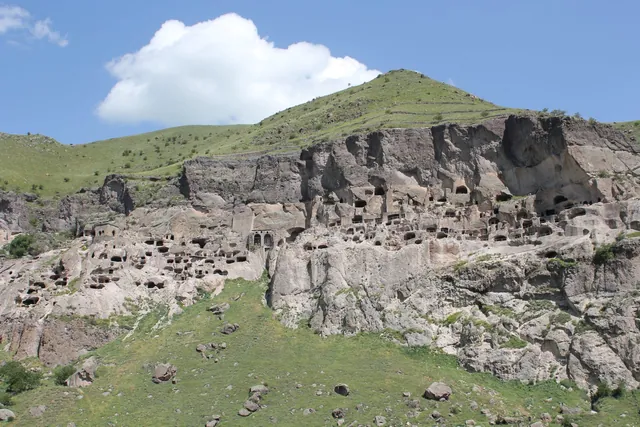
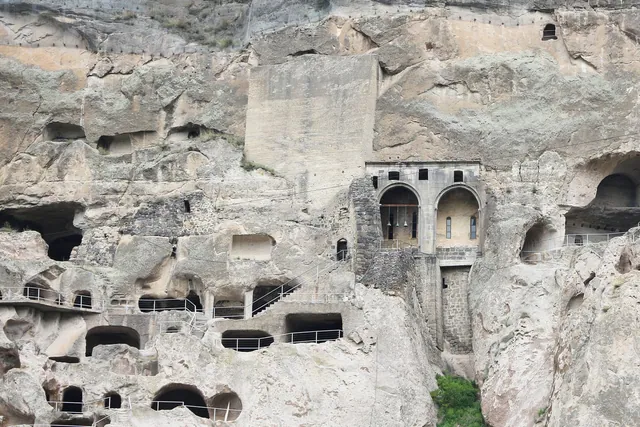
The city was laid out vertically, in tiers, and linked by internal staircases and tunnels. Water was fed through a system of pipes and cisterns, and separate passages were used as emergency and secret routes. For the 12th century that is a level of engineering which impresses more on the spot than any figure for the number of rooms: people lived in the stone permanently, they did not simply sit out a siege in it.
The name is explained in various ways. The popular version connects it with Tamar's childhood: the little princess got lost in the caves and shouted out in fright, "I'm here, uncle", in Georgian ak var, dzia. George III supposedly gave the monastery its name in memory of that.
While the cliff stayed whole it looked like a monolith from outside, and the city inside was all but invisible. The earthquake of 1283 changed everything: a slab of the mountain about 15 metres wide came down into the river and laid bare hundreds of caves. Some of the chambers were left without an outer wall, which is why open terraces now run through the complex where stone used to be. Vardzia lost its military value, but life here did not stop, and in the late 13th and early 14th centuries the bell tower and the narthex arches went up.
After that the history gets harder. In the 16th century Vardzia was taken by the Persians, then by the Turks, and for two and a half centuries it stood empty. Monastic life resumed after Samtskhe-Javakheti was joined to the Russian Empire in 1828. In the Soviet years the monastery was closed and declared a museum-reserve. The liturgy came back only in the late 1980s, through the efforts of Catholicos Ilia II of Georgia. Today it is a working monastery again, and since 2007 Vardzia, along with Khertvisi Fortress, has been on the UNESCO tentative list.
What to see inside
The complex now holds more than 600 chambers, and the cave city rises the equivalent of thirteen storeys. Individual corridors go tens of metres into the cliff, and all the tiers are joined by passages and tunnels.
The main thing here is the Church of the Dormition of the Mother of God. On the walls are 12th-century frescoes: the Last Supper, the Washing of the Feet, the Last Judgement. The particular treasures are the portraits of Queen Tamar and King George, likenesses made in their lifetimes that have come down to us through eight centuries. It is dark inside, the eyes take a minute or two to adjust, and the frescoes read noticeably better if you stand and wait rather than trying to shoot them on a phone straight away.
Besides the church, look at the living cells, the storerooms and the bathhouse complex. The monastery had working water supply and drainage, and secret passages tied the parts of the city together. Of a population in the thousands, four monks are left. They live here now, and in the far part of the complex you feel it: that is not a museum any more, it is somebody's home.
Closer to the upper tiers it is worth simply stopping and looking down the valley. From there you can see how the river goes through the gorge, and why the road along it was fought over for so many centuries.
How a visit works
The route through the complex is marked and runs one way. A small shuttle goes from the car park to the entrance; most people walk back down. Inside there are stairs, narrow tunnels and low ceilings in places. In high season queues build up in passages like these, because there is simply nowhere to turn round or step past the oncoming flow.
We arrived at opening, and that is the best time: half the cliff is still in shade and the passages are clear, while by midday the tuff is baking and there is nowhere left to hide on the terraces. Water is a must, and a hat in summer. The stone on the steps has been polished by feet, so closed shoes with a decent sole matter more here than at any fortress in the south of the country: part of the climb goes over smooth tuff.
The monastery is a working one, and that affects the everyday details. Better to cover shoulders and knees, and a headscarf comes in useful for women in the church. Georgian monasteries often keep wraps by the entrance, but do not count on them. Inside the church people speak quietly, and it is better to ask about photography or simply not take pictures.
Allow two to three hours for the visit. Ticket prices change from time to time, so check on the spot.
What is nearby
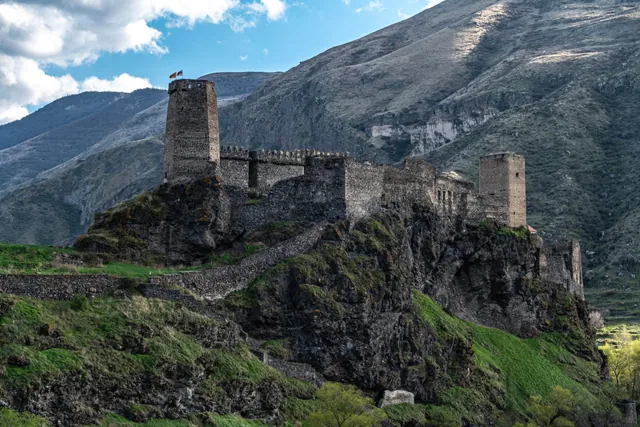
Khertvisi Fortress stands right above the river on the way to Vardzia. It is visible from the road, and the stop takes 20–30 minutes. From Khertvisi to Vardzia is 16 km on asphalt, about twenty minutes. Entry to the fortress is free, and the best shot of the whole of it comes not from inside but from the suspension bridge over the Mtkvari.
Very close to Vardzia is the cave monastery of Vanis Kvabebi, far less known and almost always empty. You have to walk up a path to it, but we met nobody there at all. Tmogvi Fortress stands on the same road in the valley; people usually look at it from the highway.
The drive from Tbilisi
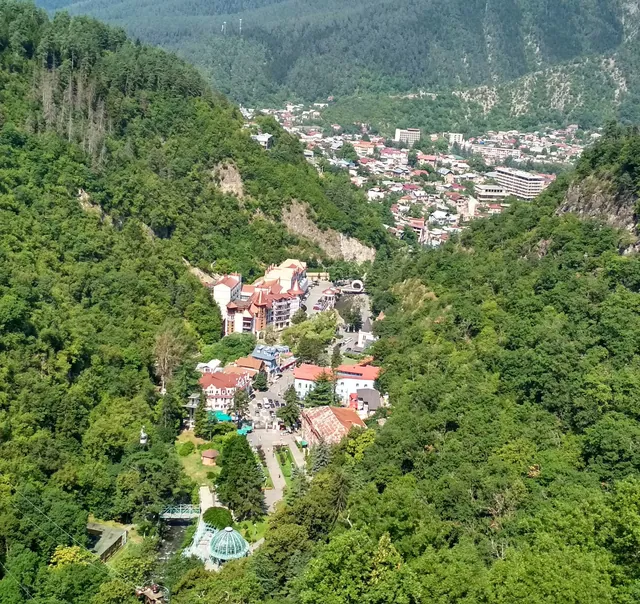
Vardzia is in the Aspindza district of Samtskhe-Javakheti, about 270 km from Tbilisi and 100 km from Borjomi. You can get here on public transport, but the timetable will take your whole day.
There are no direct minibuses from Tbilisi. First you need to reach Akhaltsikhe, about 4 hours, and change there for the minibus to Vardzia. It leaves at 10:30, 12:20, 16:00 and 17:20, and there is another hour and a half on the road. One way works out at 5–6 hours with the change, and on the way back you have to catch one of the rare departures. Get the arithmetic wrong and it means a night in Akhaltsikhe.
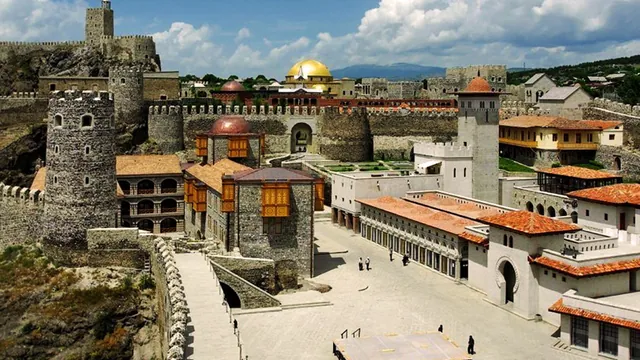
By car from Tbilisi the drive takes around 4 hours, 235–270 km depending on the route: through Gori and Khashuri, then south past Borjomi and Akhaltsikhe. This is the case where your own car settles almost everything: you pick your own departure and return times, you stop at Khertvisi on the way, you can call in at Borjomi or at Akhaltsikhe with its Rabati fortress, and all of it fits into one day without a chase.
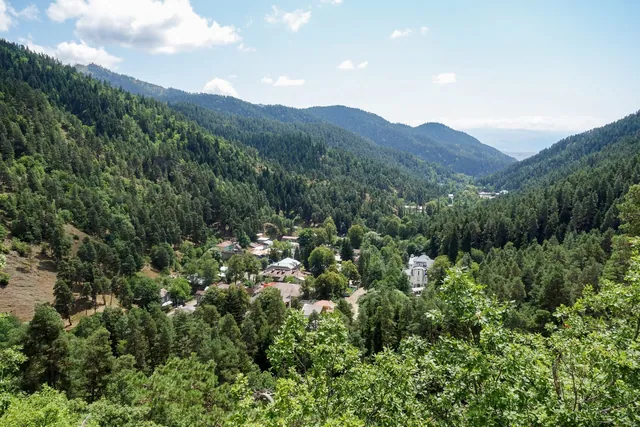
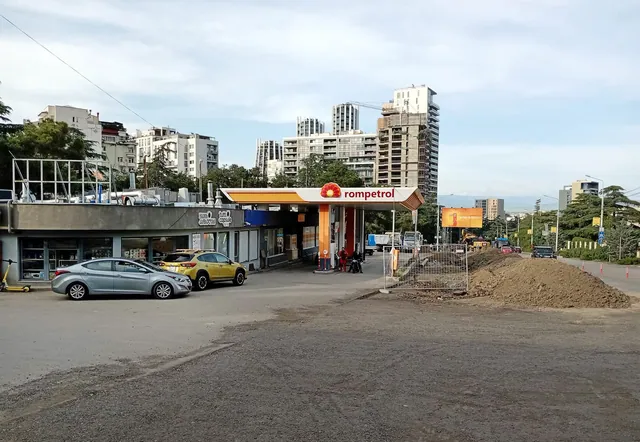
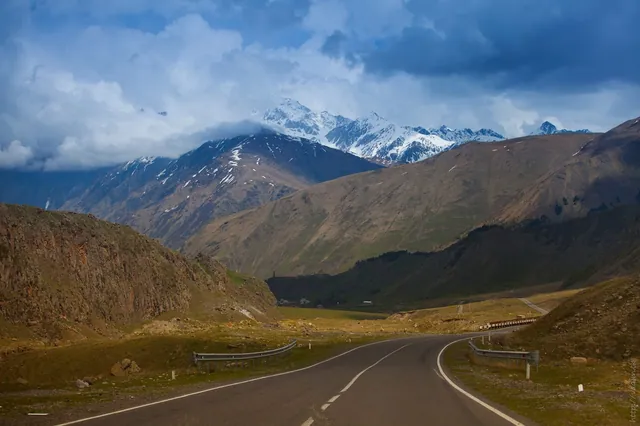
The asphalt from Tbilisi is decent, there is no serious rough road, and an ordinary car is enough. The most interesting stretch starts after Akhaltsikhe: the road goes into the Mtkvari valley, the river runs now on the left, now on the right, and the slopes get higher and drier. You do not want to drive fast here, and there are pull-ins for stops. Fill up in Akhaltsikhe; further south there are noticeably fewer petrol stations.
There is parking right by the entrance. A taxi is also an option, but it works out noticeably more expensive, especially with stops along the way. The most convenient place to take a car is in Tbilisi, and book ahead: in high season, from June to September, the choice for your date narrows a lot.
In one day or with an overnight
Vardzia does work as a single day out of Tbilisi: eight hours behind the wheel there and back, plus two or three hours on site. With that plan you have to leave around six in the morning, and there is room for exactly one stop on the way, Khertvisi.
If you would rather not rush, it makes more sense to split the route over two days with a night in Akhaltsikhe or Borjomi. We stayed in Akhaltsikhe: rooms and food there are cheaper than in Borjomi, and it is 62 km to Vardzia, about an hour and a half each way. The first day then covers Rabati and the road, and the second leaves Vardzia with Khertvisi and time in hand for Vanis Kvabebi. Vardzia fits the set of day trips out of Tbilisi worse than most places: it is a shame to walk through it at speed.
Practical information
| Location | Aspindza district, Samtskhe-Javakheti, southern Georgia |
| Distance from Tbilisi | ~270 km, ~4 hours by car |
| Distance from Akhaltsikhe | ~62 km, about 1.5 hours |
| Distance from Khertvisi | 16 km, ~20 minutes |
| Distance from Borjomi | ~100 km |
| Opening hours | daily (working monastery) |
| Admission | check on the spot or on the official website |
| Time needed | 2–3 hours, a lot of walking and stairs |
| Minibus Akhaltsikhe → Vardzia | departures roughly at 10:30, 12:20, 16:00, 17:20 (verify locally) |
| Minibus Tbilisi → Akhaltsikhe | from Didube station, every hour (leaves when full) |
When to go
Vardzia is open all year round. April, May, June and September with October are the most comfortable: moderate heat, a long day, dry roads. July and August are hard on the cliff, there is almost no shade, and groups stand about in the narrow passages. The complex stays open in winter, but some stretches of the road can be slippery, and with a short day the two or three hours for the visit have to be planned more precisely.
In any season the morning beats the afternoon: before ten the passages are clear, the light is softer and the stone has not yet heated up. A weekday is noticeably calmer than a weekend.
If you only have one day, build it around Vardzia and Khertvisi and do not add a third point. If you can take two, stay the night in Akhaltsikhe: leaving there at seven in the morning and reaching the entrance at opening is easier than driving out of Tbilisi in the dark.