
Electric cars in Georgia: the market, charging and what to plan for on the road
Electric cars in Georgia: how many are on the roads, why the market is growing, where the charging stations are, what a kilowatt costs and what to plan for in the mountains.
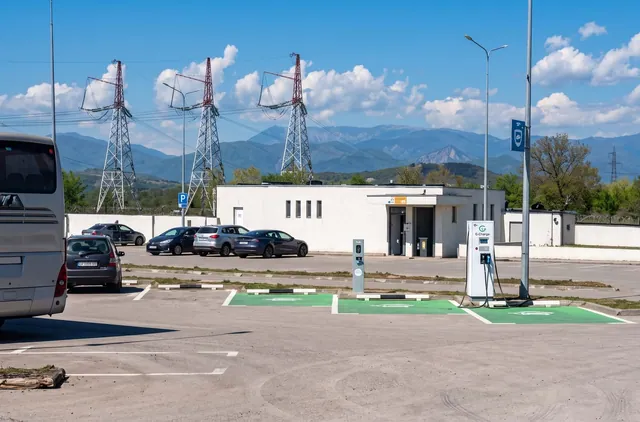
Electric cars still account for less than one percent of Georgia's total vehicle fleet, but no other segment is growing faster: as of 1 January 2025 the country had 9,045 registered cars, a 79% rise over the year. What drives this market is tax, not environmental thinking — electric cars are exempt from excise duty on import. Charging stations cover Tbilisi, the highway to Batumi, Kakheti and the main resorts, and in the high mountains there are none at all.
How many electric cars are in Georgia and where they come from
Separate statistics for electric cars in Georgia have been kept since 2017. Back then there were 852. By the start of 2025 the figure had reached 9,045 — more than a tenfold increase in eight years. About three quarters of all these cars are registered in Tbilisi, with Imereti and Samegrelo trailing a long way behind.
Most of them arrive from American auctions. In 2024 the country imported 5,454 electric cars worth $107 million: 3,313 from the US, 841 from China, 840 from Japan, 199 from Germany. In the first half of 2025, 3,616 cars came in, 88% more than a year earlier. Chinese brands are the fastest-growing part of that statistic, and BYD has already become a familiar sight in Tbilisi traffic.
There is an important caveat. Georgia works as a transit hub: some of the imported cars do not stay in the country but travel on to Azerbaijan, Armenia and Central Asia. Import figures are therefore always higher than the real growth of the fleet.
One more detail explains a lot about this market. Among new registrations in 2025, petrol accounted for around 60%, hybrids for almost a quarter, diesel for 9%, and pure electric cars for roughly 5%. The mass choice of the Georgian buyer right now is a hybrid, not an EV.
Why the electric car market in Georgia is growing
Electric cars are not subject to excise duty on import, and for hybrids the rate is reduced. For internal combustion cars the duty is calculated from engine displacement and age, and in spring 2026 the rules were tightened considerably. From 1 April the rate for cars older than six years rose to 4.5 lari per cubic centimetre, against 1.5 lari for cars under six years old. The government originally intended to ban the import of six-year-old and older cars outright, but under pressure from car importers it replaced the ban with the higher duty.
Neither the age limit nor the new rate applies to electric cars. They have no engine displacement, so there is no base on which to charge the duty. Registering a 2016 electric hatchback in Georgia today is simpler and cheaper than a petrol saloon of the same age.
The market as a whole has shrunk, though: between January and May 2026 the country imported 77,054 passenger cars, the lowest figure in four years. The share of electric cars is growing partly because everything else has become more expensive.
Where to charge an electric car in Georgia
There are several operators, each with its own app:
- E-Space. Running since 2016, more than 150 stations across the country, 78 of them free. Seven fast chargers stand on the highway between Tbilisi and Batumi; slow ones can be found in Stepantsminda, Zugdidi and around Kakheti.
- EcoCars. Mostly fast stations in cities and on the main routes, including Gudauri and the centre of Kutaisi.
- Da-tene. Fast chargers in Kakheti (Telavi, Kvareli) and in Akhaltsikhe.
- Charger Plus. A younger network, with its key points in Gudauri and Lagodekhi.
- Moveo. A new operator with powerful 60, 180 and 240 kW stations, CCS2 and GB/T connectors. The network is small but growing.
- ProCredit. A map of free chargers, including unusual spots such as Jvari and Ozurgeti. The app does not show station status, so you only find out whether it works once you are there.
On top of that there are free municipal chargers in Tbilisi. The city hall installs them at residents' request, and in early 2025 it announced an auction for another 198 points around the city. They are not fast, but for an overnight top-up in the courtyard they do the job.
The overall map is easiest to check in PlugShare or on ev-georgia.net, but you cannot start a session from there. Install the apps of the networks you need and link your card while you are still at home. The first time round I registered right at the station near Zestafoni: SMS confirmation, card linking, app update — fifteen minutes instead of three.
Connectors and cables: what should be in the boot
Fast charging in Georgia is almost always CCS2. The second most common connector is GB/T, needed by cars from the Chinese domestic market. CHAdeMO turns up more rarely, for example at the larger Socar filling stations along the motorway.
Teslas from the US are a story of their own. American cars have the NACS connector and cannot be plugged into a Georgian station without an adapter to CCS2. In rental cars the adapter is usually included; with private owners it varies.
Slow Type 2 stations most often come without a cable of their own. Your own Type 2 cable solves the problem in hotel car parks, at wineries and in shopping centres. Emergency charging from a 220 V domestic socket adds roughly 10–15 km of range per hour, so it works only overnight or as a last resort.
What charging costs compared with petrol
Indicative tariffs: about 0.6 lari per kWh at slow stations and about 0.85 lari at fast ones. The exact price is shown in the network's app, and it differs from operator to operator.
Let's do the maths per hundred kilometres. An average electric crossover uses 17–20 kWh, which comes to 15–17 lari at a fast charger and 10–12 lari at a slow one. A petrol crossover burning 9–10 litres, with 95-octane at around 3 lari a litre, will spend 27–30 lari. The difference is roughly twofold. At the free municipal stations in Tbilisi it is more striking still.
In the mountains this arithmetic stops working. On long climbs consumption rises, though on the way down regenerative braking returns part of the charge to the battery.
Mountains, winter and real range
Manufacturer range figures can safely be scaled down in Georgia:
- Frost and a running heater take away 20–30%.
- A climb to 1,500–2,000 metres eats the charge noticeably faster than a flat highway.
- The descent gives some of it back, but not all.
On the climb from Ananuri up to Gudauri in winter my consumption rose by about half compared with the highway, and I arrived in Stepantsminda with less left than I had planned for. Now I budget an extra third for that stretch and leave Tbilisi on a full battery.
The rule for long legs is simple: plan your charging stop at 20% remaining, not at 5%. And check the station's status in the app before you turn off the highway.
Where not to go in an electric car
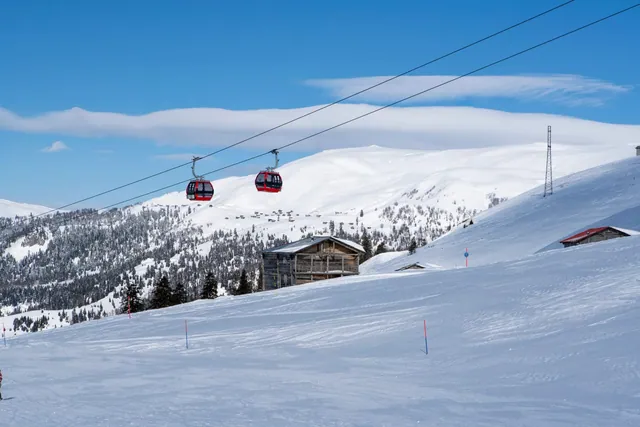
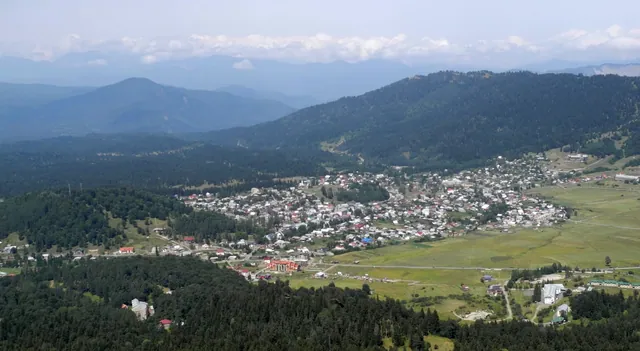
There are no chargers in Svaneti, Tusheti, Racha or Khevsureti. For some of these directions the question answers itself: rental cars are not allowed there regardless of engine type or vehicle class. The list of directions banned for rentals includes Tusheti, Ushguli, Juta, the road over the Goderdzi pass and Vashlovani.
A realistic picture by route looks like this:
- Tbilisi and around: Mtskheta, Dashbashi, Bakuriani. No questions arise.
- Kakheti: Sighnaghi, Telavi, Kvareli. There are fast chargers in Telavi and Kvareli, and many wineries and guest houses will let you use a socket.
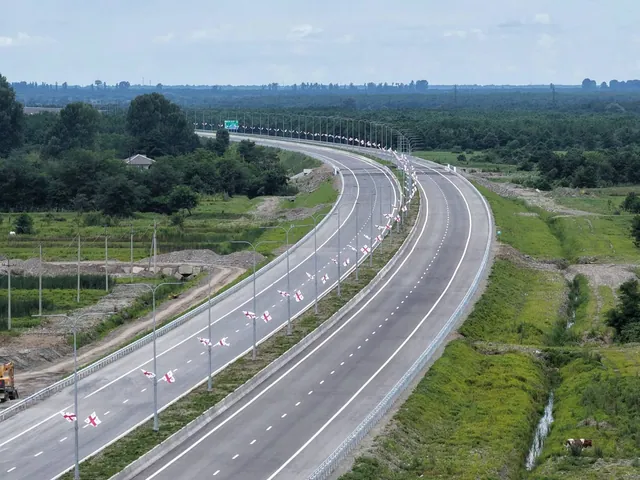
- The highway to Batumi: 370 km, one 30-minute stop around Zestafoni or Kutaisi.
- The Georgian Military Road to Stepantsminda: 150 km one way, there are chargers along the route, and in winter you need a reserve.
- Svaneti, Racha, Khevsureti: not for an electric car.
Renting an electric car in Georgia: who it suits
You can rent an electric car in Tbilisi and Batumi; the fleets most often hold a Tesla Model 3 or Model Y, less often Chinese and Korean crossovers. There are noticeably fewer electric cars in rental than petrol ones, including on MY.DRIVE, so it is better to book one in advance rather than in the last week before the trip.
Before you confirm a booking, check three things:
- Which connector the car has and whether an adapter to CCS2 is included.
- Whether there is a Type 2 cable and an emergency domestic-socket cable in the boot.
- Whether the car is registered in the Tbilisi parking system.
The last point matters because of a perk: owners of electric cars are exempt from the capital's zonal hourly parking fee. There is a flip side too. A 100 lari fine applies to parking at a charging station without charging, and that covers electric cars as well: take the space and fail to plug in, and you are in breach.
What matters most
Electric cars in Georgia have stopped being exotic, though they are still a long way from the mass segment: under one percent of the fleet, but the fastest growth curve and a tax regime that works in their favour. The infrastructure covers Tbilisi, the highway to Batumi, Kakheti and the Georgian Military Road, and does not cover the high mountains at all. For a standard tourist route that is enough, on three conditions: the network apps are installed in advance, a Type 2 cable is in the boot, and in winter a third is added to your calculated consumption.