
Where to Go in Georgia in Autumn: Routes With and Without a Car
Where to go in Georgia in autumn: rtveli in Kakheti, Kazbegi before the first snow, Racha, the bird migration at Batumi. Routes with and without a car, and the weather month by month.
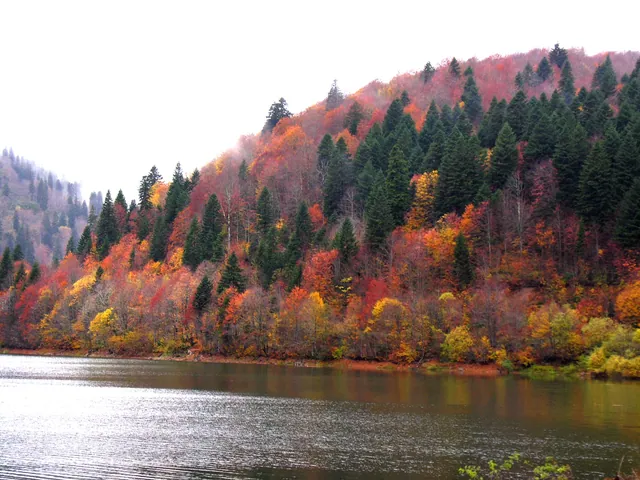
Autumn in Georgia splits into three unlike months, and where you go depends on which one you get. In September and the first half of October the mountains are still open: Kazbegi, Racha, Svaneti, the Javakheti plateau. From the end of September rtveli, the grape harvest, is under way in Kakheti. By November the high country closes and the routes shift downhill: Borjomi, Vardzia, Lagodekhi, the Adjaran coast.
Three autumns instead of one: what to expect from the weather
The difference between 10 September and 10 November in Georgia is greater than the difference between summer and autumn in a northern climate. Planning around the single word "autumn" will not work.
September
Effectively a continuation of summer. In Tbilisi it is +25 to +30 in the daytime, and by evening it is already comfortable to walk on Mtatsminda. At the sea in Batumi the water holds at around +24, and you can swim for almost the whole month. In the mountains it is clear and dry, the best time for Kazbegi and for any trek. At night at 1,700–2,200 m it is already close to zero, so a sleeping bag and a hat are needed even if you walk in a T-shirt during the day.
The one drawback of September: the colours are still summer ones. The yellow forest that many people come for is nowhere to be found in the first half of the month.
October
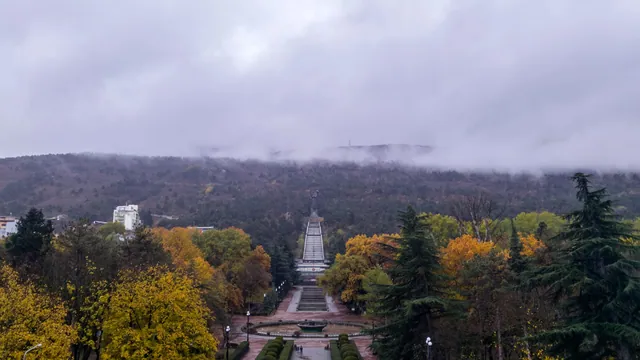
The steadiest month. In Tbilisi +18 to +23 in the daytime, with rain rare and short. The leaves in the mountains at 1,500–2,000 metres start to turn around 10–15 October; in the valleys and in Tbilisi itself the peak falls at the end of October and the first days of November. There are noticeably fewer tourists than in August, and accommodation prices in Batumi drop by a factor of one and a half to two.
The first snow is already possible in the mountains in October. It usually melts away within a day or two, but a couple of times it has closed the Cross Pass for several hours.
November
The month people underrate. In Tbilisi +10 to +14, plenty of sunny days still, and no queues anywhere. The high country, though, is effectively shut: the Abano Pass into Tusheti fills with snow from the end of October, on the Cross Pass on the road to Kazbegi the snow settles in earnest, and in Racha and Svaneti the roads are passable but the weather is a lottery.
It gets dark early in November. By the end of the month the sun sets around 17:20, and any mountain route has to be built so that the descent off the switchbacks finishes before dusk.
Kakheti and rtveli: the main autumn destination
If you have three or four days for Georgia in autumn, Kakheti settles the question. Everything lines up here at once: warm weather to the end of October, vineyards in their fading colour, the harvest itself, and the simplest logistics in the country.
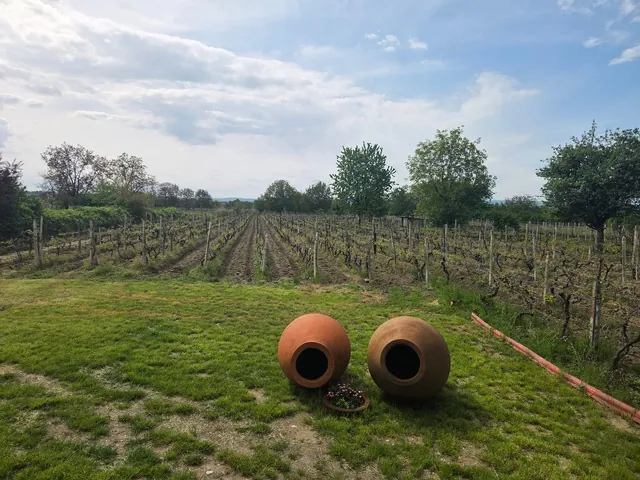
Rtveli runs from the middle of September to roughly the end of October; the exact dates move every year and depend on the grape variety and on the weather. In Kakheti the picking starts later than in cooler Racha. Taking part in rtveli at most wineries is paid, with sums starting from around 50 GEL per person, and the prices are indicative, so it is better to check directly. For that money you genuinely cut the bunches, tread the grapes in a satsnakheli and then sit down at the table. The ancient method of fermenting in qvevri is on the UNESCO list of intangible heritage, and Kakhetian estates are glad to show it.
What to see
- Sighnaghi: a fortress town on a hill above the Alazani valley, with a wall you can walk along. 110 km from Tbilisi, about 2 hours.
- Bodbe: the monastery with the grave of St Nino, two kilometres from Sighnaghi. The viewing terrace looks out over the whole valley, with the Caucasus range standing behind it.
- Telavi: a working town rather than a shop window. The Batonis-tsikhe fortress, and a plane tree that local legend puts at more than nine hundred years old.
- Alaverdi: an eleventh-century cathedral in the middle of the vineyards, one of the tallest churches in Georgia.
- Tsinandali: the Chavchavadze estate with a park that is especially good at the end of October.
- Kvareli and Lake Ilia, along with the wine tunnels cut into the rock.
The road from Tbilisi to Telavi runs over the Gombori Pass, the shortest option at about 90 km. In autumn fog settles on the pass often, visibility drops to some thirty metres, and that is not the place to overtake. The second road, through Sagarejo and Gurjaani, is around forty kilometres longer but easier. In autumn I almost always drive out over Gombori and come back along the lower road.
Without a car: marshrutkas to Telavi and Sighnaghi leave from Ortachala bus station and from Isani metro station, the trip takes 2–2.5 hours, and a ticket costs around 10–15 GEL. The trouble starts after that: between Alaverdi, Tsinandali and Kvareli there is almost no public transport, and you will have to arrange a local taxi for the day. It works, but it comes out more expensive than renting a car between two.
Kazbegi: the window that closes in November
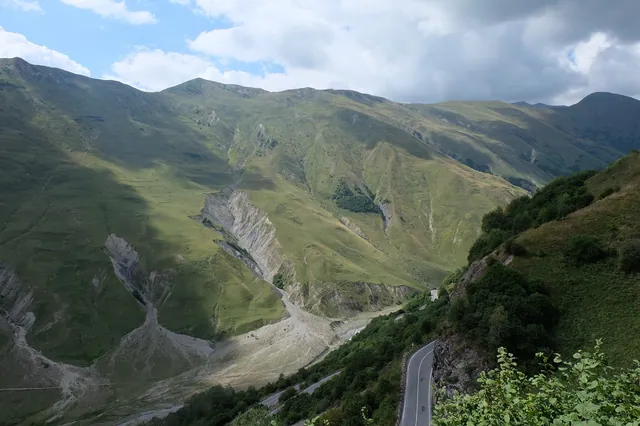
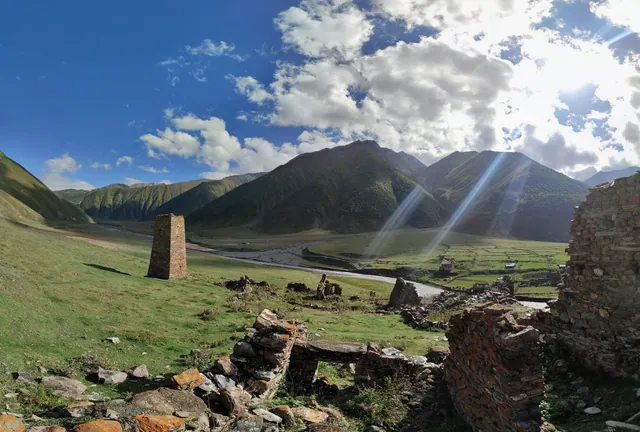
The Georgian Military Highway looks better in autumn than in summer. Fewer lorries, clear air, and Kazbek shows itself more often: in summer the summit is permanently wrapped in cloud, in October it stays open for several days in a row.
155 km from Tbilisi to Stepantsminda, 3–3.5 hours without stops. With stops, allow five.
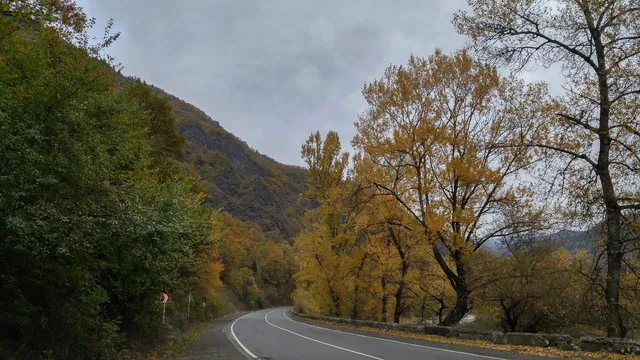
What is worth seeing along the way:
- Ananuri, the fortress on the Zhinvali reservoir, 70 km from Tbilisi. In autumn the water in the reservoir drops, the clay bed is exposed, and the colour turns from turquoise to a murky green. That is normal, not a sign that you have come to the wrong place.
- Gudauri and the Friendship of Nations viewpoint with its mosaic panorama.
- The Cross Pass, 2,379 m, the highest point of the route.
- Gergeti Trinity above Stepantsminda. A short paved road with a steep gradient leads up; in summer there is a queue of Delicas on it, in autumn it is empty. On foot, the trail from the village takes an hour to an hour and a half.
- The Gveleti waterfall, a short trail from the car park, about twenty minutes each way.
- The Truso Valley with its travertine terraces and mineral springs. Gravel road, border zone, and a passport with you is compulsory.
An important restriction: Juta is not covered by rental contracts. This is not a matter of "a difficult road" but a direct ban by the rental companies, the same as Tusheti, Ushguli, Vashlovani and Goderdzi. You cannot drive there in a rented car, even an SUV. People reach Juta by local jeep from Sno.
Without a car: marshrutkas to Stepantsminda leave from Didube bus station, take about four hours and cost around 15–20 GEL. They run regularly, in winter as well. From Stepantsminda up to Gergeti local drivers charge 30–50 GEL for the round trip with waiting. This is probably the one mountain destination in Georgia where being without a car is genuinely fine.
Racha: the autumn worth setting aside two days for
Racha in autumn looks better than most of the well-publicised places in Georgia, and almost nobody goes there. Deciduous forest, beech and hornbeam, slopes running from yellow to dark burgundy, empty roads.
The way in is through Terjola and Tkibuli. That route is paved and manageable in a saloon: from Kutaisi to Ambrolauri it comes out at about 110–120 km and 2.5 hours. The second road, along the Rioni through Tsageri, is shorter on the map, but the surface disappears in places and in a saloon you will lose more time than you gain.
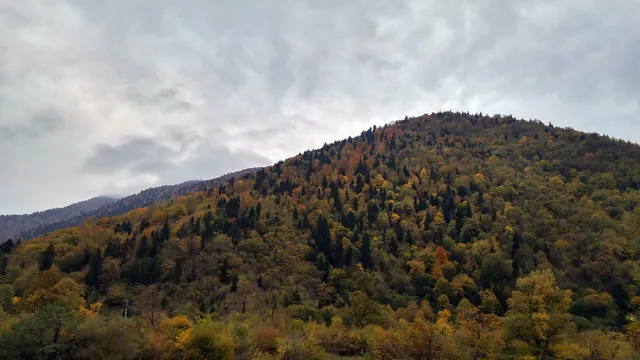
Points along the route:
- Nikortsminda, an eleventh-century church with carving on the facade that deserves a close look.
- Ambrolauri, the regional centre and the home of khvanchkara. There are not many wineries, but rtveli happens here in autumn too, and it is a more intimate affair than the Kakhetian one.
- The Shaori reservoir on the road from Tkibuli, with pines along the shore.
- Baraka and the old wooden houses of Racha architecture.
About Shovi it has to be said plainly: in August 2023 the resort was destroyed by a mudslide, and people died. The National Environmental Agency did not permit infrastructure to be rebuilt in the slide zone. As a tourist destination the resort does not exist now, and there is no reason to put it on a route.
Without a car: difficult. Marshrutkas from Kutaisi to Ambrolauri do run, but rarely and early in the morning, and inside Racha there is practically no transport. The distances between points are 20–40 kilometres of switchbacks. This is the case where a rental car is not a convenience but a condition of the trip.
Imereti and Samegrelo: canyons that empty out in autumn
Western Georgia works to its own logic in autumn: the rain comes more often, but the water rises in the canyons and the waterfalls run fuller than they do in August.
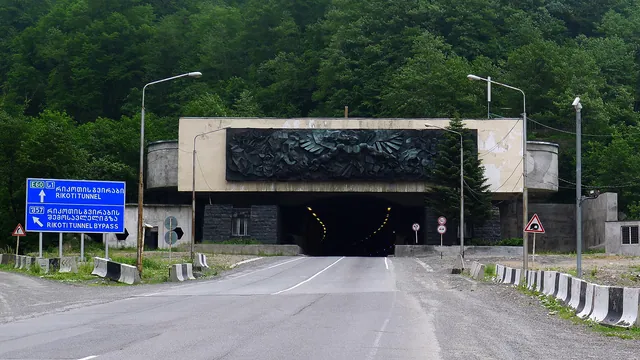
The base for the route: Kutaisi, 230 km and about 3 hours from Tbilisi along the E60 over the Rikoti Pass. The new expressway through Rikoti is now almost entirely open, and you will barely see the old narrow section with the lorries. Work continues on individual stretches and night-time restrictions are occasionally introduced, so it is worth glancing at the roads department's latest notices before you set off.
What to see:
- Martvili Canyon: a boat trip on turquoise water, about 15 minutes. It works all year round, but after heavy rain the boats are sometimes kept off the water.
- Okatse Canyon with its hanging walkway over the drop, and the Kinchkha waterfall 6 km away.
- Prometheus Cave near Tskaltubo. Inside it is around +14 all year, so a jacket is needed even in September.
- Gelati, a twelfth-century monastery with a mosaic in the apse, a UNESCO site.
- Bagrati Cathedral in Kutaisi. It was stripped of UNESCO status in 2017 over the methods used in the reconstruction; Gelati kept its status.
- The Katskhi Pillar and the cable cars of Chiatura, if you want something entirely untouristed.
Without a car: the train is a convenient way to get from Tbilisi to Kutaisi, and marshrutkas run around the city itself and out to Gelati. Public transport towards Martvili and Okatse only reaches the district centres, and after that it is taxis. Day tours of the canyons from Kutaisi cost around 60–100 GEL per person, and in this case they genuinely save time.
Adjara: bird migration and the rainy season
Batumi splits in two in autumn. Until the middle of September it is still a beach city with a warm sea and noticeably lower prices. From October the rainy season starts: Adjara is one of the wettest places on the whole Black Sea, and a downpour can last a full day.
But autumn is also when the thing happens that brings ornithologists to Batumi from all over the world. Between the Black Sea and the spurs of the Lesser Caucasus there is a narrow bottleneck through which more than a million birds of prey pass between 16 August and 16 October. Two watch stations stand in the villages of Sakhalvasho and Shuamta north of the city. Sakhalvasho is closer and simpler: 12 km from Batumi, about half an hour by car, then on foot up the gravel track from the school.
The peak days are predictable. From 28 August to 4 September comes the main wave of honey buzzards, from 25 September to 2 October the common buzzards, and on days like that a hundred thousand birds and more pass overhead in a single daylight period. The heaviest passages happen right after several days of bad weather. Binoculars are essential; without them you will see dots.
What else works in Adjara in autumn:
- Batumi Botanical Garden, 9 km from the centre. In October the bamboo grove and the Japanese garden look better than they do in the heat, and there is hardly anyone about.
- Mtirala National Park: the rainiest place in Georgia, rainforest, a trail to a waterfall. Boots, not trainers.
- The Machakhela gorge with its arched bridges and its old gunsmithing craft.
- Goderdzi is drivable in autumn from the Batumi side, but the pass is on the list of zones forbidden by the rental contract. You cannot take a rented car there.
The Tbilisi–Batumi road: 370 km, 5–6 hours allowing for stops. The alternative without a car: the Stadler train, 5–5.5 hours, tickets from 29 GEL, which runs to timetable and does not sit in traffic. Once the railway reconstruction is finished the journey time is promised to come down to about four hours, but check the current timetable on the Georgian Railway site. Marshrutkas and buses cost 35–40 GEL and take longer.
Samtskhe-Javakheti: Vardzia, Rabati and Borjomi in autumn
The south-western direction beats all the others in autumn for one reason: it is dry there. The rain fronts off the sea barely reach it, and the mountains are not high enough for the road to be closed by snow in October.
- Borjomi, 160 km and about 2.5 hours from Tbilisi. The central park with its mineral spring is buried in yellow at the end of October, and the cable car takes you up to the plateau above the town. Borjomi-Kharagauli National Park is next door, and the multi-day trails need registration at the visitor centre.
- Rabati in Akhaltsikhe, a restored fortress with walls, a mosque and a citadel. About an hour from Borjomi.
- Vardzia, a twelfth-century cave monastery in the cliff above the Kura. About 100 km from Borjomi, on a good road. In autumn the slopes around it are rust-coloured, and the rock itself reads better against them.
- Khertvisi, a fortress at the confluence of the rivers on the way to Vardzia. People stop for five minutes; it is worth half an hour.
- Abastumani with its astrophysical observatory at 1,700 metres.
A separate story: the Javakheti lakes on the plateau above 2,000 metres, Paravani, Khanchali, Madatapa, Bughdasheni. In autumn cranes and geese stop there on migration. The plateau is open, the wind is strong, and by the end of October it can be below zero there while Tbilisi is +18 the same day. The road through Tsalka is paved.
On the way to Tsalka, Dashbashi Canyon with its glass bridge over the gorge is worth the stop, an hour and a half to two hours from Tbilisi.
Without a car: marshrutkas to Borjomi and Akhaltsikhe run from Didube bus station, and there is a Tbilisi–Borjomi train as well. Transport from Akhaltsikhe to Vardzia is sparse, a couple of departures a day, and you risk not making it back. For this leg of the route a car or a taxi for the day is close to the only option.
Lagodekhi: the east that holds out longest
Lagodekhi reserve on the border with Dagestan sits 160 km and 2.5 hours from Tbilisi. In autumn it is the best deciduous forest in the country: hornbeam, beech, maple, all of it turning in the second half of October and holding almost to the end of November.
The most straightforward trail: to the Gurgeni waterfall, 8 km each way, 4–5 hours there and back, with a moderate climb. Registration at the visitor centre is free and compulsory. There is a route to the Black Lake, but it is a two-day one with an overnight, and in November it is already closed.
I once arrived there at the end of October in trainers, because Tbilisi was +20 and dry. In the forest after overnight rain the trail turns to clay, and I walked the last two kilometres sideways, holding on to the trees. Shoes with a tread are not a recommendation here.
Without a car: marshrutkas from Tbilisi to Lagodekhi leave Ortachala several times a day, and the trip takes about three hours. From the bus station to the park entrance is fifteen minutes on foot. This is one of the few natural places in Georgia that is genuinely simple to reach without a car.
Where not to go in autumn
- Tusheti. The Abano Pass at nearly 2,900 metres is closed by snow from the end of October to the middle of May. On top of that, Tusheti is on the list of zones where the rental contract forbids entry. Even in September people go there only with a local driver in a jeep.
- Ushguli. The road into upper Svaneti from Mestia is passable until the first serious snow, but Ushguli is likewise on the list of forbidden zones in rental contracts. You can drive to Mestia in a rented car; beyond that you need local transport.
- Shovi. The resort was destroyed by a mudslide in 2023 and is not being rebuilt.
- Vashlovani. It needs four-wheel drive, a permit and an escort, and the rental companies do not allow this area.
- High passes in November in general. Goderdzi, Abano, the road to Shatili: all of that is an autumn option only until the middle of October.
What to keep in mind if you are driving
Tyres. From 1 December to 1 March winter tyres specifically are compulsory on a number of Georgian roads, including the approaches to Gudauri, Bakuriani and Goderdzi, and the Rikoti Pass. The fine is 100 GEL, and the police have the right simply not to let the car through. In autumn the rule is not formally in force yet, but snow on the Cross Pass in November is entirely realistic, and summer tyres on wet switchbacks at +3 are dangerous whatever the date. If you are going into the mountains in November, ask about the tyres when you book. On MY.DRIVE the specification of the car is visible in advance, along with the final price, with no "call us to check".
Daylight. In October it gets dark around 18:30, at the end of November around 17:20. Plan so that the mountain part of the route finishes in daylight: an unlit road of switchbacks with no markings is unpleasant to drive at night.
Fog. The Gombori Pass, Rikoti and the climb to Gudauri fill with it regularly in autumn. Fog lights, distance, and half your usual speed.
Animals. Cows and pigs on the road are not a joke about Georgia but the reality of the western regions. At dusk a cow on dark asphalt is visible from about twenty metres.
Signal and maps. In Truso, in upper Racha, in Javakheti and in the gorges of Adjara the network drops out. Download offline maps in advance. Insurance in Georgia is electronic, there is no paper policy in the car, and the rental agreement may be digital too: save it so you can open it offline, not only in your email.
Fuel. In Racha, in Javakheti and on the approach to Truso the filling stations are sparse. The rule is simple: full tank before a mountain section.
How to travel without a car: what actually works
A rental is not compulsory everywhere. An honest picture by destination:
- Works well: Kazbegi, Lagodekhi, Borjomi, Kutaisi, Batumi, Sighnaghi, Mtskheta. Regular marshrutkas, and trains to Batumi and Borjomi on top of that.
- Works with reservations: Kakheti as a whole, Imereti with the canyons, Vardzia. You can reach the base town, and after that you need taxis or day tours.
- Practically does not work: Racha, the Javakheti lakes, Truso, anything outside the district centres.
The main bus stations in Tbilisi: Didube (west and north of the country, Kazbegi, Kutaisi, Borjomi), Ortachala and Isani (east, Kakheti, Lagodekhi), Samgori (the suburbs and some of the Kakhetian routes). Tickets are bought on the spot, and marshrutkas leave when they fill up rather than to a timetable, apart from on the major routes.
Intercity trips by Bolt out of Tbilisi are possible, but on long legs the app often fails to find a car, and it is simpler to arrange it with a driver directly. As a price guide: Tbilisi to Sighnaghi is around 100–130 GEL per car one way, and the figures are approximate and depend on the season.
Three ready-made autumn routes
Three days: Kakheti. Day one: Tbilisi, Sighnaghi, Bodbe, night in Sighnaghi. Day two: Tsinandali, Telavi, Alaverdi, rtveli at a winery, night in Telavi. Day three: Kvareli, Lake Ilia, back over Gombori. Around 330 km.
Five days: the mountains and the west. Day one: Tbilisi, Ananuri, Gudauri, Stepantsminda. Day two: Gergeti, the Gveleti waterfall, Truso. Day three: transfer to Kutaisi over Rikoti, Gelati. Day four: Martvili, Okatse, Kinchkha. Day five: Prometheus Cave and the drive back. Around 900 km.
Seven days with Racha. The five-day route plus a night in Ambrolauri with a detour to Nikortsminda and the Shaori reservoir, and Chiatura and Katskhi on the way back. The mileage grows to about 1,200 km. This version only makes sense until the middle of October.
In short
Give September to the mountains and the sea, October to Kakheti and Racha, November to Borjomi, Vardzia, Lagodekhi and the cities. Rtveli can be caught from the middle of September to the end of October, the bird migration at Batumi runs to 16 October, and the high passes close at about the same time. Check the forecast for the specific pass the day before you set off, not a week ahead: in the mountains it changes within a day. And count the daylight: in autumn it runs out before the route does.