
Noravank: how to get there from Yerevan and what to see
Noravank Monastery in the Amaghu Gorge, about 122 km from Yerevan: the M2 drive via Areni, Surb Astvatsatsin church with its stone staircases, entry, parking and the best time for photos.
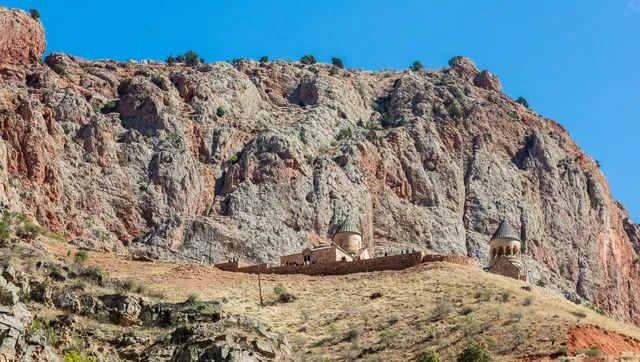
Noravank sits in the narrow Amaghu Gorge in Vayots Dzor province, roughly 122 km south of Yerevan. By car it takes about two hours: along the M2 highway to the turn just past Areni, then about 8 km up the canyon. The 13th-century monastery is ringed by sheer red cliffs, and that view is exactly what people come for.
What Noravank is
The name means "new monastery". It was founded in the early 13th century and became the seat of the bishops of Syunik and the burial place of the Orbelian princes, who ruled these lands. The complex is small, you can walk around it in half an hour, but almost every building here stands out.
What to see:
- Surb Astvatsatsin. A two-storey burial church completed in 1339. It is considered the last work of the architect Momik. The lower floor served as a tomb, the upper one as a church. Two narrow stone staircases jutting straight out of the facade lead to the second floor.
- Surb Karapet. The main church of the complex, first half of the 13th century.
- The gavit. The narthex in front of Surb Karapet, with a carved portal and tombstones set into the floor. The reliefs in the tympana above the entrance are among the best-known pieces of Armenian medieval sculpture.
- St. Grigor Chapel. A small building attached to the main church, also an Orbelian burial place.
Momik was both an architect and a stone carver. His khachkars, stone crosses with fine carving, are counted among the best in Armenia, and one of them stands at Noravank. Take a close look at the khachkars in the courtyard: the carving on the finest ones is almost lace.
How to get to Noravank from Yerevan
The route is simple. Leave Yerevan heading south on the M2, pass the turn for Khor Virap, then Ararat and Yeraskh. After Yeraskh the road climbs into the mountains over a pass and drops down into the Vayots Dzor valley.
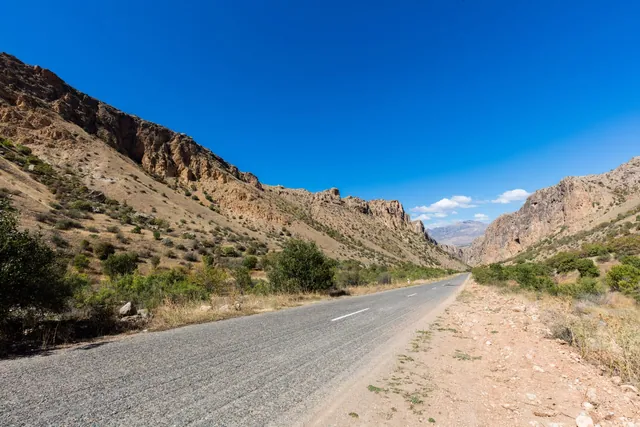
The first big village at the bottom is Areni. The Noravank turn is a little further on, about 1–2 km past the village at the mouth of the Amaghu Gorge, and it is signposted. Right after the turn the road passes the Areni-1 cave. From the highway to the monastery it is about 8 km of canyon road. The asphalt is fine, but the road is narrow and winding, with tight bends and rock on both sides. Oncoming buses squeeze past on the bends, so keep your speed low here.
Near Yeraskh the highway runs close to the border. Don't pull over on the shoulder or take photos on this stretch, just drive through.
Speed cameras on the M2 are frequent. The limit outside built-up areas is usually 90 km/h, in villages 60 km/h. The fine goes to the car's owner, and the rental company bills it to the renter after the trip.
Distances and driving times
| From | Distance | Driving time |
|---|---|---|
| Central Yerevan | about 122 km | about 2 h |
| Zvartnots Airport | about 130 km | 2 h 10 min |
| Khor Virap | about 80 km | 1 h 15 min |
| Areni | about 10 km | 15–20 min |
Times are for daytime driving without traffic. Leaving Yerevan in the morning, allow another twenty minutes or so.
Surb Astvatsatsin church and the stone staircases
Noravank's most famous building stands apart, closer to the edge of the grounds. This is the two-storey church with staircases on its facade that ends up on every postcard.
The stairs are narrow, with no handrail, and the steps are uneven and worn. You can climb them, but calmly and one person at a time. Coming down is scarier than going up: go sideways, keeping a hand on the wall. With children or in smooth-soled shoes, better not try.
At the top is a small church room and a view over the gorge and the other buildings. Above the entrance to the lower floor is a carved tympanum with the Virgin and Child, visible from the ground.
I climbed up here in the middle of a July day. The stone was so hot it was unpleasant to touch the steps, and there wasn't a scrap of shade at the top. If you're going in summer, plan the stairs for the morning or evening.
When to go and the best light
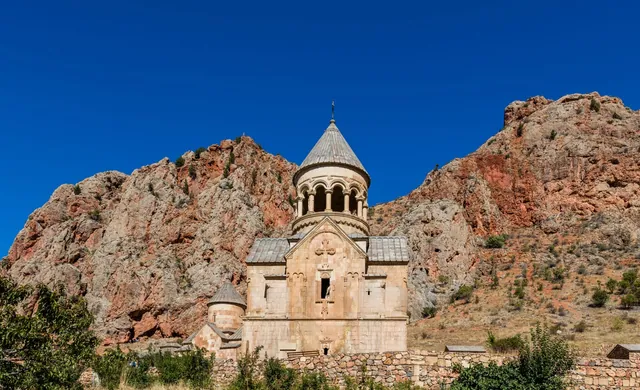
The red cliffs come into their own in the afternoon. As the sun drops it lights the gorge walls with a warm glow and the rock turns almost orange. In the morning part of the complex is in shadow and photos come out flatter.
By season:
- Spring, April–May. The slopes turn green, it isn't hot yet and there are fewer visitors.
- Summer. The gorge is hot during the day with almost no shade. Go early or arrive towards evening.
- Autumn, September–October. The most comfortable time. Harvest in Areni, steady temperatures, good light.
- Winter. The monastery is open, but the gorge road isn't always cleared right after snowfall, and the pass on the M2 can be slippery. Check the weather in the morning.
Entry, parking and what to bring
As a rule there is no separate ticket for the monastery. Candles, water and souvenirs are sold at the gate for cash. Parking is right by the monastery; at weekends tour buses take some of the spaces, but you can usually find a spot.
Noravank is a working monastery. Cover your shoulders and knees, keep quiet inside the churches and don't use flash during a service.
What comes in handy:
- Water. You can't always buy it on site, and in summer the gorge is dry and hot.
- A hat and sunscreen.
- Shoes with non-slip soles for the stairs.
- Cash in drams for candles, water and souvenirs at the gate.
There is no ATM at the monastery, so withdraw cash in Yerevan or Yeghegnadzor. Mobile coverage in the gorge is patchy, so an offline map helps.
Areni, Khor Virap and Noravank in one day
Noravank pairs easily with the neighbouring stops along the M2, and together they fill a full day.
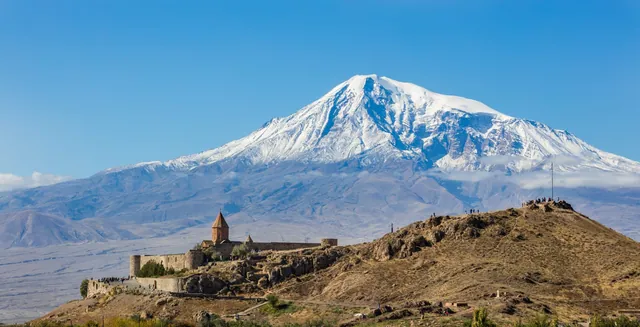
- Khor Virap. About 45 km from Yerevan. A monastery at the foot of Ararat; the mountain is clearest in the morning, so it usually comes first.
- Areni. A village on the M2 next to the gorge, known for its wine. Wineries line the highway, and some take visitors without booking. Nearby is the Areni-1 cave, where archaeologists found the oldest known winery.
- Noravank. About 8 km up the gorge from the turn past Areni.
A rough plan: leave Yerevan at 7:00, Khor Virap by 8:00, Noravank by 10:30–11:00, lunch and a tasting in Areni, back by evening. If you want Noravank in the best light, swap the order: Khor Virap in the morning, lunch in Areni, Noravank towards evening. The whole loop is about 250 km and 8–9 hours with stops. You can put individual stops together in the route planner, and the monastery is also on the places map.
If you're driving, go easy at the tastings. You can buy wine to take away and open it in the evening back in Yerevan.
FAQ
How long is the drive from Yerevan to Noravank? About 122 km, roughly two hours by car. Almost the whole way is on the M2 highway; the last 8 km from the turn past Areni run along a narrow road through the Amaghu Gorge.
Do you have to pay to enter Noravank? As a rule, no, there is no separate ticket for the monastery. Cash is useful for candles, water and souvenirs.
Can you climb the staircases of Surb Astvatsatsin church? Yes, but the steps are narrow, worn and have no handrail. Go up one at a time and carefully, and come down sideways holding the wall. Children and anyone afraid of heights are better off staying below.
When is the best time to arrive for photos? In the afternoon, when the sun lights up the red cliffs of the gorge. In summer it is also a way to avoid the midday heat.
Can you combine Noravank, Areni and Khor Virap in one day? Yes, it's the standard route by car. About 250 km and 8–9 hours with stops; it's best to leave Yerevan early in the morning.
In short
Noravank is two hours from Yerevan along the M2, with the last 8 km through the Amaghu Gorge. Come for the red cliffs and Momik's two-storey church with its stone staircases, ideally in the afternoon, in spring or autumn. Bring water, cash and comfortable shoes, and stop at Khor Virap and the Areni wineries on the way.