
The Chronicle of Georgia monument in Tbilisi: how to get there and what to see
The Chronicle of Georgia monument in Tbilisi: 16 columns 30–35 metres high above the Tbilisi Sea. How to get there, when to come and what else is nearby.
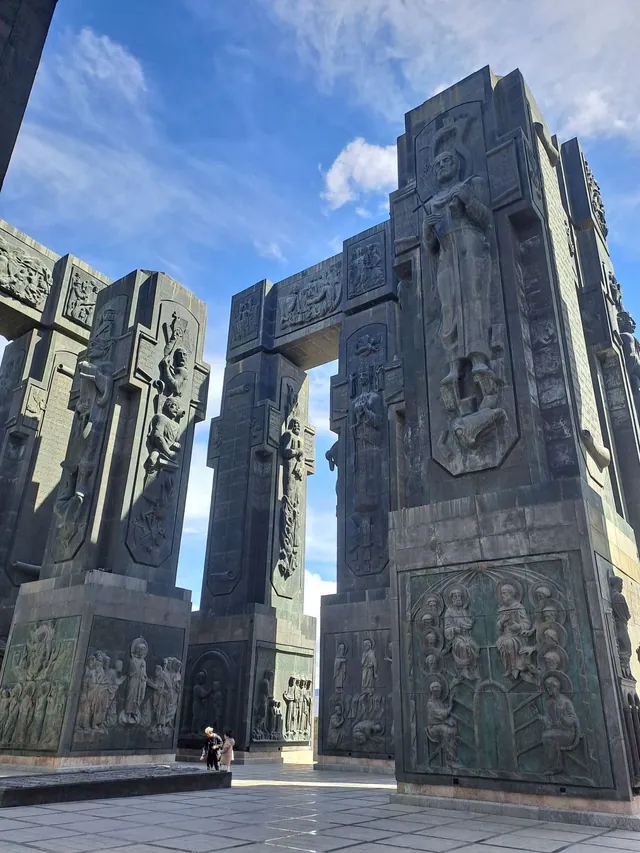
The Chronicle of Georgia stands on Keeni hill above the Tbilisi reservoir, roughly 11 km from the centre of Tbilisi. It is sixteen bronze columns 30–35 metres high, covered in reliefs. Entry is free and open around the clock, there is no ticket office and no ticket, and the drive from Freedom Square takes 25–30 minutes.
What this place is
Work on the complex began in 1985, to a design by Zurab Tsereteli. He spent around twenty years on it, and it is the largest thing he ever made in Georgia. It was never finished: the money ran out along with the Soviet Union, and part of the design stayed on paper. Tsereteli died in April 2025, and the monument is still formally listed as incomplete.
The place goes by several names, and guidebooks muddle them. "Chronicle of Georgia", "Chronicles of Georgia", "The History of Georgia" and "the monument to Georgian history" all mean the same thing. Tourists often call it the Georgian Stonehenge, and from a distance the resemblance really is there: sixteen dark verticals on a bare hill, nothing around them.
There is no infrastructure on the site whatsoever. No ticket window, no café, no souvenir stall, no toilet. Just a staircase, the columns and the wind.
What was on this hill before the monument
Keeni hill stood empty for a long time, although the spot was always considered a good one: it rises straight up out of the water and is visible from the northern districts of the city. The Tbilisi Sea appeared at its foot in 1952, and the idea of putting something conspicuous on the top followed almost at once.
People in the city still repeat the story that the first project here was a giant monument to Stalin, which Moscow refused to approve. There is no documentary evidence for it, and it is best treated as Tbilisi folklore. What is reliable is this: until the mid-eighties the summit was undeveloped, and Tsereteli got a practically clean hill for his idea.
What is depicted on the columns
Each column is divided horizontally into tiers, and you need to read it from the bottom up:
- The lower tier is given over to biblical subjects and scenes from the life of Christ.
- The upper part is devoted to Georgian history: kings and queens, commanders, poets, saints.
- In between you come across everyday scenes: the grape harvest, festivals, feasts.
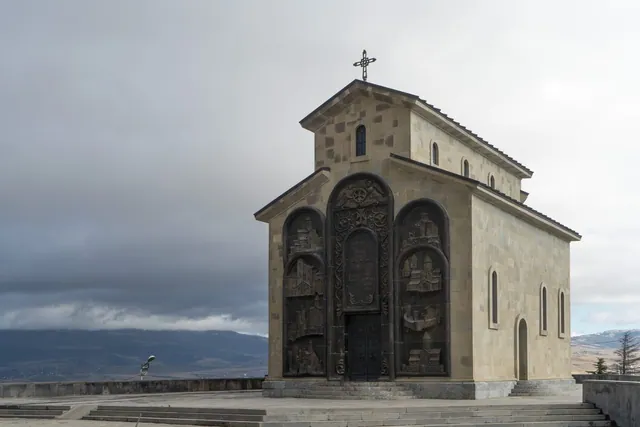
Standing apart on the site is the cross of Saint Nino, woven from grape vine. The same kind, tradition says, that she brought to Iberia in the 4th century. Beside it is the small Church of the Annunciation; you can go inside when it is open.
There are no captions under the reliefs. None at all. Without a guide or some reading done in advance, half the scenes remain simply handsome bronze, so it is worth spending fifteen minutes before the trip on at least the five figures that turn up on the columns more often than the rest:
- Vakhtang Gorgasali, the 5th-century king who founded Tbilisi.
- Saint Nino, who brought Christianity to the country.
- David IV the Builder, under whom Georgia won Tbilisi back from the Arabs.
- Queen Tamar, whose reign is considered the golden age.
- Shota Rustaveli and his "Knight in the Panther's Skin".
With that set in your head, the reliefs stop being ornament. The difference is tangible.
How to get to the Chronicle of Georgia
By car. It is 11–12 km from the centre, 25–30 minutes without traffic. In navigation apps the point is called Chronicle of Georgia, so it is hard to go wrong. The last couple of kilometres climb uphill and the asphalt is broken in places, but any ordinary car gets through. There is free parking at the foot of the staircase; in summer at weekends it fills up by midday.
By taxi. A Bolt from the centre works out at roughly 15–25 GEL one way, depending on the time of day. The real difficulty starts on the way back: there are almost no drivers on the app up there, and you can wait a long time for a car. It is easier to agree with the driver who brought you to wait 30–40 minutes. Reception on the hill is fine, so calling a car is technically possible — the only question is whether anyone will drive up.
By public transport. There is no direct route to the monument. Buses and marshrutkas take you as far as the Temka and Gldani residential districts at the foot of the hill, and after that you have about half an hour of walking up along the verge. It works, but in the heat it is exhausting, and you should budget half a day for it.
On a tour. The Chronicle of Georgia is often bundled into group tours together with Mtskheta, because the two lie in the same direction out of the city.
The logic of the trip: what to combine it with
Driving out here specially and heading straight back to the centre feels like a waste, because looking round takes less than an hour. It makes far more sense to build the monument into the route of a day — including one of the day trips out of Tbilisi:
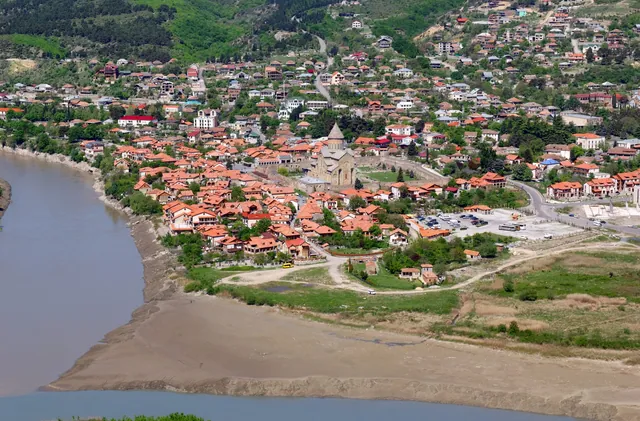
- Mtskheta is 20 km away, the same half-hour along the highway.
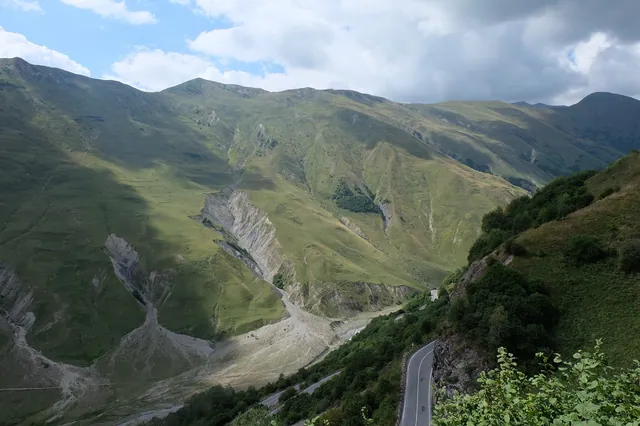
- The Georgian Military Highway to Gudauri and Kazbegi starts in the same direction, so the monument is convenient to see first thing in the morning.
- The Tbilisi Sea lies right below the hill; in summer there are beach clubs and a water park down there.
If you are planning a day like that, a car settles the question entirely: up to the hill, down to the reservoir, on to Mtskheta. A rental with MY.DRIVE can be arranged in advance at a final price, with no surcharges on arrival, and picked up in the city or at the airport. Every stretch listed above is paved; you do not need an off-roader for it.
The Tbilisi Sea below the hill
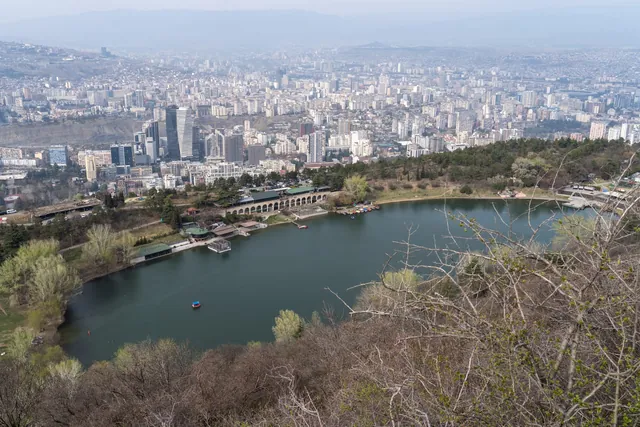
From the viewing platform you can see the whole reservoir, and the scale from up there is deceptive. It is in fact 9 km long and 3 km wide, with a maximum depth of around 45 metres — the deepest artificial body of water in the country. It was filled with water from the Iori in 1952, flooding three salt lakes.
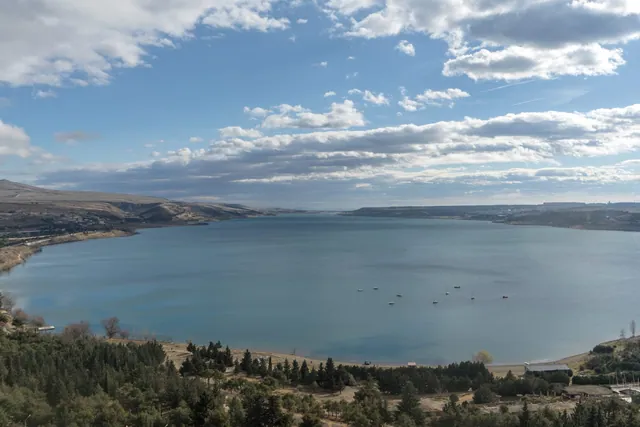
You can swim here from June to September; by July the water warms up to 26–28 degrees. The beaches are equipped but charge for entry, and the price depends on the club. The water level fluctuates noticeably with the season, because the reservoir serves the Samgori irrigation system: by the end of summer the shore retreats, and the walk from the sunloungers to the water is longer than it was in June.
If you fancy a swim after the monument, bring your swimming things with you from the start. Going back to the centre for them means an hour there and an hour back. More on the sea as a place for a walk in the roundup of Tbilisi's parks.
When to come
The best time is early morning, up to about ten, or the hour and a half before sunset. The reasons are purely practical.
During the day there is not a scrap of shade on the site. Not a scrap: the columns stand in such a way that the shadow falls inside the square and never reaches people. The first time I came here it was July, around two in the afternoon, with one small bottle of water, and after twenty minutes I was thinking less about Queen Tamar than about where the nearest shop was. There is no shop at the bottom either.
The second factor is the wind. It blows in off the reservoir constantly, and on the hill it is noticeably stronger than in the city. In summer that saves you. In winter and the shoulder seasons you need a warm jacket, even if it was plus twelve and sunny in central Tbilisi. The difference in how it feels is about five degrees.
At sunset the columns are lit from the side, the reliefs become readable and the water below changes colour. There is no lighting on the monument, so once it is dark there is nothing left to see. Best to leave straight after the sun goes down.
What to bring with you
- Water, at least half a litre per person. There is nowhere to buy any up there.
- Proper shoes. A long staircase leads up to the columns, and the site itself is uneven, with crumbling steps around the edges.
- A windproof jacket in any season except July and August.
- A hat from April to September.
- Cash is not needed: entry is free and there is nothing to pay for on site.
How much time to allow
40–60 minutes is enough for the monument itself: climb up, walk around the square of columns, look into the church, look down at the reservoir and at the housing estates on the other side. The viewing platforms give you two completely different views, and the second one, with the tower blocks of Gldani, is no less interesting than the postcard one.
With the drive both ways and without adding Mtskheta, the outing takes about two and a half hours. A full day with the monument, a swim in the Tbilisi Sea and Mtskheta fits into 7–8 hours if you set off around nine in the morning.
Is the place suitable for children and older visitors
The staircase is long but gentle, with landings where you can get your breath back. There is no handrail along it, and there are no barriers around the edges of the upper platform either: the drop begins immediately behind the columns, so children need watching more closely here than usual.
Getting a pushchair up is doable but awkward. Anyone who finds walking uphill hard should plan the visit for the morning: by midday the stone heats up, and there is nowhere to hide from the sun on the climb.
What matters most
The Chronicle of Georgia is not about beauty in the usual sense, nor about antiquity. It is Soviet monumentalism at maximum scale, abandoned halfway and, because of that, more convincing than it would have been finished. It is worth the trip if you are interested in twentieth-century architecture, if you want unusual views over Tbilisi, or if you are heading towards Mtskheta anyway. An hour to look around, water in your rucksack and a well-planned ride back cover every question.