
Turtle Lake in Tbilisi: how to get there and what to do
Turtle Lake in Tbilisi: the drive and the 1 GEL cable car, parking, the beach, the trail to Mtatsminda and the ethnographic museum next door. Prices and opening hours.
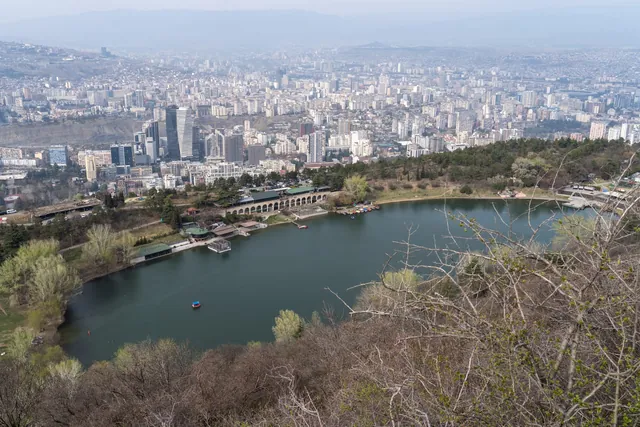
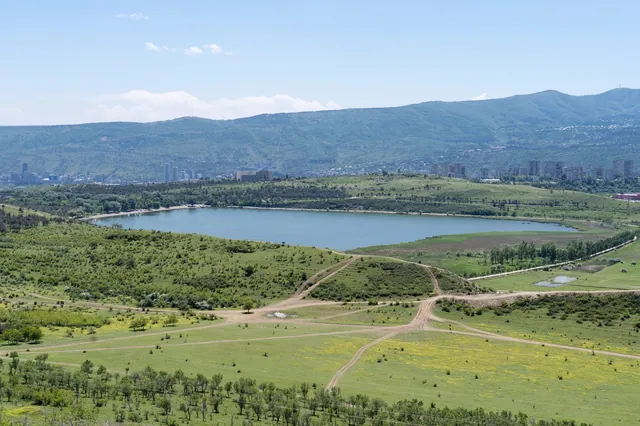
Turtle Lake sits on the northern slope of Mtatsminda, inside Tbilisi, at about 690 metres. From the centre it is 15–20 minutes by car, entry to the grounds is free, and you can also ride up from Vake Park on the cable car for 1 GEL. In summer there is a beach and pedal boats; cafés and the path around the water stay open year-round.
What Turtle Lake actually is
In Georgian it is called Kus Tba: “ku” is turtle, “tba” is lake. The water body is small, about 4.4 hectares, up to three metres deep, fed by the Varaziskhevi stream and by springs. That is why the water is noticeably colder than you expect in a city that hits +35 in summer.
This is a city recreation spot, not a tourist attraction. On weekdays the people by the water are mostly Tbilisians: looping the path, walking with prams, sitting with coffee, someone fishing. At weekends families arrive, and by one o'clock there are no free tables left on the terraces.
Where the name comes from, and whether there are turtles
There are two versions of the name. The first and main one: there used to be so many turtles here that the lake was named for them. The second, less convincing, points to the shape of the water, which from above is said to look like a shell.
There are still turtles in the lake, just not many, and they are not easy to spot. Look on the shore farthest from the beach, where branches and snags lie over the water: on a warm day the turtles climb out to bask and slide back in at the first rustle. The best time is early morning, before the runners start, and mid-weekday, when the path is empty. Most visitors see none at all and leave sure the name is purely historical.
How to drive there and where to park
The road up starts in Vake. From Freedom Square it is about 7 kilometres and 20 minutes with no traffic, from Chavchavadze Avenue about ten minutes. The asphalt is fine, you do not need four-wheel drive, any sedan will manage. The carriageway is narrow, though, the bends are blind, and some drivers cut them down the middle. Better to go up calmly.
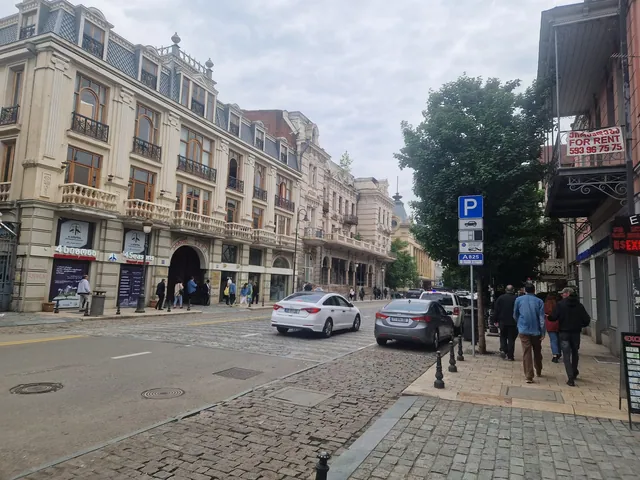
Parking by the lake is free and small. On weekdays there are always spaces; on Sunday after noon cars line the verge for several hundred metres down the slope. I have arrived at exactly that hour a couple of times and then circled until someone left. Now I go up either before eleven in the morning or closer to seven in the evening. It is worth checking parking in Tbilisi in general beforehand: the centre has paid zones, at the lake it is simpler.
A rental car just for the lake does not pay off: a taxi covers the same distance for about 8–12 GEL. A rental makes sense when the lake is part of a day: water and the ethnographic museum in the morning, after lunch Mtskheta 25 kilometres away or the road into Kakheti. The final price for the whole rental period is visible at once on MY.DRIVE, with no extras at pickup. Practical details of the handover are in the Tbilisi rental guide; if you are building the day around drives out, see also the one-day routes from the city.
The cable car from Vake Park
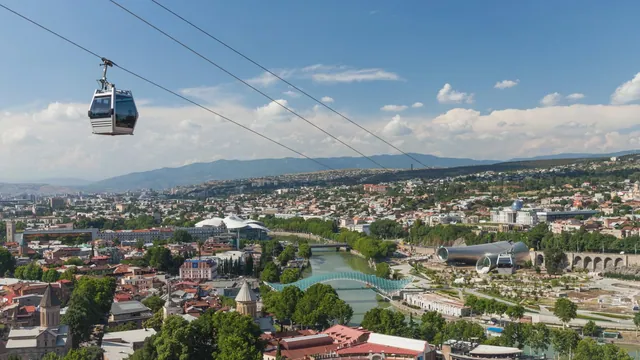
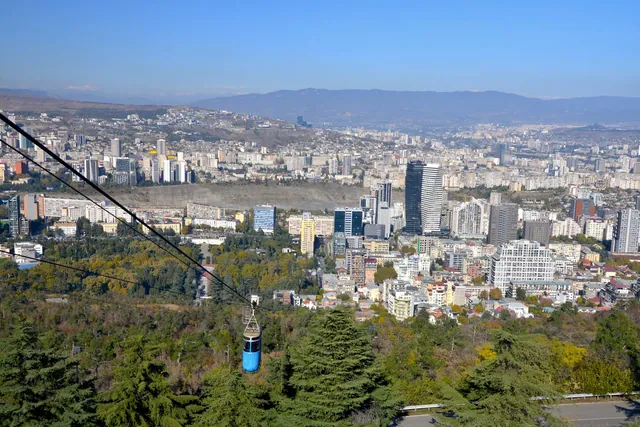
The lower station stands on Chavchavadze Avenue, by the main entrance to Vake Park. The ride takes 6–7 minutes, the old-style cabins hold about ten people and leave every ten minutes, sometimes waiting until a few more gather. The line runs from 8:00 to 22:00, in summer sometimes later.
A ride costs 1 GEL one way, but you can pay only with a Metromoney transport card; cash is not accepted. The card itself costs 2 GEL and is sold at metro ticket windows. The first time I arrived at the cable car without one and spent an extra hour going to the nearest metro station and back.
The line was restarted in September 2016. The old one, from the seventies, finally closed in 2007, so today's gondolas look retro and run quite steadily. This is the longest cable car in the city.
What to do by the water
A full loop of the path along the shore takes 20–25 minutes at an easy pace. Around the perimeter: benches, outdoor gym machines, playgrounds and several cafés with terraces over the water. In summer there are pedal boats for hire.
From the upper terrace you get a view of Vake and Saburtalo, and the ride up itself passes over the park canopy. In the morning it is quiet: only birds and someone running on the asphalt. By midday at weekends the quiet is gone.
Allow an hour to an hour and a half if you came just to walk, and half a day if you add the museum or the trail.
Swimming in Turtle Lake
The beach is pebbly and small, with changing cabins. Loungers and umbrellas are paid, swimming itself is free. The water is spring-fed and cool; it only really warms up towards July.
A couple of honest caveats. The bottom is silty, after rain the water clouds, and opinions on how clean it is diverge: some people swim here all summer, others make a point of going to the Tbilisi Sea or Lisi Lake. The buoys sit close to the shore, and the depth next to them is already decent, so keep an eye on children.
If the point of the trip is water and a beach, the Tbilisi Sea is a better fit: more space, a water park and boat stations. Turtle Lake is more about the walk, the shade and a meal with a view.
The open-air Ethnographic Museum
The Giorgi Chitaia Museum sits west of the lake, about fifteen minutes on foot along the road or three minutes by car. It is more than 70 genuine buildings, brought from all over the country and laid out in 14 ethnographic zones: Kartli, Kakheti, Svaneti, Adjara, Imereti, Racha and others. Plus a 5th–6th century Sioni basilica and a collection of carved gravestones.
Practical:
- Open Tuesday–Sunday, 10:00–18:00, closed Monday
- Last ticket sold 30 minutes before closing
- A ticket for foreigners is roughly 20–25 GEL, cheaper for Georgian citizens; prices have been revised, better to check at the desk
- Allow 2–3 hours for a look round
- The grounds are large and on a slope, so wear proper shoes
- Some houses are closed, but in the open ones attendants sit and talk readily
The museum has its own car park, so you can move the car rather than walk uphill in the heat.
The trail from the lake to Mtatsminda
A marked trail starts from the shore and follows the ridge. To Mtatsminda Park it is about 6 kilometres and an hour and a half to two hours of walking, to the Mother Georgia monument four to five hours. The start is marked with a map board; along the way there are benches and signposts, and at weekends people ride mountain bikes on the same path.
The contrast with the car is telling: the same trip from the lake to Mtatsminda Park by road is about 16 kilometres around the slope. On foot it is almost three times shorter.
For those who want more, the route continues to Mount Udzo (1416 m) on the Trialeti range. There are many open stretches, little shade; bring water from below.
A half-day route
If you are driving, this order works best:
- 9:30 up to the lake, the car park still empty
- 10:00–11:00 a loop of the path, coffee on the terrace
- 11:15 drive to the ethnographic museum, three minutes along the road
- 11:30–14:00 the museum; better to start with the far, mountain zones while it is not yet hot
- 14:30 down to Vake for lunch or on with your own plans
Without a car the scheme is the same, only instead of parking you take the cable car from Vake Park, and between the lake and the museum it is fifteen minutes on foot along the verge. The verge is narrow; awkward with a pram. If you still have an evening in the city, the lake slots well into the one-day route.
When to go
The best months are May, June and September: green, not hot, the water already or still decent. In July and August it is noticeably cooler by the lake than down in the city, which is why Tbilisians come up here in the heat, and parking spaces get scarcer.
In winter the grounds stay open, the cafés work in part, there is no swimming. On the rare icy day the climb gets slippery, and if the car is on summer tyres it is better not to go up at all.
In autumn it smells of rotting leaves and barbecue smoke, and in fog the far shore disappears entirely. That is, perhaps, the most beautiful time by the water.
In short
Turtle Lake in Tbilisi works as a pause in the middle of the city: half an hour on the road, an hour for a loop around the water, coffee on a terrace looking over Vake. By car that is 15–20 minutes from the centre plus free parking, which fills up at weekends after noon. The alternative is the cable car from Vake Park for 1 GEL on a Metromoney card.
You get the most from the trip if you add the ethnographic museum, a fifteen-minute walk, or the trail to Mtatsminda. For swimming as the main aim, the Tbilisi Sea is the better choice.