
Tbilisi in One Day: A Route Through the Main Sights
How to see Tbilisi in a single day: the Old Town, Narikala, the sulfur baths, the Bridge of Peace, Mtatsminda. The order of stops, time for each and practical tips.
Tbilisi is compact: the center fits into one full day if you walk it as a logical loop rather than darting between districts across the map. Below is a route of 8–10 hours that covers the basic list of what is worth seeing first, with an explanation of why to go to each stop and how much time you really need there.
The Old Town and Narikala Fortress
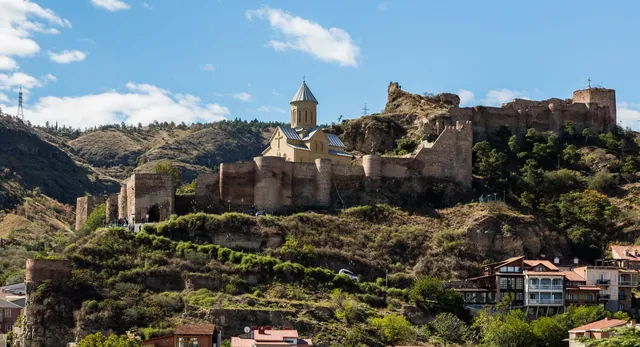
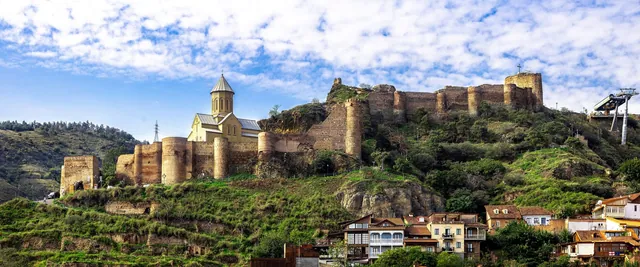
It makes sense to start with Narikala hill: this is where you get the view by which Tbilisi is later recognized in every photograph. The fortress was built and rebuilt roughly from the 4th to the 18th century, and by our time all that remains are partly ruined walls, a few towers and the Church of St. Nicholas on the grounds, restored in the 1990s. The fortress territory itself is open around the clock and free to enter — a rarity for central landmarks of this scale.
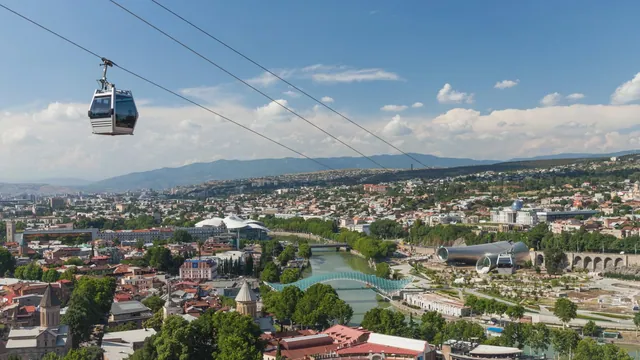
A cable car from Rike Park takes you to the top: the cabin ride lasts about two minutes, with the route passing right over the roofs of the old town, Meidan Square and the river. The ticket offices at the lower station mostly take cash, but you can pay by card directly at the turnstiles, without a trip to the booth. Queues build up on weekends and in midsummer, so if your route is flexible it is better to plan the ascent for a weekday or early morning.
From the upper station you can reach the fortress itself in about ten minutes, or turn the other way toward the 20-meter Mother of Kartli monument, a symbolic female figure holding a bowl of wine in one hand and a sword in the other: she greets guests with wine and enemies with the sword. This detail is worth catching when a guide or companion explains it. It is more convenient to descend on foot through the botanical garden, if your shoes and time allow, or back on the same cable car if your schedule is tight.
Set aside an hour to an hour and a half for the fortress and the views, including the trip up and back.
The Abanotubani Sulfur Baths
The quarter with the bathhouse domes gave the city its name: according to legend, King Vakhtang Gorgasali discovered hot sulfur springs here back in the 5th century, and the city grew up on this very spot. The baths operate almost around the clock and differ mainly in interior and room price, from simple shared halls to private rooms with their own pool. The classic format for a tourist is a room for an hour or two with a private pool of sulfur water, while a scrub or massage is paid to the attendant separately, and by local custom no more than a set amount per service.
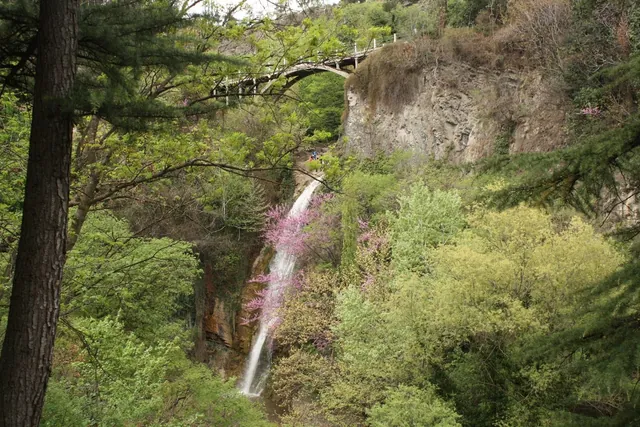
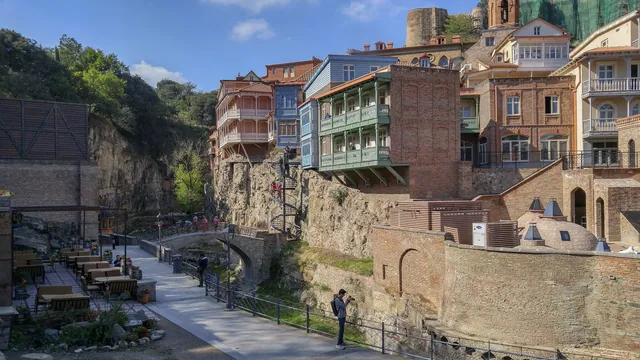
Even without bathing it is worth walking to this quarter for the architecture: the low brick domes of the baths, the nearby Jumah Mosque — the only one in the city where Sunnis and Shiites pray together — and the narrow Leghvtakhevi gorge with a waterfall right behind the baths, where organized tour groups hardly ever go, even though it is a five-minute walk from the quarter's main street.
If your day is packed and there is no time for a full soak, 20–30 minutes is enough for a stroll around the quarter and the waterfall. If you want to lie in the sulfur water, set aside a separate 1.5–2 hours and plan it toward evening, after the active part of the route rather than before it.
Metekhi Church and the Viewpoint Over the Kura
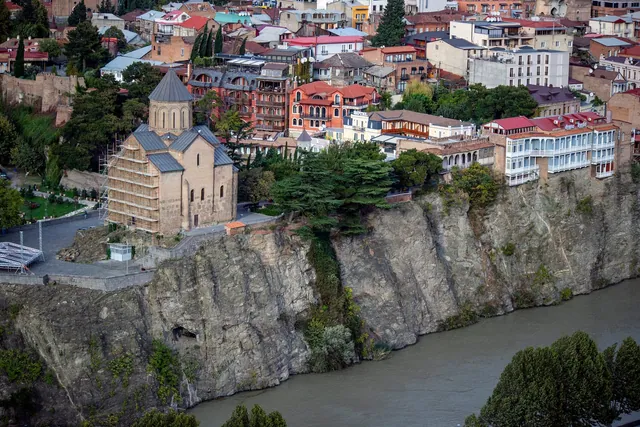
On the cliff above the river, directly opposite the old town, stands Metekhi Church with a bronze equestrian statue of Vakhtang Gorgasali in front of the entrance. The first church on this site presumably appeared under Vakhtang himself in the 5th century; the present building was constructed in the 12th century, destroyed by the Mongols in 1235 and rebuilt by the end of the same century. In Soviet times the premises were used as a theater and for other needs, the king's statue was installed only in 1967, and the church itself was returned to worshippers in 1988.
The place works at once as a church and as a viewpoint: from the observation part of the cliff you can see the old town, the Bridge of Peace, Rike Park and the domes of the sulfur baths all at once, and this spot is not as densely packed with tourists as the upper cable-car station at Narikala, even though the view is barely inferior.
Metekhi is easy to reach on foot from Abanotubani or from Meidan Square; the walk takes 10–15 minutes one way. The spot itself needs about 20–30 minutes if you do not linger inside the church.
The Bridge of Peace and Rike Park
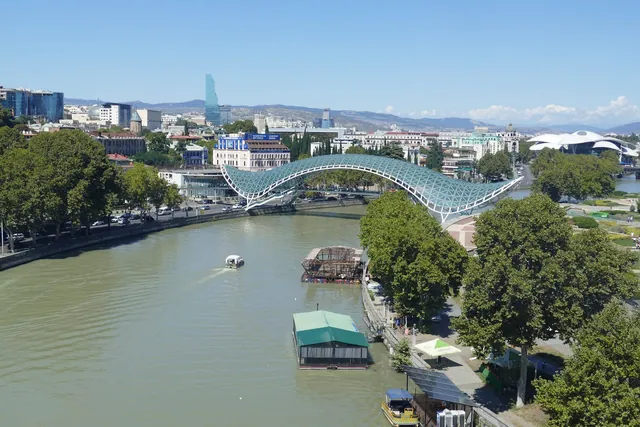
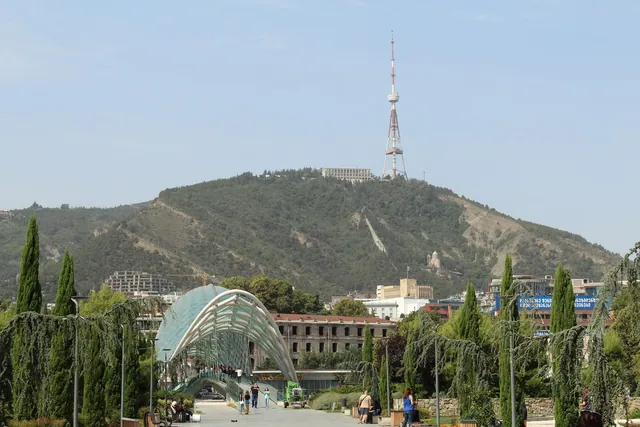
The glass pedestrian bridge over the Kura was designed by the Italian Michele De Lucchi; the structure opened in 2010 on the initiative of Georgia's then-president, and the name was meant to symbolize reconciliation after the 2008 conflict. The bridge connects Erekle II Street in the old town with Rike Park on the other bank, consists of a steel frame 156 meters long covered with glass, and in the evening is lit by thousands of LEDs, which makes it one of the city's most photographed spots after sunset.
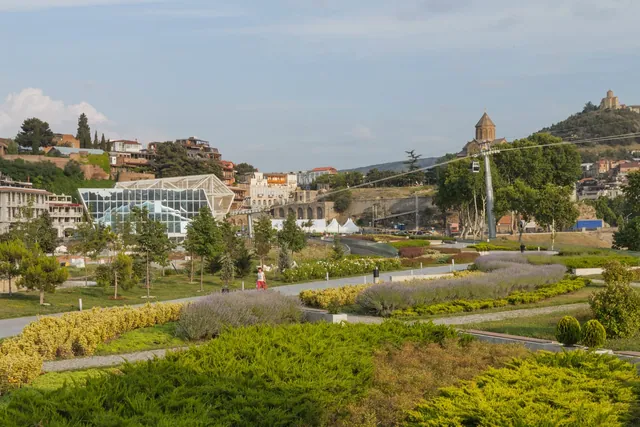
Rike Park at the far end of the bridge is an open space with fountains, benches and a direct view of the illuminated Narikala Fortress on the hill. The cable car up also departs from here, so if you build the route in reverse order, this is a convenient place to begin the ascent.
A good time to cross the bridge is at sunset or just after: the city gradually lights up while the hill with the fortress is lit by floodlights. 20–30 minutes is enough for the crossing and photos, but if you combine it with dinner at one of the park's restaurants, set aside more.
The Streets of the Old Town: Shardeni, Sioni, Anchiskhati
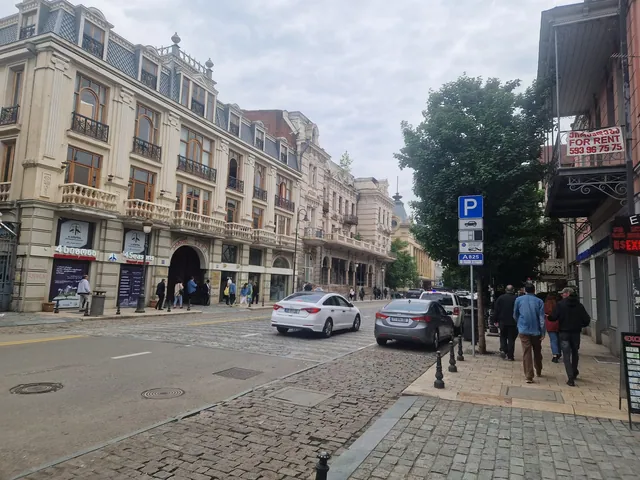
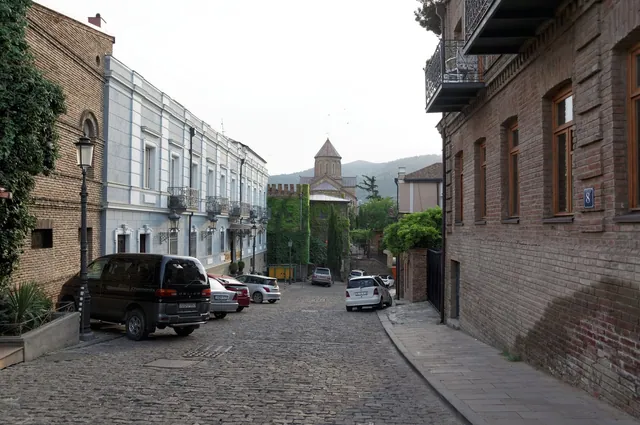
Between Abanotubani and Freedom Square lies a dense network of streets with carved wooden balconies, cafés on the ground floors and small galleries. Here it is worth planning not so much a route between specific points as time to simply wander without a goal and peek into the side lanes, where the strongest impressions of Tbilisi usually happen.
Among the specific stops in this district:
- The Anchiskhati Basilica — the oldest surviving church in the city, built in the 6th century under King Dachi Ujarmeli. It is an active church with free entry, and inside it preserves fragments of 17th-century painting and an altar icon from 1683.
- Sioni Cathedral — the cathedral of old Tbilisi, destroyed several times during raids and rebuilt anew; it now holds the cross of St. Nino, woven, according to tradition, from grapevine and the saint's own hair.
- Shardeni Street and Meidan Square — dense 19th-century development, restaurants with terraces and live music in the evenings, from which it is convenient to head both to the Bridge of Peace and to the sulfur baths.
For the whole quarter, if you walk unhurriedly and step into a couple of churches, expect an hour to an hour and a half.
Freedom Square and Rustaveli Avenue
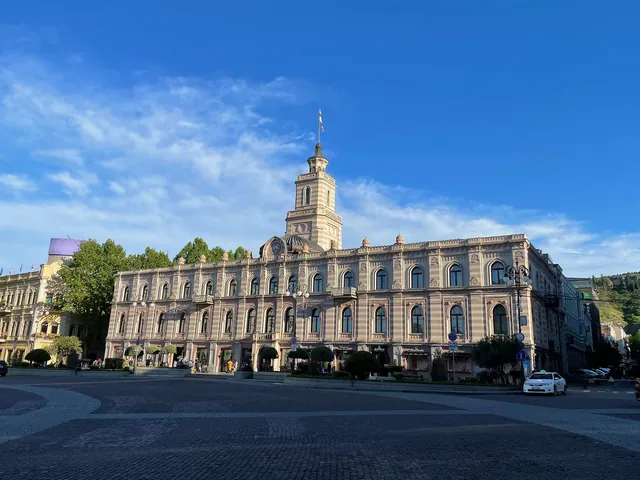
The square has changed its name several times over the past century: first Erivan Square in honor of General Paskevich, then, under Soviet rule, Transcaucasian Federation Square, then Beria Square, then Lenin Square with an 18-meter monument to the leader in the center. Its present name, Freedom Square, returned in 1990, and in 2006 a column with a gilded statue of St. George slaying the dragon, by the sculptor Zurab Tsereteli, was installed in the center.
Several streets and the city's main avenue, Rustaveli, fan out from the square; along it stand the parliament building, the opera house and the Georgian National Museum with its rich collection of gold from the Colchian and later eras. For the city this is not so much a separate landmark as a convenient transport and pedestrian axis, along which it makes sense to walk between the old town and the newer districts, if the route continues beyond a single day.
If a museum is not in your plans, 30–40 minutes is enough for the square itself and a short walk along the beginning of the avenue.
The Holy Trinity Cathedral (Tsminda Sameba)
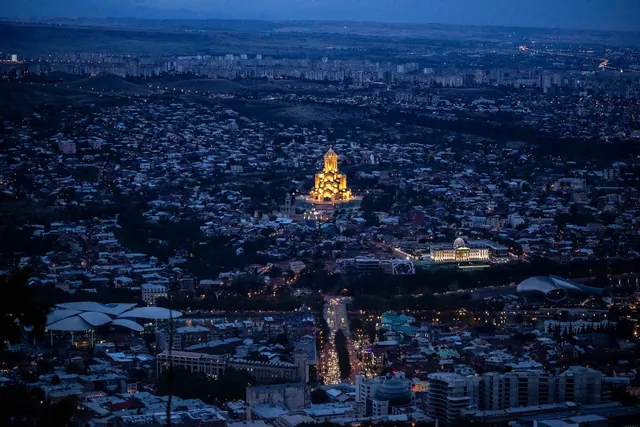
The cathedral on St. Elias Hill is visible from almost anywhere in Tbilisi thanks to its golden dome and a height of more than 100 meters, which makes it the tallest church in the country. Construction began in 1995 and the cathedral was consecrated in 2004, marking the 1,500th anniversary of the autocephaly of the Georgian Church and 2,000 years of Christianity; at the laying of the foundation, stones and soil brought from holy places were placed in it. You can enter for free, and the complex includes the patriarch's residence, a theological academy and several small underground chapels.
This is a working place, not a museum one: in the mornings and on feast days locals come here for services, and this is worth taking into account when choosing the time of your visit if the goal is more a quiet look at the architecture than taking part in the liturgy. A dress code applies inside the cathedral — covered shoulders and knees are required for everyone, and women should bring a headscarf if they do not have one; there are usually shawls at the entrance for those who arrive unprepared.
The cathedral stands on a separate hill away from the dense old-town route, so it is more convenient to drive there than to walk: the trip from Freedom Square by car takes 10–15 minutes, while on foot you would have to allow more than an hour one way through residential blocks with no particular views along the way.
Mtatsminda Mountain: The Funicular and the View From Above
The funicular up Mtatsminda was built in 1905 to the design of a Belgian engineer with money from the same company that owned Tbilisi's tram network, and it has remained one of the city's symbols ever since, on a par with the mountain itself. The cabin rises to a height of 770 meters above sea level; on the way you can get off at the middle station by the Pantheon, where Georgian writers, scholars and public figures are buried, including Stalin's mother and brother — which often surprises tourists who did not expect such company on the list of names.
At the top spreads a park with a Ferris wheel about 60 meters high, a panoramic restaurant and several viewpoints, from which on a clear day you can see the Caucasus range to the north and the Trialeti Mountains to the south. Payment on the funicular and the rides goes through a separate plastic card, which you buy and top up at the booth before the turnstiles; you cannot pay here with a city transport card.
It is better to go up in the second half of the day, to catch the sunset and the evening illumination of the city with the TV tower, but keep in mind that the viewpoint gets crowded closer to evening, especially on weekends. For the mountain itself, with the trip up and back, set aside an hour to an hour and a half — more if you plan to linger at the rides or have dinner at the panoramic restaurant.
What to See If You Extend the Day Into the Evening
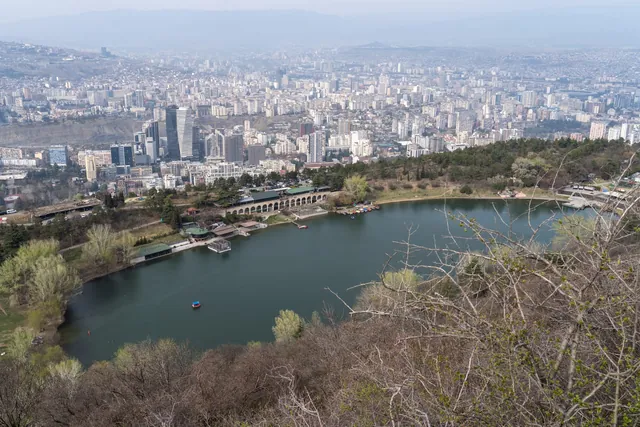
Tbilisi stretches along the river over several hills, and although the center is quite walkable, getting to points beyond it — such as Turtle Lake, the far entrance to the botanical garden or the Vake district with its park and lake — takes a long time by taxi at rush hour and is not always predictable in price, while public-transport routes there are not always direct. For such trips beyond the dense tourist center, a rental car saves time and spares you from fitting your route to transport schedules, especially if the trip is planned for the evening, when taxis are snapped up faster and cost more.
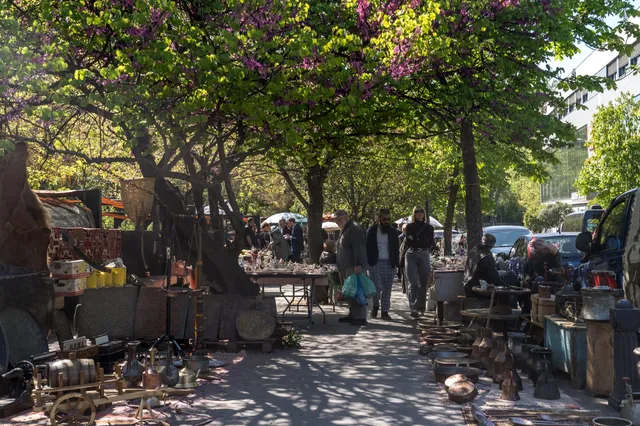
The flea market on the Dry Bridge, if it falls within your day by schedule, operates on weekends and part of the weekdays: old coins, Soviet porcelain, carpets, jewelry and cameras are laid out right on the asphalt along the embankment. Here people do not hurry and bargain slowly, and buying something worthwhile is realistic only if you have enough time to sift through dozens of stalls, so this place fits with difficulty into a packed one-day route and is better suited to a second day in the city.
The Main Points in Brief
One day in Tbilisi really does cover the basic list: Narikala and the cable car, the sulfur baths and the waterfall in Abanotubani, Metekhi Church with its viewpoint, the Bridge of Peace, the old town between Shardeni and Freedom Square, and Mtatsminda at sunset. It makes sense to add Sameba Cathedral if the day is not strictly limited by time or you have a car, since it stands apart from the rest of the route. Anything that did not fit, such as the Dry Bridge or the far parks, is worth leaving for a second day rather than squeezing into the first just to tick it off — the strongest impressions of the city usually happen not on the list of stops but between them.