
The Dry Bridge in Tbilisi: flea market and prices
The flea market on the Dry Bridge in Tbilisi: when to come, what they sell, how to bargain, where to leave the car and what you can take out of the country.
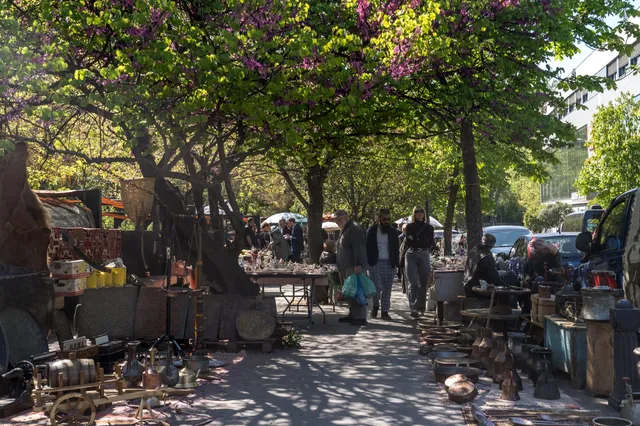
The flea market on the Dry Bridge is open every day, roughly from 9:00 to 17:00, but it really spreads out at weekends between 11:00 and 15:00. It sits in the centre of Tbilisi, on the right bank of the Kura, a ten-minute walk from Freedom Square. They sell Soviet porcelain, silver, optical gear, records, badges, old photographs and paintings, and the price can almost always be discussed. If you are building a day around the city, it is better to leave the market for the second morning: it does not fit into a packed itinerary, but it pairs well with a walk through the parks in the centre.
Where the Dry Bridge is and how to get there
The bridge itself stands in the centre, between Mtatsminda and Chugureti, and the market takes up more than the bridge alone. Stalls stretch along Khidi Street, drop down to the right-bank embankment and run into Dedaena park, where the artists stand with their canvases.
Walking is the easiest way here. From Rustaveli metro it is about 10 minutes down the avenue; from Freedom Square it is the same along the park. From Chugureti across the Saarbrücken Bridge it is even quicker.
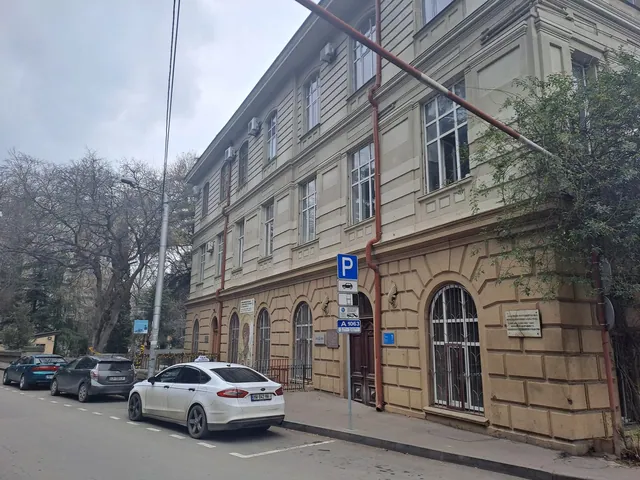
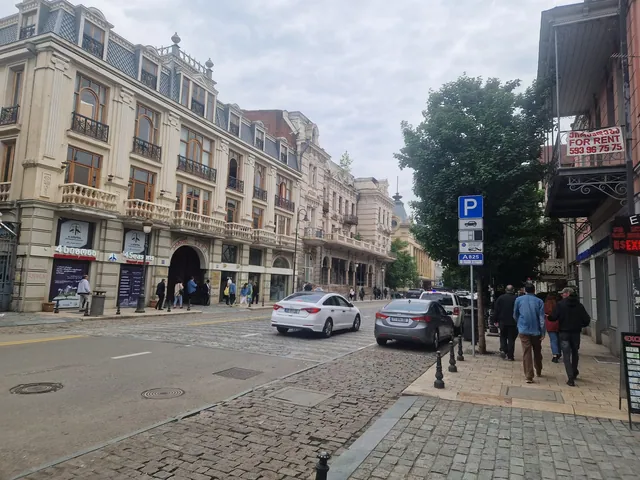
By car it is harder. Khidi Street is narrow, sellers and buyers stand on both sides, and at weekends a free space only turns up by chance. The first time I came was a Sunday around noon: I circled for twenty minutes and ended up leaving the car in the underground car park at Galleria Tbilisi on Rustaveli. Now I go straight there: seven minutes on foot along the park and you are at the market.
What is worth knowing about parking:
- Central Tbilisi is split into zones, an hour costs about 1 GEL, paid through the Tbilisi Parking app or through local bank apps by number plate
- There is a separate city pass (about 50 GEL a year); on a rental car it is usually already paid by the owner, but this is better to check in advance
- The fine for unpaid parking is currently around 50 GEL
- The nearest covered option, the underground car park at the Galleria Tbilisi mall on Rustaveli Avenue, is dearer than the street zone, around 5 GEL an hour
If the car is a rental, for example on MY.DRIVE, you still pay the zonal hours yourself: the pass does not cover them. All the figures are approximate and they change; the tariff is always written on the plate under the "P" sign. More on the zones and how to pay is in the guide to parking in Tbilisi, and on picking the car up in the rental basics.
Why the bridge is called Dry
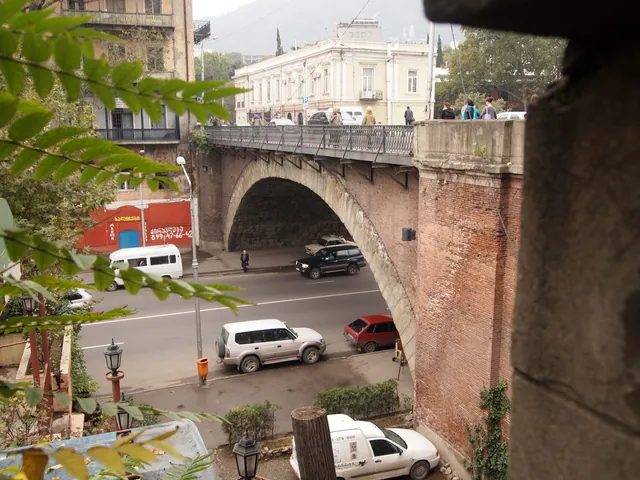
There is no water under it, and that is not a metaphor. In the nineteenth century the Kura split here into two channels, with a small island between them: Tbilisians called it Madatov Island, after the owner, General Valerian Madatov. The crossing came out in two parts. The long span ran from the left bank onto the island; a short one was thrown over the narrow channel to the right bank. Both were built by the Italian architect Giovanni Scudieri in the mid-nineteenth century, and they were then called the Mikhailovsky bridges.
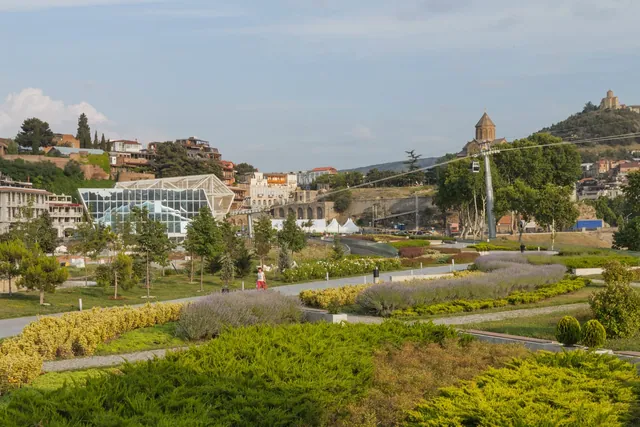
In the 1930s, when the banks were being reinforced and the embankments built, the channel was filled in. The island stopped being an island and became a piece of dry land, which is now Dedaena park. They did not pull the little bridge down. It stayed standing over the former channel; only instead of water they ran a road under it, today's Zviad Gamsakhurdia Street. The name stuck of its own accord.
If you walk to the end of the bridge and look down over the parapet, it is all there: four lanes of cars under your feet, exactly where a branch of the river used to be. The dates in the sources disagree; the infill is put at 1933 in some accounts and 1938 in others, but the point stays the same.
When to come: opening hours and the best days
Formally the market opens at 9:00, but on a weekday few sellers have laid out by nine in the morning. The main body of sellers appears around 10:30–11:00 and packs up around 16:00–17:00, earlier in winter because it gets dark.
Saturday and Sunday give the widest choice: resellers come in from the regions and bring out what they do not haul every day. Weekdays are quieter, bargaining is easier, but half the tables will not be there. In the rain the market is almost empty: the goods fear water more than the sellers do.
The best window, if you want both the choice and a chance to look at a piece in peace: Sunday, from 10:30 to 12:00. After midday the aisles get tight with tour groups.
What they sell at the flea market in Tbilisi
The stock falls into a few clear layers, and they are physically spread across the site.
On the bridge itself and along the parapets lies the small stuff: badges, coins, watches, cigarette cases, table silver and nickel silver, binoculars, Zenit and FED cameras, Christmas ornaments, postcards, keys to who knows what.
In the lower rows by the embankment comes the large stuff: samovars, brass lamps, carpets, dishes, old radios, sewing machines, furniture hardware, tools.
In Dedaena park stand the artists. Some of the work is original, some is copies of Tbilisi views turned out in batches. The price difference is obvious at once, and it is honest.
A category of its own: Georgian ethnic pieces and things made to look like them. Daggers, wine horns, chased metal, minankari enamel. There are fewer genuinely old pieces here than you would think. Badges and medals are often modern reproductions, porcelain has sometimes been glued back together, and "pre-revolutionary" silver sometimes turns out to be 1970s plating.
Checking is simple. Look at the hallmarks, turn the piece over, look for signs of restoration; on glass and porcelain run a finger along the rim. The sellers are calm about this; looking things over is normal here.
How much it costs and how to bargain
Most tables have no price tags. The first figure named to a tourist is usually about twice too high, and that is not a cheat but the format: bargaining is part of the deal here, and a refusal to bargain is taken as odd.
Rough ranges for 2026:
- Badges and coins: 1–10 GEL apiece
- Postcards and photographs: 2–15 GEL
- A film camera: 40–150 GEL
- A brass lamp or candlestick: 60–200 GEL
- A vinyl record: 10–40 GEL
- A small painting from an artist: from 80 GEL, original work costs more
- A samovar: 150–400 GEL depending on condition
The figures are approximate and depend heavily on how well the piece has survived and on how confident you look while you haggle.
A pause works. For a brass desk lamp they quoted me 150 GEL; I put it down, walked the row to the end and came back. It went for 90. Buying two things from one seller works even better: a set discount comes almost automatically.
Cash is mandatory. Only a handful take a card; sometimes they offer a transfer to a phone number, but you should not count on it. Bring small notes: change from a hundred GEL may not be there at a one-table stall, and you will lose the discount you have just bargained.
What you cannot take out of Georgia without a permit
This is the point that sometimes leaves a beautiful purchase at the airport. The export of cultural property from Georgia is regulated by a separate law, and items of historical or artistic value need a permit from the Ministry of Culture. It is one-off, valid for three months and costs about 14 GEL. The same procedure also issues a certificate stating that an object is not an item of cultural value, and that is the paper most often needed at customs.
Export without a permit is treated as a criminal offence and is punished by a fine or imprisonment for up to two years.
In practice this covers icons, old painting, archaeology, weapons, rare books and manuscripts, serious antiques. Mass Soviet pieces, badges, dishes, lamps and records usually go through without questions, but the line between "souvenir" and "valuable" is not drawn by the buyer's eye. If a piece looks older than the twentieth century or cost more than a couple of hundred GEL, it is better to check the procedure in advance with the National Agency for Cultural Heritage Preservation and allow a day for it. The order and the sums change over time; check what is current before you fly.
One more point: ask the seller at least for a contact or a simple receipt with a description of the object and the sum. Formally this is not a document of provenance, but in a conversation with an expert it never hurts.
What to see nearby
The market is compact; an hour or an hour and a half covers it fully. After that everything is in walking distance:
- 9 April Park and the National Gallery, entrance from Rustaveli Avenue
- Kashveti Church opposite the gallery
- Freedom Square and the start of the old town, 10 minutes along the park
- Deserters' Bazaar by the station, if after the antiques you want spices, cheese and churchkhela, about 20 minutes on foot or five by car
A logical half-day pairing: the Dry Bridge in the morning, then the embankment and the old town. In that setup it is more sensible to leave the car in one car park and not move it.
The short version
The Dry Bridge market is open every day, but it is worth going at the weekend before midday, when the rows are at their fullest and the crowds have not arrived. Bring cash in small notes and bargain calmly: a third off the price is normal practice here. Do not count on parking on Khidi: it is simpler to leave the car in the car park on Rustaveli and walk. And if you are buying something genuinely old, sort out the export permit before you find yourself at the airport with a samovar in the suitcase.