
New Year in Tbilisi: fireworks, Alilo and what's open on 1 January
How to see in the New Year in Tbilisi: where to watch the fireworks, when to book a restaurant and a place to stay, how to get home after midnight, what's open on 1 January and how Christmas on 7 January works.
The stretch between 31 December and 7 January holds Georgia's two biggest holidays of the year: the secular New Year and Orthodox Christmas. Tbilisi runs on its own timetable these days. At midnight fireworks go up over the whole city at once, on 1 January the centre is nearly empty until lunchtime, and on the 7th the Alilo Christmas procession walks through the streets.
New Year and Christmas: how Georgia does it
New Year in Georgian is Akhali Tseli, and it is the main family holiday of the winter. People celebrate it at home, around a long table, not out on a square. The table always has gozinaki (roasted walnuts in honey), satsivi and churchkhela. In the corner there is often a chichilaki: a small tree made of fine shavings of walnut wood, which Georgians put up instead of a fir tree or next to one. It is bought at markets in the last days of December and burned at Epiphany, on 19 January.
There is also the custom of the mekvle. The first guest to step over the threshold in the new year is believed to set the tone for the household for the whole year, so some families choose this person in advance and invite them specially. If you are asked to visit someone on 1 January, take it as a compliment rather than a formality.
Public holidays: 1 and 2 January, 7 January (Christmas) and 19 January (Epiphany). Many people also mark the Old New Year on 14 January, but it is a normal working day.
Christmas in Georgia is Orthodox and falls on 7 January. On the night of the 6th to the 7th there is a festive service at Tsminda Sameba Cathedral, and people light candles in their windows. During the day on 7 January Alilo passes through the centre: a procession with church banners, choirs and people in national costume. It usually goes along Rustaveli Avenue and through Freedom Square towards Sameba. Participants collect food and gifts that are later given to people in need, so carts and small trucks loaded with bags roll along in the column. You can watch from the pavement on Rustaveli. The Patriarchate announces the start time and exact route every year, so check them the day before.
The holidays in Tbilisi stretch over eight days. They are loud at the start and at the end, and quiet in between.
The city before the holiday: 25–31 December
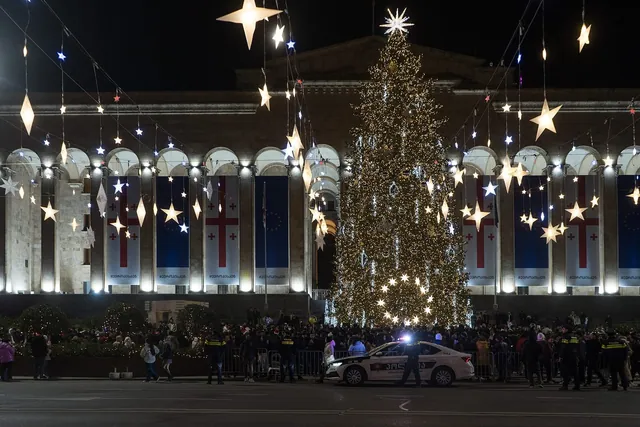
The lights on Rustaveli and in the old town usually go on in mid-December. A New Year market runs on First Republic Square by the parliament: mulled wine, hot khachapuri, souvenirs, a carousel for children. The tree goes up on Freedom Square, and several smaller markets are scattered around the centre; the city hall publishes their addresses closer to the date.
For the last three or four days before the holiday the city is shopping. Supermarkets are packed, and by 30 December the Dezerter Bazaar by the station is as crowded as the metro at rush hour: this is where people buy walnuts, honey for gozinaki, turkey for satsivi and those chichilaki trees. If you want to see the New Year preparations from the inside, go to the market on the morning of 29 or 30 December. By the afternoon of the 31st the stalls are already being packed away.
During the day on 31 December the city is still working, but by evening it starts to empty: locals head off to family, shops close earlier than usual, and cafés without a New Year banquet often don't open at all.
Where to watch the fireworks
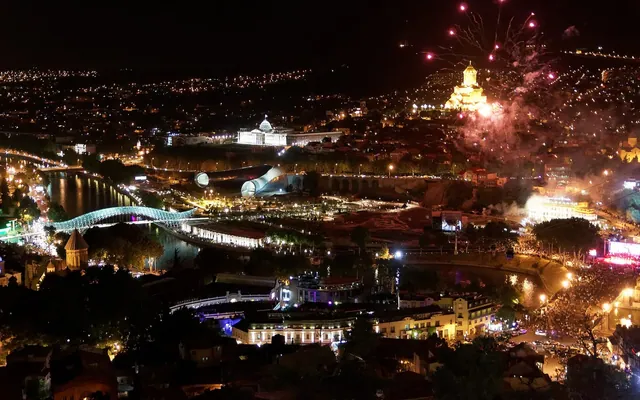
Tbilisi usually has no single official fireworks display, although the city hall sometimes puts on its own. The fireworks are set off by residents themselves: at exactly midnight rockets go up from balconies, rooftops, courtyards and roadsides all over the city. For about twenty minutes the sky is lit from every direction at once, so it is best to watch from a high point where you can see several districts.
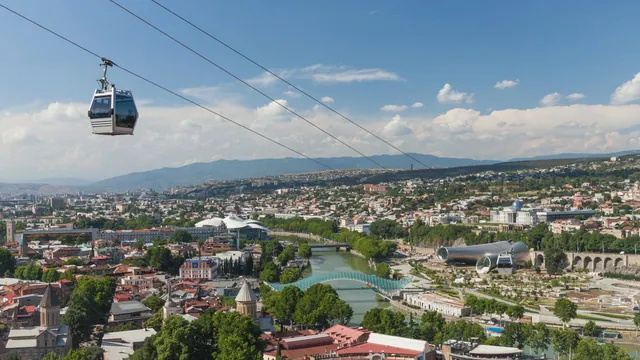
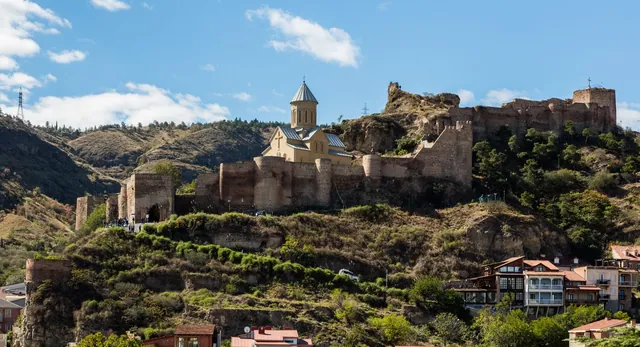
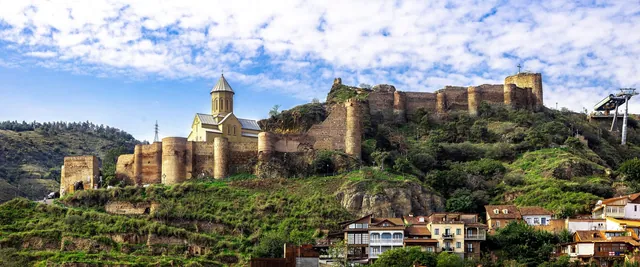
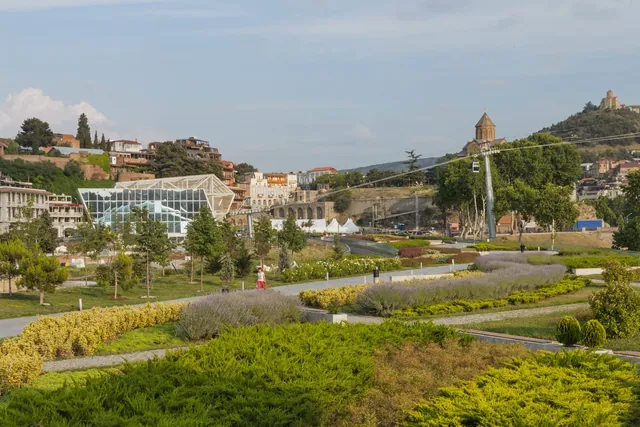
Narikala. The fortress hill above the old town gives a full view over both banks of the Mtkvari. The grounds are open around the clock and entry is free. On the winter timetable the cable car from Rike Park usually runs until 22:00, and there is no way to know in advance whether it will be extended on New Year's Eve, so plan to walk up: from Abanotubani or from Betlemi Street it takes 15–25 minutes. The area by the walls fills up towards midnight, but it never gets cramped.
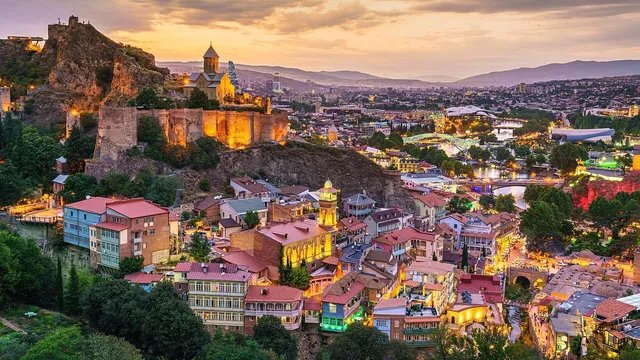
Betlemi. A quarter of stairways and old houses below Narikala, between Sololaki and Abanotubani. The viewpoints by Betlemi Church sit lower than the fortress, but it is quieter here and closer to the old-town restaurants. A good choice if you are coming straight from dinner and don't feel like climbing all the way to the top.
Mtatsminda. From the mountain the whole city lies at your feet. The downside is that the funicular and the cable car from Rustaveli keep their own hours (in winter the cable car usually closes around 21:00) and they may change on New Year's Eve, while up top there is a restaurant with a banquet and a park that normally closes before midnight. Check the park's hours for the year you are going. If you can't get up the mountain, the residential streets of Mtatsminda and Sololaki lower down the slope also have a decent view.
Rike Park and the embankments. Down below, in Rike Park by the Bridge of Peace, you look up at the floodlit Narikala and the fireworks over the old town. The view is narrower than from above, but there is no climb, and the restaurants on Meidan are five minutes away.
A few practical details:
- Firecrackers and rockets are let off anywhere, including narrow streets and balconies right above your head. Keep away from groups with boxes of fireworks and don't stand directly under balconies.
- With children or dogs, midnight is better spent indoors or in a car out of town: the noise is dense and goes on for a long time.
- Half an hour after midnight smoke hangs over the city, and on the morning of 1 January the centre smells of gunpowder and is littered with cardboard casings. Street sweepers have cleared them by lunchtime.
Restaurants on New Year's Eve
A café that takes walk-ins on any ordinary evening works in one of two modes on 31 December: closed, because the staff are celebrating at home, or open with a fixed banquet. The regular menu is almost nowhere to be found that night.
A banquet means a set menu (essentially a supra: starters, mains, wine, sometimes live music or a tamada) and a per-person price. At popular restaurants in the old town and Vake, going by recent years, that comes to roughly 150–400 lari a head, sometimes more, with children's places usually cheaper. Book 2–4 weeks ahead; tables with a view of Narikala or the river go even earlier. A deposit is standard, and if you cancel a couple of days before, it is usually not refunded. Ask in advance how late the place stays open after midnight: some close around two in the morning.
If you don't want a banquet, there is a simpler option. Many guesthouses and aparthotels can help you order a New Year spread to your door, and on the 31st supermarkets sell ready-made satsivi, pkhali and gozinaki. Spending midnight on the balcony of a Sololaki flat with a view over the city is sometimes nicer than a noisy dining room.
On 1–2 January and 7 January many restaurants are closed or open only towards evening. Chain cafés and places on tourist streets like Shardeni and Meidan are more likely to be open, but not all of them.
Accommodation and prices
The period from 28 December to 8 January is the most expensive in the city for the whole winter season. Prices for central accommodation climb noticeably, sometimes to one and a half or two times the mid-December level, and flats with a view and a balcony are often gone by November. Flights at the end of December are also among the most expensive of the year.
What to check when booking:
- Ask about heating. Old buildings in Sololaki and Abanotubani have thin walls, high ceilings and electric heaters instead of central heating. A beautiful flat with a balcony facing Narikala can turn out to be cold in January. Ask the host how the flat is heated and whether there is underfloor heating or an air conditioner with a heating mode.
- Minimum stay. Over the holidays many hosts set a minimum of three to five nights. If you are coming for two, start looking early.
- Early check-in. If your flight lands at Tbilisi airport on the night of 31 December or on 1 January, agree on check-in in writing: hosts celebrate too.
Transport, taxis and driving on New Year's Eve
On New Year's Eve the metro runs on a special timetable that the city hall announces a few days ahead. In some years service was extended and in others it wasn't, so watch the news closer to the 31st. Buses are rare after midnight.
After midnight app taxis cost several times the usual fare, and waits stretch to half an hour or more. The easiest solution is to stay within walking distance of wherever you spend midnight. Central Tbilisi is compact: from Meidan it is a 10-minute walk to Sololaki and 15 to Freedom Square.
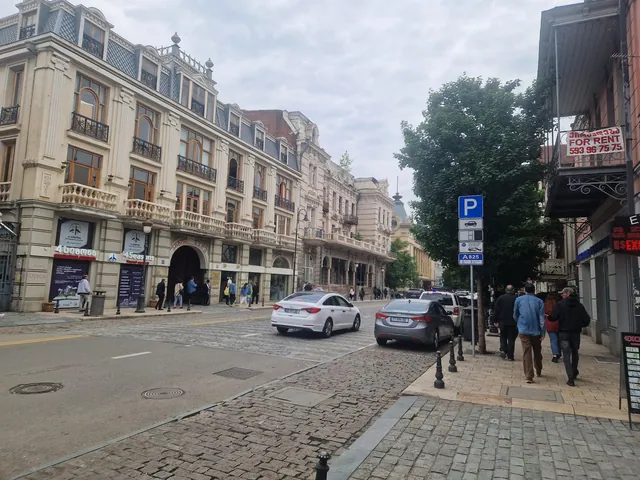
Driving that night is hard work. The old-town streets are narrow and blocked by crowds and fireworks, there are a lot of drunk drivers about, and police are posted on the main avenues. If you have a rental car, leave it by your accommodation in the daytime on the 31st and don't touch it until 1 January. Zone parking in the centre costs 1 lari an hour and runs around the clock, holidays included, so look for a spot on free streets in residential areas a little further from the centre. If there is no "P" sign with a zone code, the spot is free.
In the old town it is better to walk either way. The cobbles in Abanotubani and on the climb to Narikala are slippery after rain, especially going downhill.
What's open on 1 January
On the first of January the city wakes up around lunchtime. In the morning the streets belong mostly to street sweepers and the odd tourist.
What is usually open:
- Large supermarkets and some neighbourhood shops, especially the 24-hour ones.
- Pharmacies, at least one on duty in every district.
- Cafés and bars on the tourist streets, closer to lunchtime.
- The sulphur baths in Abanotubani; many work through the holidays. Phone ahead to check times: this is one of the most popular things to do on 1 January, and there can be queues even with a booking.
- The Narikala grounds and parks, which are open access.
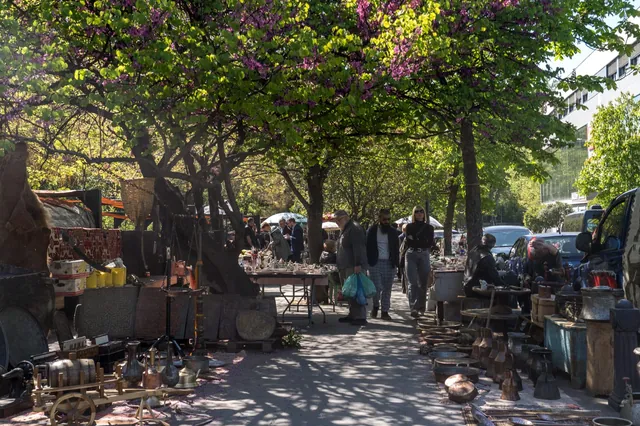
What is usually closed on 1–2 January: most museums, some restaurants, small shops and markets. The flea market on the Dry Bridge runs patchily in the first days of the year: some sellers are back by 3–4 January, and in winter they pack up early because it gets dark around five.
I like 1 January for exactly that emptiness. You can walk along Shardeni, down the embankment and up to Narikala and meet no one except neighbours carrying out empty fireworks boxes. There is a route for a walk like this in Tbilisi in one day; just don't start it before eleven.
Weather and what to pack
In late December and early January Tbilisi is usually +3 to +8 °C during the day and around zero at night, lower on cold nights. Snow falls in the city a few times each winter and rarely lies for more than a day or two; rain or sleet is more common. Wind blows in from the mountains, and at exposed spots like Narikala and Mtatsminda it feels several degrees colder at midnight than down below.
What comes in handy:
- shoes with non-slip soles: wet cobbles and the stones around the fortress are slippery;
- a warm jacket, hat and gloves for the midnight you will spend outdoors;
- a small umbrella;
- covered shoulders and a headscarf for women, if you plan to go to church at Christmas;
- earplugs, if you are staying in the centre and want to sleep through the night.
Adding the mountains
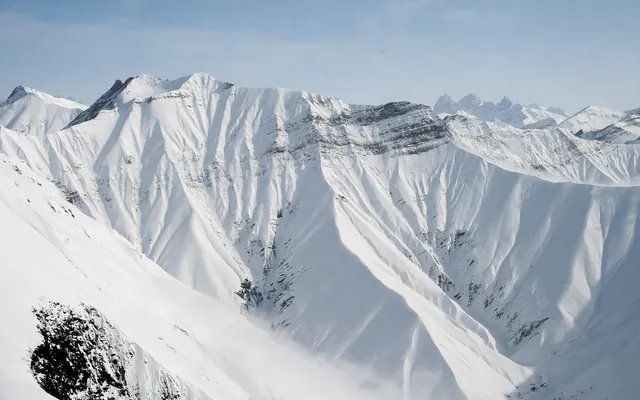
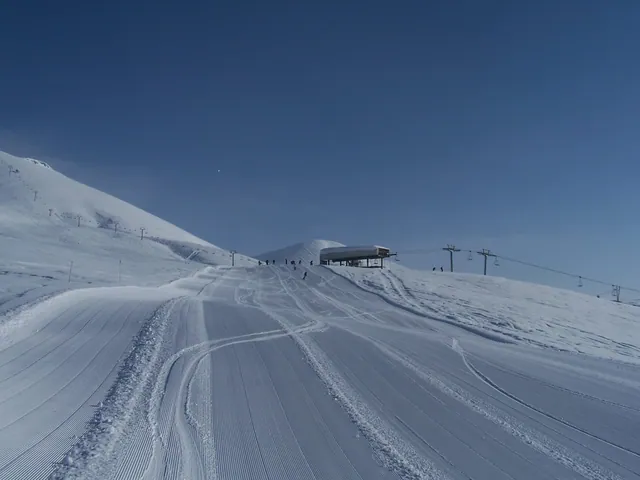
It is easy to add a couple of days in the mountains to the Tbilisi holidays. But from late December to 8 January the resorts are packed, and accommodation and rentals there go up more steeply than in the capital.
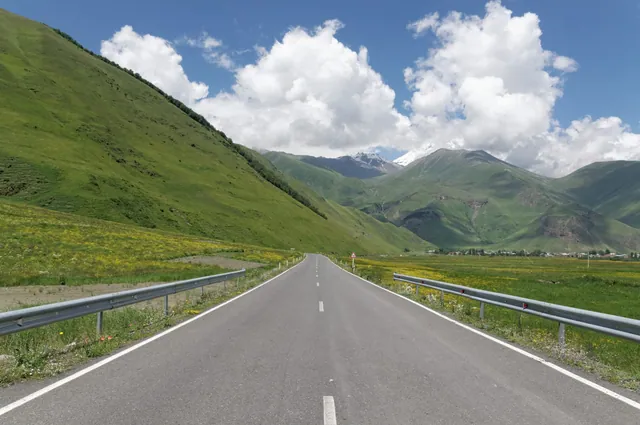
Gudauri is the closest: about 120 km and 2–2.5 hours along the Georgian Military Road in good weather. Over the holidays there can be jams near Mtskheta and on the switchbacks after Pasanauri, and in a snowfall the road is slow even on winter tyres, so allow extra time. Bakuriani, reached via Borjomi, is calmer and more family-oriented: about 180 km, 2.5–3 hours. From 1 December to 1 March winter tyres are mandatory on the mountain sections of both routes. Winter tyres, chains and choosing between the resorts are covered in detail in the guide to Georgia in winter.
If the main goal is skiing and the holiday itself doesn't matter, head for the slopes closer to mid-January: fewer people, lower prices, and the snow is usually settled by then.
How to plan the week
A workable plan for anyone coming for the whole holiday week:
- 29–30 December: arrival, the market on Rustaveli, a morning trip to the bazaar.
- 31 December: an easy walk through the old town during the day, then dinner and midnight on Narikala, in Betlemi or on a balcony.
- 1 January: a late start, the empty city, the sulphur baths.
- 2–5 January: the mountains or trips out of town while Tbilisi rests.
- 6–7 January: back in the city, the Christmas night service at Sameba or the Alilo procession during the day.
As early as November it is worth finding a place with proper heating near the centre, booking a restaurant if you want a banquet, and deciding how you will get home after midnight. The rest you can plan on the spot.